 10Dec
10Dec

A high frequency UPS or low frequency UPS should be chosen by its documented fit for the load and site. Neither label proves better reliability, isolation, or overload performance in every industrial installation.
A high frequency UPS comparison starts with the actual power circuit. Ask where the transformer sits, how the system handles faults, and which operating mode the quoted ratings describe. Then compare installation space, efficiency at your load, and service access.
This guide covers AC uninterruptible power supply (UPS) architecture. It separates the frequency labels from output frequency, online topology, and modular construction. You’ll also find a requirements table, worked examples, and a list of documents to request before selecting a configuration.
Key takeaways
- High-frequency switching does not mean the load receives high-frequency AC output.
- Double conversion and galvanic isolation are separate concepts.
- Overload ratings need a percentage, duration, and operating condition.
- Compare efficiency at the same load and mode, rather than comparing peak figures.
- Verify the exact model and installation before accepting a reliability claim.
What low frequency and high frequency UPS mean
What low frequency and high frequency UPS mean
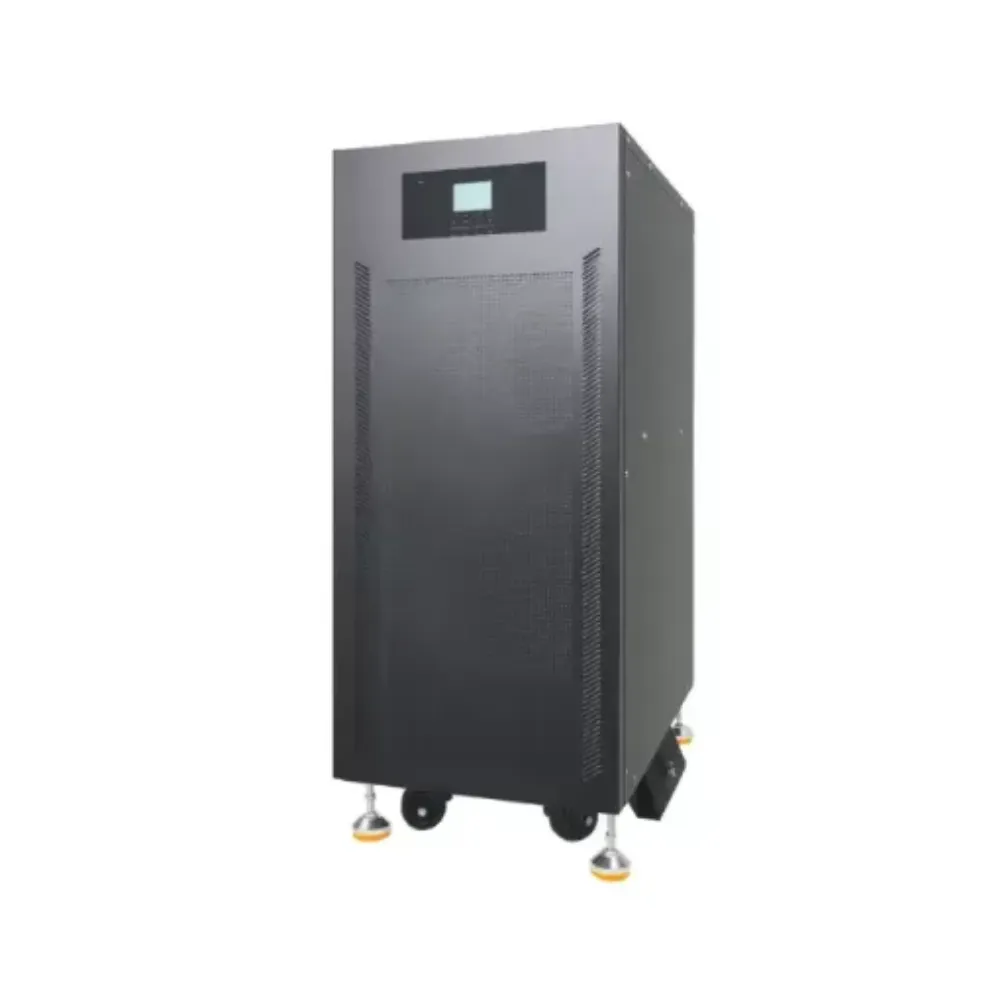
Suppliers commonly use low frequency UPS for designs that include line-frequency magnetics, often an output transformer. High frequency UPS commonly describes designs using high-frequency power switching, often without a large line-frequency output transformer. Those labels are useful starting points, but they aren’t a complete circuit specification.
For a high frequency UPS, ask the supplier to identify the rectifier, inverter, battery interface, transformer arrangement, and bypass paths. An SCR or IGBT component name describes part of the circuit. It doesn’t establish how the complete UPS behaves under every load or fault.
Eaton’s transformerless UPS white paper explains high-frequency power processing and compares transformer-based and transformerless designs. Published in May 2013, it is a historical engineering reference, not a current market survey. Its discussion also shows why transformerless products need individual assessment. Do not treat its performance figures as specifications for another manufacturer’s equipment.
Separate three different frequency questions
When a buyer asks about a high frequency UPS, clarify which question they mean:
- Internal switching: how the power electronics convert energy inside the unit.
- Output frequency: the AC frequency required by the protected equipment.
- Noise: an audible or electrical disturbance that needs diagnosis under stated conditions.
Specify the required output frequency independently. If the equipment needs frequency conversion, ask for that capability explicitly. If the concern is noise, record where it occurs, the load, and the operating mode. Changing a frequency label is not a diagnosis.
Start with a suitable shortlist. Browse Banatton Group’s UPS systems, then ask for circuit and operating documents for the models that match your load. Keep catalog descriptions separate from the final engineering specification.
Low frequency vs high frequency UPS: compare requirements
Use this table to compare the proposals you receive. It avoids assigning a universal winner before the load and installation are defined.
| Requirement | Low-frequency proposal | High-frequency proposal | Evidence needed |
|---|---|---|---|
| Architecture | Identify transformer and conversion paths | Identify transformer and conversion paths | Model-specific block diagram |
| Isolation | Check which supplies and modes are separated | Check which supplies and modes are separated | Circuit and grounding documentation |
| Overload | Match the curve to the load event | Match the curve to the load event | Percentage, duration, mode, temperature |
| Fault response | Review current limits and bypass behavior | Review current limits and bypass behavior | Protection coordination and fault data |
| Efficiency | Check losses at the planned load | Check losses at the planned load | Curve with test conditions |
| Installation | Include access and external components | Include access and external components | Dimensions, mass, clearances |
| Service | Define maintenance and repair scope | Define maintenance and repair scope | Procedures, spares, service terms |
A high frequency UPS with a strong documented fit can remain on an industrial shortlist. A transformer-based proposal can also be appropriate when its documented configuration meets the requirement. The decision rests on those documents, not a general ranking of technologies.
Illustrative scenario: protecting controls, not the entire machine
A plant buyer wants backup power for a production station. The first request lists only the machine’s total rating. After reviewing the protected circuits, the team identifies a separate control supply and records its load and shutdown needs.
The team can now compare low frequency and high frequency UPS proposals for that defined scope. This invented scenario does not establish that either architecture wins. It shows why the protected circuit must be clear before evaluating surge, runtime, or capacity claims.
If a high frequency UPS proposal covers motors or drives themselves, record their startup and operating behavior separately. Don’t assume a UPS suitable for a control cabinet is suitable for every connected process load. Ask the responsible designer to confirm the proposed protection boundary.
Check isolation, normal operation, and bypass separately
Check isolation, normal operation, and bypass separately
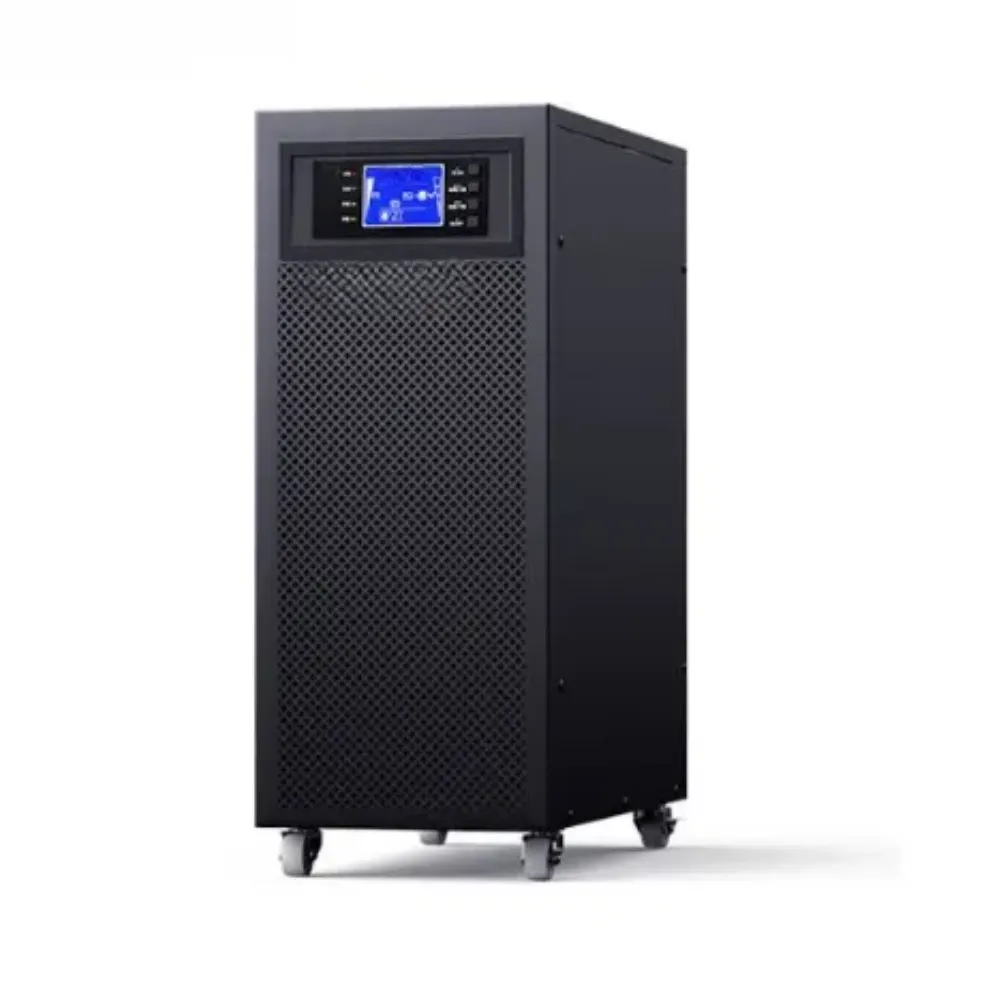
A high frequency UPS may be offered with additional isolation equipment. A transformer-based design also needs a path-by-path review. The presence of a transformer does not answer every question about isolation in bypass operation.
Galvanic isolation separates circuits electrically; double conversion describes a conversion path. Riello’s explanation of galvanic isolation describes isolation transformers and different installation positions. Use that distinction to request a drawing of the proposed arrangement, rather than assuming double conversion alone provides the required separation.
Ask what happens in normal operation, battery operation, static bypass, and maintenance bypass. Identify the supply used by each path. Record whether the required isolation remains present in that mode, and refer grounding and neutral arrangements to the installation designer.
Why a zero-transfer statement needs context
For both low frequency and high frequency UPS offers, ask which transition a transfer claim describes. A normal online transition to battery is not the same event as transferring a load to another supply path during a fault.
Schneider Electric’s Easy UPS 3S bypass explanation distinguishes static bypass from maintenance bypass and notes that bypass operation does not provide the same conditioning as the double-conversion path. It is an explanation of that product’s paths, not proof of another model’s transfer performance.
Request the selected model’s transfer conditions, source limits, synchronization requirements, and failure response. Check them against the load’s permitted interruption. Avoid an unconditional promise that every possible transfer is instantaneous or that all grid disturbances are removed.
Keep architecture and redundancy separate
A high frequency UPS is not automatically modular or redundant. Ask whether the proposed unit is standalone, modular, or approved for parallel operation. Then establish what load remains supported if a unit or module is unavailable.
Dual inputs also need an installation drawing. Two input terminals do not prove that two independent sources exist on site. Shared batteries, bypass equipment, controls, or downstream distribution can affect the overall design. List those shared elements when evaluating availability.
Match overload and fault behavior to the actual load
The high frequency UPS versus low frequency UPS decision needs more than a continuous power rating. Record normal demand, startup events, repeated load changes, and the required response during a downstream fault.
Use both kW and kVA limits. Real power and apparent power are different ratings, so meeting one does not by itself prove the other is satisfied. Keep any allowance for future growth visible in the load schedule rather than hiding it in a product label.
Illustrative scenario: comparing two overload statements
Assume two hypothetical quotations both list the same continuous rating. Proposal A states 150% overload for 60 seconds under its specified conditions. Proposal B states 125% for 60 seconds. These numbers are invented for comparison and are not Banatton specifications.
The buyer’s next question is how long the actual load event lasts and what happens afterward. A larger quoted percentage doesn’t establish overall reliability, repeated-start capability, or performance in another operating mode. Request the complete curve and the applicable conditions for both proposals.
For a high frequency UPS, just as for a transformer-based unit, ask whether an overload causes current limiting, bypass transfer, or shutdown. Check the temperature and repetition assumptions. Review startup behavior with the load supplier when necessary.
Ask how a fault is cleared
Protection coordination asks which protective device operates during a fault and what happens to healthy circuits. The architecture label alone cannot answer that. Request the UPS fault-current characteristics and the relevant bypass and downstream protective-device information.
Record the permitted operating conditions instead of accepting a claim that one component type always handles faults better. A reliability assessment should also consider cooling, environment, failure modes, redundancy, and service. Neither SCR nor IGBT is a complete system reliability measure.
For broader capacity and site selection, see the industrial UPS selection guide. Keep that full sizing process separate from this architecture comparison.
Compare efficiency, space, batteries, and service
Compare efficiency, space, batteries, and service
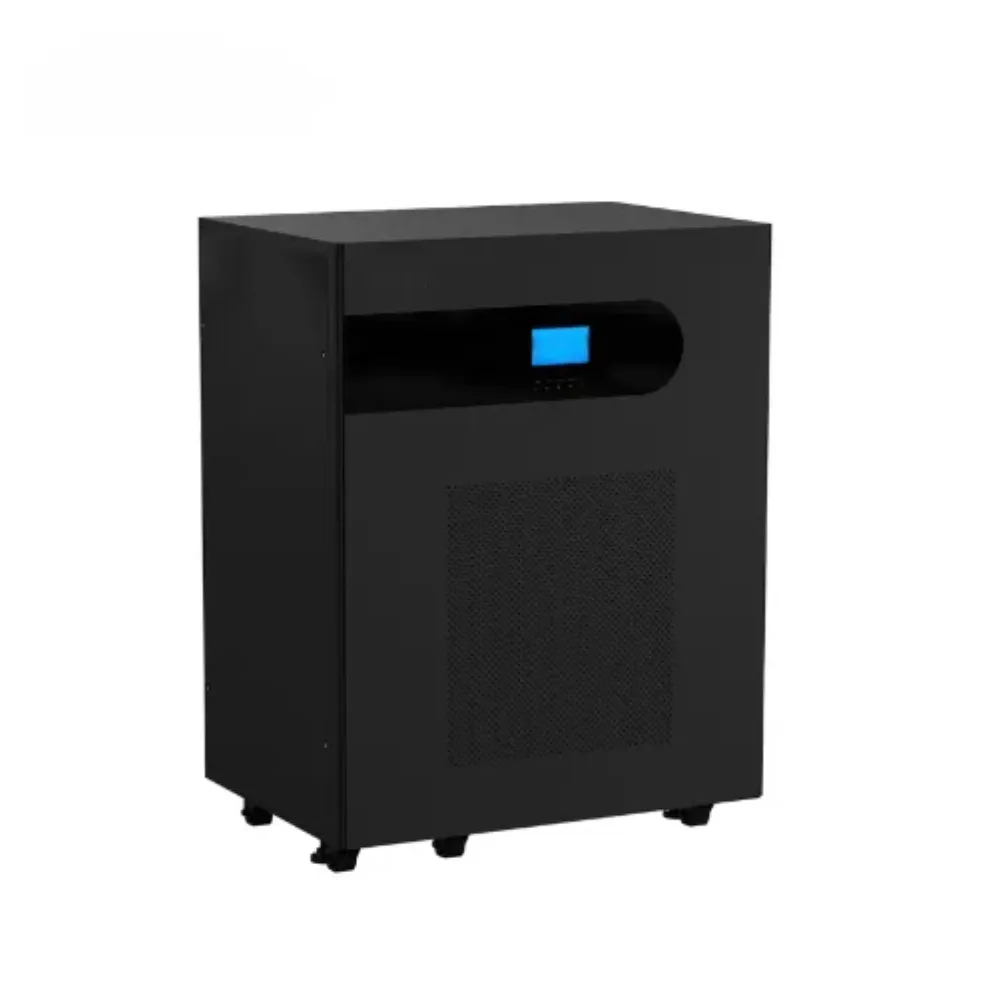
A high frequency UPS can be worth evaluating when footprint and energy use matter. Compare the actual configuration, including any external transformer, batteries, bypass cabinet, and required service clearance. A compact base cabinet does not describe the whole installation.
Ask for efficiency at the expected load and operating mode. Separate input power factor, input current distortion, and conversion efficiency. They describe different properties and should appear as separate fields in a quotation.
Illustrative scenario: a transparent loss calculation
Assume a constant 40 kW output load and two hypothetical efficiencies: 94% and 96%. Input power is output power divided by efficiency. The calculations are 40/0.94 = 42.55 kW and 40/0.96 = 41.67 kW, rounded to two decimals.
The corresponding losses are approximately 2.55 kW and 1.67 kW, a difference of about 0.89 kW using unrounded values. This is arithmetic under stated assumptions, not a product comparison or measured saving. Actual cost calculations need the load profile, mode, operating hours, tariff, and cooling assumptions.
Don’t use this example to assume every high frequency UPS has the higher efficiency. Request curves for the actual candidates and compare equivalent conditions. If one offer uses an energy-saving mode and another uses double conversion, label that difference explicitly.
Battery life is a separate question
For a high frequency UPS or low-frequency proposal, ask for the battery configuration and runtime at the stated load. Runtime concerns how long the load can be supported during the defined event. Battery service life concerns replacement over time; warranty concerns contractual coverage.
A battery-management feature name does not prove a particular life extension. Request the charging method, permitted battery types, temperature assumptions, maintenance procedure, and replacement terms. Avoid adopting another supplier’s battery claims for the proposed configuration.
Include the maintenance scope
Check access, spare parts, service coverage, and the steps needed to isolate equipment for maintenance. If an offer claims hot replacement or continued supply during service, ask which components and conditions that statement covers. High-frequency construction alone doesn’t establish either capability.
The three-phase online UPS listing and low-frequency industrial UPS listing provide product routes to investigate. Confirm each selected model’s current documents; these links are not evidence of universal performance.
Compare complete scopes. Review the industrial UPS category, then request matched proposals covering the same load, runtime, installation components, and maintenance requirement.
Request evidence before choosing an architecture
Send suppliers a clear requirements sheet. A high frequency UPS quotation and a low-frequency quotation should answer the same questions, with any exceptions identified alongside the proposed configuration.
Include these inputs in your request for quotation:
- Protected circuits, measured kW/kVA, and relevant startup or load-change events.
- Input supply, required output arrangement, and alternative sources.
- Temperature, contamination, ventilation, available space, and access constraints.
- Required runtime, shutdown sequence, and acceptable interruption.
- Isolation requirements and the operating paths in which they apply.
- Redundancy objective, maintenance windows, monitoring, and service location.
Ask for a model/version datasheet, block diagram, operating-mode description, overload curves, runtime curve, and installation instructions. Request efficiency and input-quality data with test conditions. Put any absent document or unresolved requirement into the proposal comparison rather than filling it with an assumption.
For detailed transformer placement, continue to the UPS isolation transformer guide. For a capacity-specific example, use the 100kVA three-phase UPS article. Those pages address narrower decisions; their presence does not verify a configuration proposed for your site.
Frequently asked questions and the final decision
Is a high frequency UPS always transformerless?
No. Confirm the actual design and any external transformer arrangement. The term commonly describes high-frequency switching, but the circuit and installation documents establish where transformers are present and what they do.
Is a low frequency UPS always more reliable?
No universal ranking follows from the label. Compare the selected models’ operating limits, fault response, protection, redundancy, and service arrangements. An individual component or transformer does not establish whole-system reliability.
Does high frequency mean a different output frequency?
Internal switching frequency and AC output frequency are separate specifications. State the output frequency required by the equipment. If frequency conversion is needed, request explicit support for that function and its operating limits.
Can a high frequency UPS support industrial loads?
Consider it when the documented configuration meets the load and site requirements. Review startup, overload, fault handling, environment, isolation, and runtime. An industrial address or a technology label alone doesn’t decide suitability.
Does double conversion guarantee galvanic isolation?
No. Ask for the circuit and transformer arrangement across the relevant power paths. Normal operation and bypass can have different properties, so isolation requirements need a mode-specific review.
Choose a high frequency UPS or low-frequency solution only after comparing equivalent requirements and matching evidence. Keep unresolved load, isolation, fault, and service questions visible until the proposed configuration answers them.
Prepare your next enquiry. Use Banatton Group’s contact page to send the requirements sheet and request model-specific supporting documents. That gives both sides a concrete basis for comparing architecture and installation scope.