 07Jan
07Jan

Small businesses face growing pressure from rising electricity costs and grid instability. Whether you run a retail store, a small factory, or a farm, energy expenses directly impact your bottom line. For many commercial operations, solar power offers a practical solution—but only if the system is designed to maximize every kilowatt-hour of energy produced. This is where hybrid solar inverters with MPPT technology enter the picture. These advanced inverters do more than convert DC power to AC; they intelligently manage solar generation, battery storage, and grid interaction to deliver measurable return on investment. This article examines how MPPT-equipped hybrid solar inverters improve energy economics for small commercial systems.
The Energy Challenges Facing Small Commercial Operations
Small businesses encounter distinct energy challenges that larger enterprises often avoid. Electricity costs typically represent a significant operating expense, and peak demand charges can spike bills unexpectedly during business hours. In many regions, grid reliability is not guaranteed—a single power outage can halt operations, spoil inventory, or damage sensitive equipment. For a restaurant, a few hours without refrigeration means product loss. For a workshop, downtime translates directly to missed orders and idle labor.
Traditional grid-tied solar inverters address part of this problem by offsetting daytime energy consumption. However, they have a fundamental limitation: when the grid goes down, the solar system shuts off. This safety feature prevents back-feeding but leaves businesses without power even when the sun is shining. Additionally, without energy storage, surplus solar generation is exported to the grid at feed-in tariffs that are often far lower than retail electricity rates. The business loses the full value of the energy it produces.
To solve these problems, a more capable inverter is needed—one that can manage solar input, battery charging and discharging, and grid interaction all within a single unit.
How a Hybrid Solar Inverter Functions
A hybrid solar inverter combines three core capabilities in one device. First, it converts direct current generated by photovoltaic panels into alternating current to meet immediate power demand. This is the fundamental DC to AC power conversion function that all solar inverters perform. Second, it manages energy storage—directing excess solar power into batteries when generation exceeds load, and drawing from batteries when sunlight is insufficient or during grid outages. Third, it handles grid interaction by automatically switching between grid-connected and off-grid modes based on real-time conditions.
The intelligent control system embedded in a hybrid inverter continuously monitors three data points: PV power generation, battery state of charge, and load demand. Based on configurable priorities, it makes automatic decisions about where power should flow. For example, during peak sunlight hours, solar power can be directed first to the load, then to battery charging, and only then exported to the grid. At night, stored battery energy can be discharged to avoid drawing expensive grid power during peak rate periods.
This dual-mode capability—simultaneously supporting grid-tied and off-grid operation—gives commercial users reliable backup power while also enabling active energy cost management.
MPPT Technology and Energy Harvesting
The maximum power point tracking (MPPT) function built into modern hybrid inverters plays a decisive role in system efficiency. PV panels have a non-linear output curve that shifts constantly with irradiance and temperature. There is one specific voltage and current combination—the maximum power point—where the panel produces peak power. An MPPT solar charge controller continuously tracks this point and adjusts the operating voltage accordingly.
In practical terms, MPPT ensures that the solar array delivers maximum possible output under changing weather conditions. When a cloud passes, irradiance drops, and the MPPT algorithm recalibrates within seconds. In cooler morning temperatures, panel voltage rises, and MPPT captures the additional power that a simpler PWM controller would leave unharvested.
How Hybrid Inverters Drive ROI for Commercial Users
Return on investment for a commercial solar installation depends on several factors: how much grid electricity the system displaces, how battery life affects total cost of ownership, and whether energy is available when it matters most. Hybrid inverters influence all three.
Lower electricity bills through solar self-consumption. The most direct financial benefit comes from using more of the solar energy you produce. A hybrid inverter with configurable AC and solar input priority allows businesses to maximize self-consumption by charging batteries during the day and discharging them during high-rate evening hours. Rather than exporting surplus energy at a low feed-in tariff, the system stores it for later use, displacing retail-priced grid electricity. For a small business with consistent daytime loads, this strategy can significantly reduce monthly energy bills.
Backup power reduces costly downtime. When the grid fails, a hybrid inverter with battery storage can automatically isolate from the grid and continue powering critical loads. The auto restart function ensures that when AC input recovers, the system transitions back to normal operation without manual intervention. For businesses that depend on continuous refrigeration, lighting, point-of-sale systems, or communications equipment, this backup capability prevents the financial losses associated with even brief outages.
Smart battery management extends system life. Battery replacement cost is a major factor in long-term system economics. The intelligent battery charger design incorporated in hybrid inverters optimizes charging profiles to maximize battery performance and cycle life. By managing depth of discharge and charging rates appropriately, the system delays the point at which expensive battery replacement becomes necessary. This directly lowers total cost of ownership over the system’s operating life.
Scalable architecture protects the initial investment. Commercial energy needs often grow over time. Hybrid inverters that support parallel operation allow businesses to start with a right-sized system and expand capacity later without replacing the original equipment. This modular approach preserves the initial capital outlay while providing a clear path to meet future demand.
MPPT Hybrid Solar Inverters for Small Commercial Projects
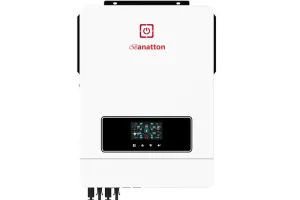
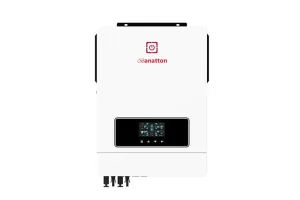
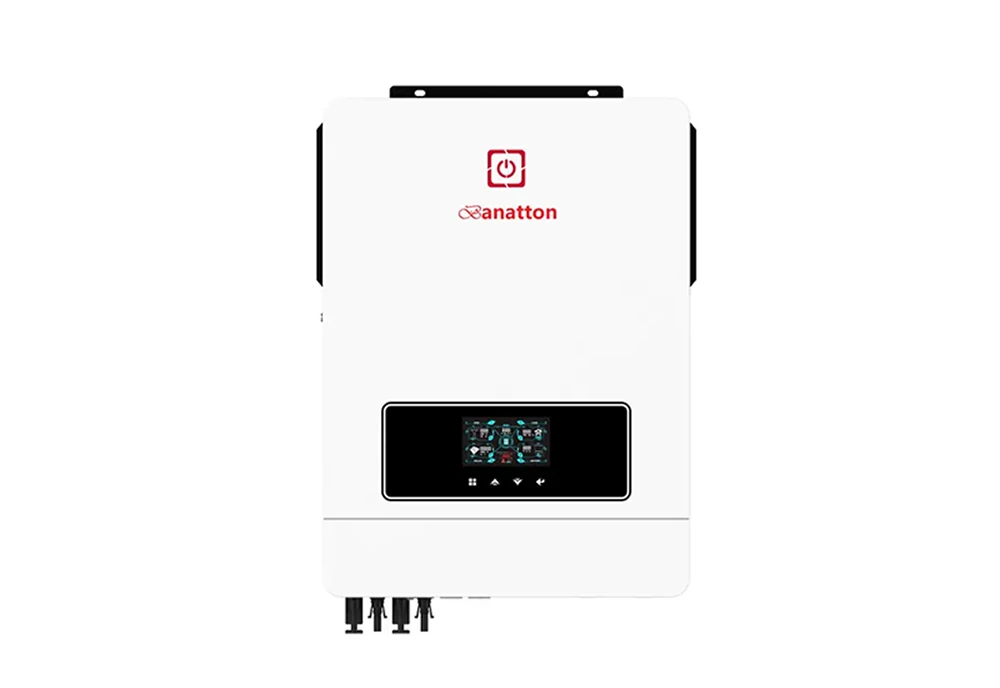
For the energy requirements of small commercial systems, we offer a series of dc to ac inverters with integrated MPPT solar charge controllers, covering three rated output power options: 4.2KW, 6.2KW, and 10.2KW, corresponding to output capacities of 4200W, 6200W, and 10200W respectively. These single-phase units combine DC to AC power conversion, battery energy storage management, and grid interaction functions into one device, making them suitable for retail stores, small workshops, agricultural facilities, and other commercial settings that require reliable power supply and efficient energy management.
The inverters feature a transformer-less design that delivers reliable power conversion in a compact size with high efficiency, achieving a maximum DC/AC conversion efficiency of 98%. The aluminum housing and integrated interface system make the units light and handy, simplifying installation for both indoor and outdoor use.
Pure sine wave output for sensitive equipment. The series delivers a pure sine wave output waveform, providing power quality comparable to utility electricity. This ensures safe operation of sensitive commercial loads including computers, communication equipment, point-of-sale systems, and variable-speed motor drives, without risk of damage or interference.
Built-in MPPT solar charge controller. Each inverter incorporates a built-in MPPT solar charge controller designed to maximize and regulate DC power from the solar array for battery bank charging. The MPPT voltage range spans 60VDC to 450VDC. Start-up voltage and initial feeding voltage are 120VDC, with a nominal DC voltage of 360VDC and a maximum DC voltage of 500VDC. Depending on the model, maximum input current is 1/18A, 1/22A, or 1/23A, with the 10.2KW model offering a dual input configuration of 2/18A.
Flexible input and output configuration. The inverters support DC input voltages of 12V, 24V, or 48V and an AC output voltage range of 120V to 240V. Users can select the input voltage range for home and commercial applications via the LCD interface. Charging current is also selectable based on specific application requirements. AC and solar input priority can be configured through the LCD setting, allowing businesses to adjust the power supply sequence according to their energy strategy.
Compatible with mains voltage and generator power. The series is compatible with both mains voltage and generator power. In grid-tied operation, the AC output voltage range is 190-253VAC. In off-grid mode, the acceptable AC input voltage range is 90-280VAC or 170-280VAC, with a frequency range of 49-51±1Hz and an AC start-up voltage/auto restart voltage of 120-140VAC/180VAC. Maximum AC input current varies by model: 30A for the 4.2KW, 40A for the 6.2KW, and 50A for the 10.2KW unit.
Parallel operation for growing energy demand. The inverters support parallel operation with up to 9 units. This allows businesses to start with an appropriately sized system based on current load requirements and expand capacity later as energy demand grows, without replacing existing equipment.
Intelligent LCD configuration and remote communication. The integrated LCD interface enables operators to configure settings directly, including input voltage range, charging current, and source priority. Communication ports include RS232, RS485, Wi-Fi, and GPRS, enabling remote monitoring and integration with lithium battery management systems.
Protection features for reliable operation. The inverters are equipped with overload protection, short circuit protection, and a smart battery charger design that optimizes charging for improved battery performance. A cold start function is included. When AC power recovers after an outage, the auto restart feature resumes normal operation without manual intervention. Operating temperature range is -10°C to 50°C, and the humidity range is 5% to 95% relative humidity (non-condensing).
Physical dimensions for the 4.2KW and 6.2KW models are 420×350×110mm, with net weights of 8.5kg and 9kg respectively. The 10.2KW model measures 530×420×160mm and has a net weight of 15kg.
The series is suitable for solar energy applications and can power a wide range of equipment including washing machines, air conditioners, vacuum cleaners, televisions, refrigerators, electric lights, microwave ovens, and fans, meeting the diverse power needs found in small commercial environments.
Commercial Applications
MPPT hybrid solar inverters serve a broad range of small commercial energy applications. Retail stores and offices benefit from uninterrupted power for lighting, computers, and security systems. Farms and agricultural facilities use them to power irrigation pumps, ventilation systems, and cold storage. Small factories and workshops rely on them to keep production equipment, lighting, and power tools running. Hotels, restaurants, and commercial buildings integrate them into broader energy management strategies to reduce operating costs while maintaining service continuity. The same inverter technology also powers residential energy storage systems, reflecting the versatility of the hybrid architecture.
Frequently Asked Questions
What is the difference between a solar inverter and a hybrid solar inverter?
A standard solar inverter converts DC power from solar panels to AC power for immediate use or grid export. It cannot connect to batteries and shuts down during grid outages. A hybrid solar inverter performs the same DC to AC conversion but also manages battery charging and discharging, and can operate in both grid-tied and off-grid modes.
Is an MPPT solar inverter worth the investment?
MPPT technology typically yields 15% to 30% more energy from the same PV array compared to PWM controllers, particularly under variable weather conditions. This additional energy harvest contributes directly to faster payback periods and higher lifetime system returns.
Can a hybrid solar inverter work without the utility grid?
Yes. Hybrid inverters can operate in off-grid mode using solar and battery power. When configured with batteries and a solar array, the system provides independent power without any grid connection.
What are the key features of the best hybrid solar inverters?
Choosing the best hybrid solar inverter depends on factors such as capacity, efficiency, and user-friendly features. Look for models with high output power that can easily handle high loads. Key highlights include: an intuitive LCD display for real-time monitoring of energy output and battery status; and a compact wall-mount design that perfectly fits modern spaces. These products utilize hybrid inverter technology with ventilated panels for superior heat dissipation, extending their lifespan. Compared to conventional solar inverters, the best choices offer environmental advantages, reducing electricity bills and carbon emissions.
What are the advantages of hybrid inverter technology?
The advantages of hybrid inverters lie in their versatility and energy efficiency, making them ideal for both off-grid and grid-connected systems. For example, a grid-connected hybrid solar inverter can feed excess solar energy back to the grid while storing surplus electricity in batteries for nighttime use. This configuration reduces dependence on fossil fuels and enhances energy security during power outages. It maximizes solar output, reducing costs by up to 50% in sunny areas.