 26Sep
26Sep

Industrial facilities depend on stable power to keep production equipment, control systems, instrumentation, and other critical loads operating. A power interruption, voltage fluctuation, or electrical disturbance can affect production processes and may cause equipment downtime or data loss.
Choosing an Industrial UPS requires a clear understanding of the site’s electrical conditions and the equipment being protected. Capacity is only the starting point. Load characteristics, backup time, power quality, operating environment, redundancy, installation, and maintenance all have a direct impact on the final configuration.
This guide explains the main factors buyers should review when selecting an industrial Uninterruptible Power Supply for high-power applications.
What Should You Consider When Choosing an Industrial UPS?
Start by assessing the power requirements of the facility and the equipment the UPS will support. Calculate the total critical load and check the power factor and startup current of the connected equipment. Motors, inductive equipment, and non-linear loads can create higher power demands, particularly during startup. These factors should be considered when determining the required UPS capacity.
The operating environment also needs to be evaluated. Temperature, humidity, dust, oil mist, corrosive gases, vibration, and available cooling can affect equipment operation and maintenance.
Buyers should also define the required battery backup time and review the UPS topology, input and output configuration, bypass functions, redundancy, monitoring, and maintenance requirements.
Determine Your Power and Backup Requirements
Calculate UPS Capacity and Allow for Future Expansion
UPS capacity should be based on the actual critical load rather than the total connected load alone. Calculate the power requirements of equipment that must remain operational during a power failure, then convert the load into the appropriate kVA and kW requirements.
A capacity margin of around 20%–30% can be considered when future expansion is expected. This provides additional capacity for new equipment without immediately replacing the UPS.
Consider Power Factor and Inrush Current
Power factor affects the relationship between the apparent power and actual power required by the load. Both kVA and kW ratings should therefore be reviewed when selecting a UPS.
Inrush current is another important consideration. Motors, transformers, compressors, and other inductive equipment can draw significantly more current during startup than during normal operation. The UPS should have sufficient overload and current-handling capability to accommodate these conditions.
Define the Required Battery Backup Time
Battery runtime should be determined according to the purpose of the UPS. Some facilities need enough time for a standby generator to start and take over the load, while others require enough power for a controlled shutdown.
The required runtime depends on the UPS load and battery capacity. If extended backup is required, an external battery cabinet or a larger battery system may be necessary.
Choose the Right UPS Topology and Power Configuration
Online Double-Conversion UPS
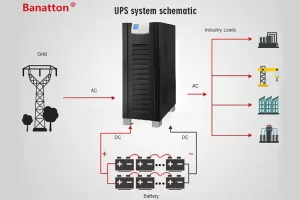
Online double-conversion is commonly used where the connected equipment requires a stable and conditioned power supply. The UPS converts incoming AC power to DC and then uses an inverter to produce AC output.
This process allows the UPS to regulate voltage and frequency while reducing the impact of input power disturbances on the connected load. It also provides a consistent output waveform for sensitive equipment.
Three-Phase Input and Output for High-Power Loads
Three Phase Online UPS systems are designed for electrical installations where three-phase power is required. They are commonly considered for industrial machinery, process systems, data-intensive facilities, and other high-power loads.
A three-phase configuration can also simplify integration with an existing industrial power distribution system. During selection, check the input and output voltage, frequency, phase configuration, neutral requirements, and load balance.
Low Frequency UPS for Industrial Applications
Low Frequency UPS systems are often considered for industrial loads with high starting currents or strong inductive characteristics. Typical examples include motors, pumps, compressors, transformers, and other equipment that can create a temporary surge in current when starting.
For these applications, the UPS should be sized according to both the normal running load and the starting demand. A unit may have enough capacity for continuous operation but still struggle with a large inrush current if its overload capability is insufficient.
Evaluate Power Quality, Load Compatibility, and Reliability
Grid Compatibility and Output Power Quality
Industrial power networks may experience voltage fluctuations, frequency variations, and other disturbances. The UPS input range should match the conditions of the local power supply.
Output quality is equally important. Key specifications include output voltage accuracy, frequency stability, waveform, and total harmonic distortion (THD).
For sensitive control systems and instrumentation, lower output distortion can help maintain stable operation. Buyers should therefore compare power quality specifications under both linear and non-linear load conditions.
Motor, Inductive, and Non-Linear Loads
Industrial facilities often operate equipment with demanding electrical characteristics. Motors may require high starting current, while variable frequency drives, switching power supplies, and other non-linear loads can generate harmonic currents.
Check the UPS crest factor, overload capability, current limiting, and load compatibility against the actual equipment requirements. A UPS that is suitable for a stable resistive load may require a different capacity or configuration when connected to motors or other dynamic loads.
Overload, Short-Circuit, and Bypass Protection
Overload protection allows the UPS to handle temporary increases in demand without immediate shutdown. When comparing systems, check how long the UPS can operate at different overload levels.
Short-circuit protection is also important for industrial installations. The UPS should have appropriate current-limiting and protection functions for the connected distribution system.
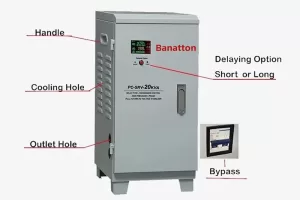
A static bypass provides an alternative power path when the UPS is overloaded or requires transfer to bypass operation. A maintenance bypass allows the UPS to be isolated for servicing while the load continues to receive power from the bypass source.
Redundancy and Parallel Operation
Redundancy becomes more important when a power interruption could affect critical production or process systems.
Parallel UPS systems can provide additional capacity and, depending on the configuration, redundancy. Buyers should check the maximum number of UPS units that can operate in parallel, the required parallel equipment, load-sharing method, and failure response.
The goal is to understand what happens when one unit is unavailable and how the remaining units support the load.
Check Environmental Adaptability and Installation Requirements
Temperature, Cooling, and Heat Dissipation
UPS equipment generates heat during operation, so the installation area needs sufficient ventilation and heat dissipation.
Before installation, check the specified operating temperature range and cooling requirements. High ambient temperatures can increase thermal stress and may affect maintenance requirements and equipment service conditions.
The UPS room or installation area should also provide enough space for ventilation, inspection, cable routing, and maintenance access.
Dust, Moisture, Corrosive Gases, and Vibration
Industrial environments can expose electrical equipment to dust, moisture, oil mist, corrosive gases, vibration, and mechanical shock.
The required protection level should match the installation environment. A UPS installed in a clean electrical room may have different environmental requirements from one located near a production line or in a demanding industrial workshop.
These conditions should be confirmed before purchase so that the equipment’s enclosure, cooling method, and installation arrangement are suitable for the site.
Installation Space, Grounding, and Cable Requirements
High-power UPS systems require careful installation planning. Check the equipment dimensions and weight, floor loading, access routes, ventilation space, cable specifications, and grounding requirements before delivery.
Grounding is particularly important for electrical safety and reliable operation. Power cables should also be correctly sized according to the UPS capacity and installation requirements.
Professional installation and commissioning can help ensure that the UPS operates according to its specified performance.
Compare Industrial UPS Specifications Before Buying
A specification sheet provides a useful starting point for comparing UPS systems, but each parameter should be considered in relation to the actual application.
| Specification | Key Parameters | What Buyers Should Check |
| UPS Capacity | Rated kVA / kW | Confirm that the UPS can support the total critical load and leave sufficient capacity for future expansion. |
| Input Voltage | Rated voltage and acceptable voltage range | Check whether the input range matches the site’s utility supply and can accommodate expected voltage fluctuations. |
| Input Frequency | Rated frequency and frequency tolerance | Verify compatibility with the local grid or generator and check the allowable frequency variation. |
| Output Voltage | Rated voltage and voltage regulation | Confirm that the output voltage matches the protected equipment and review steady-state and transient voltage accuracy. |
| Output Waveform | Pure sine wave and waveform quality | Check whether the UPS provides a stable sine-wave output suitable for sensitive electronics, control systems, and industrial equipment. |
| THD | Total harmonic distortion under different load conditions | Review THD values for both linear and non-linear loads, especially when the system supplies drives, rectifiers, or other non-linear equipment. |
| Overload Capability | Allowable load percentage and duration | Check how long the UPS can support 110%, 150%, or higher loads and how it responds to short-duration overloads. |
| Bypass | Static bypass and maintenance bypass | Confirm whether the system supports automatic transfer during overload or UPS faults and uninterrupted maintenance bypass operation. |
| Battery System | Battery quantity, DC voltage, charging method, and capacity | Check the battery configuration, charging method, required backup time, and whether the battery system can be expanded for longer runtime. |
| Parallel Operation | Maximum number of parallel UPS units and redundancy configuration | Verify the maximum number of units that can operate in parallel and whether the configuration can provide the required redundancy or capacity expansion. |
| Efficiency | Efficiency in line mode and battery mode | Compare efficiency under actual operating conditions because efficiency affects energy consumption, heat generation, and operating costs. |
| Installation Requirements | Dimensions, weight, cooling, grounding, and cable requirements | Confirm that the installation area can accommodate the UPS and provide adequate ventilation, access for maintenance, grounding, and correctly sized cables. |
| Monitoring and Communication | Communication ports, protocols, alarms, and monitoring functions | Check whether the UPS can connect with the site’s monitoring or control system and provide the alarms and operating data required by maintenance teams. |
A comparison based on these parameters makes it easier to identify whether a UPS matches the electrical, environmental, and operational requirements of the site.
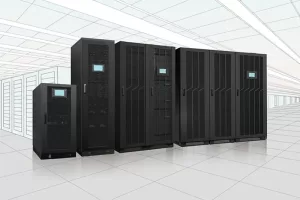
Banatton Industrial UPS for High-Power Applications
High Reliability and Online Double-Conversion Design
Banatton’s three-phase Industrial UPS uses an online double-conversion topology to provide conditioned power for critical loads. The system provides pure sine-wave output, frequency tracking, phase locking, voltage regulation, and noise filtering.
The main input and bypass input can be separated, allowing two independent mains power lines to be used when required by the installation.
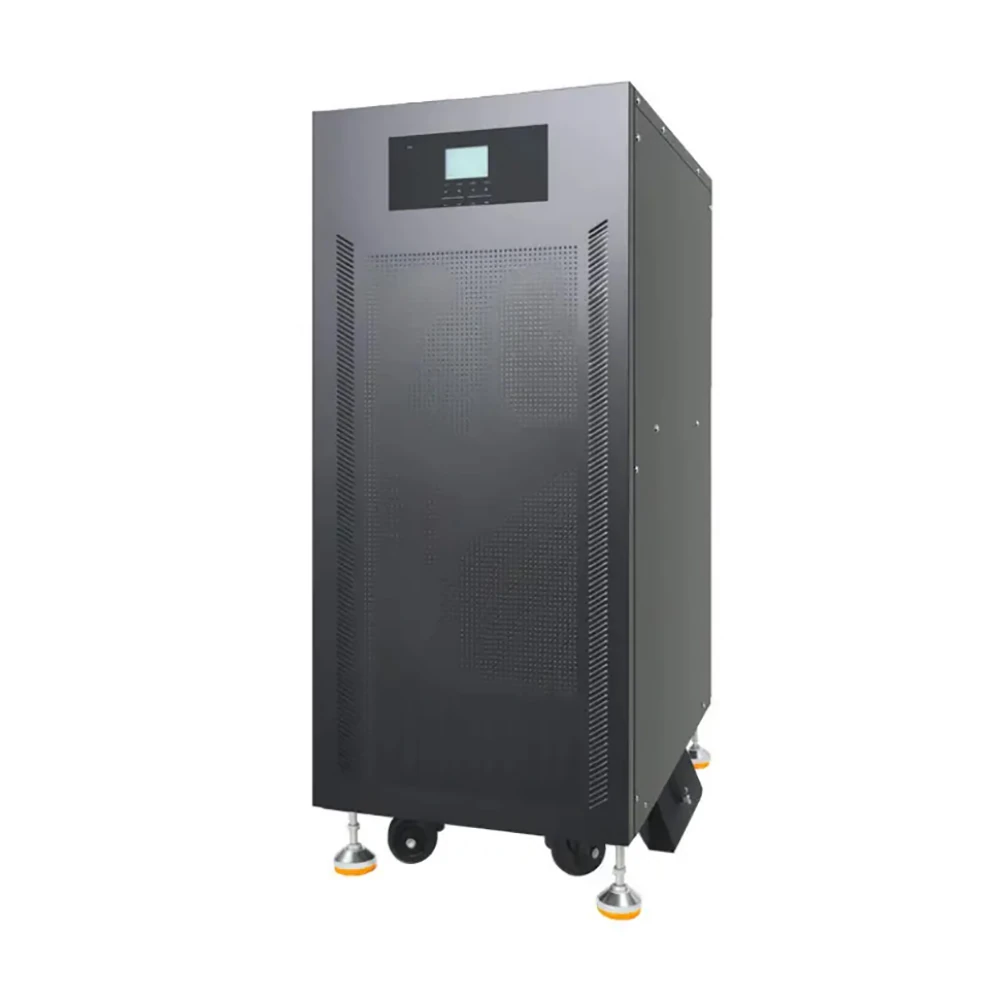
Intelligent Battery Management and Backup Performance
The system uses Intelligent Battery Management (ABM) and automatic constant-current charging. The supplied battery configuration is 12VDC × 32 batteries, with 29–32 batteries adjustable.
The nominal battery voltage is 384VDC when 32 batteries are used. The charging system uses CC/CV control, with a default charging current of 10A.
Parallel Capability and System Scalability
With an optional parallel module, up to eight UPS units can operate in parallel.
The parallel system does not rely on a fixed master-slave relationship. The first unit to power on becomes the master, while the other units operate as slaves. The roles can be exchanged. If one UPS fails, it automatically shuts down and the remaining units continue supplying the load.
Energy Efficiency and Thermal Management
The system uses intelligent fan-speed control based on UPS load, ambient temperature, and actual temperature rise.
It also incorporates non-circulating current control and green rectification and inverter technologies. The supplied specifications indicate an overall line-mode efficiency of 89%–92% and battery-mode efficiency of 90%–93% across the listed models.
Three-Phase Configuration for Industrial Applications
The listed models range from 10KVA/8KW to 200KVA/160KW and use three-phase input and output at 380VAC/400VAC/415VAC.
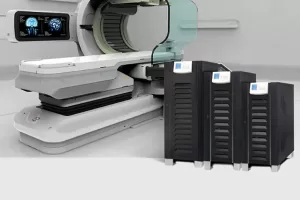
The system can be used in industrial process applications such as manufacturing and control systems, industrial machinery, instrumentation and measurement, process monitoring, security, and transport systems. Other listed application areas include hospitals, airports, semiconductor facilities, water treatment, power plants, metallurgy, oil and gas, petrochemical, mining, and military applications.
Conclusion
Selecting an Industrial UPS starts with the actual electrical requirements of the facility. Load capacity, startup current, power factor, backup time, power quality, operating environment, redundancy, installation, and maintenance all need to be considered before the final configuration is determined.
Banatton provides three-phase industrial UPS models from 10KVA/8KW to 200KVA/160KW, with online double-conversion technology, intelligent battery management, parallel operation, and bypass functions for industrial and infrastructure applications. For specific load requirements, backup time, and system configuration, contact Banatton to discuss a suitable Industrial UPS solution for your facility.
Frequently Asked Questions
1. How do I calculate the required Industrial UPS capacity?
Calculate the total kW and kVA of the critical loads, then consider power factor, startup current, and future expansion. A capacity margin of around 20%–30% can be considered when additional loads are expected.
2. How long can an Industrial UPS provide backup power?
Backup time depends mainly on the UPS load and battery capacity. The required runtime should be determined by the site’s needs, such as generator startup time or the time required for a controlled shutdown.
3. What is the difference between an Online UPS and a Low Frequency UPS?
An Online UPS describes how the UPS processes power, while a Low Frequency UPS refers to a specific design approach. Online double-conversion UPS systems continuously convert and regulate the power before supplying it to the load. Low Frequency UPS systems are often considered for industrial applications with motors, pumps, compressors, or other loads with high starting currents. When selecting a UPS, buyers should evaluate the actual load characteristics and determine which configuration meets the site’s power requirements.