 26Sep

Reliable power is no longer a luxury for businesses that depend on servers, networking equipment, and other critical infrastructure. A single interruption or a subtle distortion in the power supply can halt operations, corrupt data, and damage sensitive hardware. This is why an online UPS has become the backbone of modern IT environments, and why understanding how these systems handle frequency is essential before making a purchasing decision.
This article explains the fundamentals of frequency conversion in a Rack Mount UPS, walks through how double-conversion technology works, and introduces the key benefits of a high frequency online UPS that delivers a pure sine wave UPS output. Read on to build a clear foundation before evaluating any specific model.
10FAQs
Why Frequency Matters in a UPS
Electrical grids around the world operate at different frequencies. North America, parts of Asia, and many regions standardize on 60 Hz, while Europe, much of Africa, and large parts of Asia run at 50 Hz. Equipment designed for one frequency can behave unpredictably—or fail entirely—when connected to another.
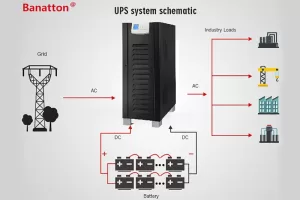
In an online double-conversion UPS, the incoming AC power is first converted to DC, then inverted back into clean AC. This two-stage process is what makes frequency control possible at all. Because the inverter generates the output independently, it is not locked to the frequency of the utility input. That independence is the foundation of the frequency conversion feature discussed throughout this article.
What Is Frequency Conversion in an Online UPS?
Frequency conversion refers to the ability of a UPS to accept power at one frequency and deliver it at another. A common scenario is a device rated for 60 Hz that must operate in a facility supplied with 50 Hz power—or the reverse. Rather than replacing the equipment or installing a separate converter, an online UPS with a frequency converter mode can bridge the difference directly.
This capability is valuable in several situations:
- Importing or exporting equipment across regions with different grid standards.
- Testing or commissioning hardware intended for an overseas market.
- Operating specialized machinery that requires a fixed frequency regardless of the local grid.
Because an online UPS performs continuous double conversion, the frequency of its output is determined by the inverter rather than the input. This allows the same unit to synchronize with the grid when appropriate, or to run at a fixed frequency when running on battery.
How Double Conversion Guarantees Stable Output
The term “online” in Online UPS refers to the fact that the load is continuously powered by the inverter, not directly by the mains. The typical operating sequence is:
- Rectification – the incoming AC is converted to DC.
- Inversion – the DC is converted back to clean AC with a controlled voltage and frequency.
Because there is no break in this path, the transfer time between utility and battery operation is effectively zero. The load does not notice the transition. This is a critical advantage over offline or line-interactive designs, where even a brief interruption can cause servers and network equipment to reboot.
The double-conversion architecture also regenerates the waveform. Incoming power that is noisy, distorted, or unstable is isolated and replaced with a stable sine wave. This is the core reason an online UPS is preferred for sensitive and mission-critical applications.
The Role of Frequency Auto-Sensing
Modern online UPS units often include automatic frequency sensing. The system detects whether the input is running at 50 Hz or 60 Hz and configures itself accordingly, eliminating the need for manual jumper settings or complex configuration. This is especially useful for organizations that operate across regions or that connect equipment to temporary generator power.
Frequency auto-sensing also supports generator compatibility. Generators frequently produce power with a wider frequency tolerance than the public grid. A UPS with a broad input frequency range can accept this variable power without forcing an unnecessary switch to battery, which helps preserve battery life and keeps the load running continuously.
What Is a High Frequency Online UPS?
A high frequency online UPS uses a high-frequency switching topology rather than the bulky, heavy transformer-based design of older models. This architectural change delivers several practical benefits:
- Higher power density – more capacity in a smaller footprint, which is essential in rack environments where space is limited.
- Reduced weight – easier installation and simpler maintenance, especially in data centers with weight-sensitive racks.
- Improved efficiency – less energy is lost as heat, which lowers both electricity cost and cooling requirements.
Digital control also plays a central role. Many modern units use a digital signal processor (DSP) to monitor and adjust the conversion process continuously. DSP-based control improves the accuracy of voltage and frequency regulation and enables features such as active power factor correction, which reduces harmonic pollution on the utility grid.
Why a Pure Sine Wave Output Matters
The quality of the output waveform has a direct impact on the equipment being powered. A pure sine wave UPS produces a waveform that closely matches the smooth, continuous sine wave of a clean utility supply. This is important because:
- Sensitive loads run correctly – servers, storage systems, and networking equipment are designed for sine wave power and can behave erratically on modified or stepped waveforms.
- Reduced stress on power supplies – a clean waveform prevents overheating and premature failure of the input stages of connected equipment.
- Better compatibility – some medical, industrial, and precision equipment may refuse to operate, or operate unreliably, on a non-sinusoidal supply.
For any environment where reliability is the priority, a pure sine wave output is the expected standard rather than an optional extra.
Understanding Key Specifications
Before evaluating a specific Rack Mount UPS, it helps to understand what the most important specifications actually mean.
Input Voltage and Frequency Range
A wide input voltage range means the UPS can tolerate fluctuations in the mains without switching to battery. This reduces the number of discharge cycles the battery experiences, which in turn extends battery service life. A wide input frequency range provides similar tolerance for frequency drift and for generator-supplied power.
Output Power Factor
The output power factor indicates how much real (usable) power the UPS can deliver relative to its rated apparent power. A higher output power factor means more of the unit’s capacity is available for actual load. This is significant when planning capacity, because a unit with a higher power factor can support more equipment for the same VA rating.
Efficiency
Efficiency describes how much of the input energy reaches the load as useful output. Higher efficiency means less energy is wasted as heat and lower operating costs over the life of the unit. Many online UPS units also offer an economic (ECO) mode that trades a degree of protection for significantly higher efficiency, which some organizations use for non-critical loads.
Harmonic Distortion
Total harmonic distortion (THD) measures how much the output waveform deviates from a pure sine wave. Lower THD values indicate cleaner power. For linear loads the distortion is typically very low, while non-linear loads such as switch-mode power supplies produce slightly higher values—this is normal and accounted for in the specifications.
Introducing Banatton Rack Mount Online UPS
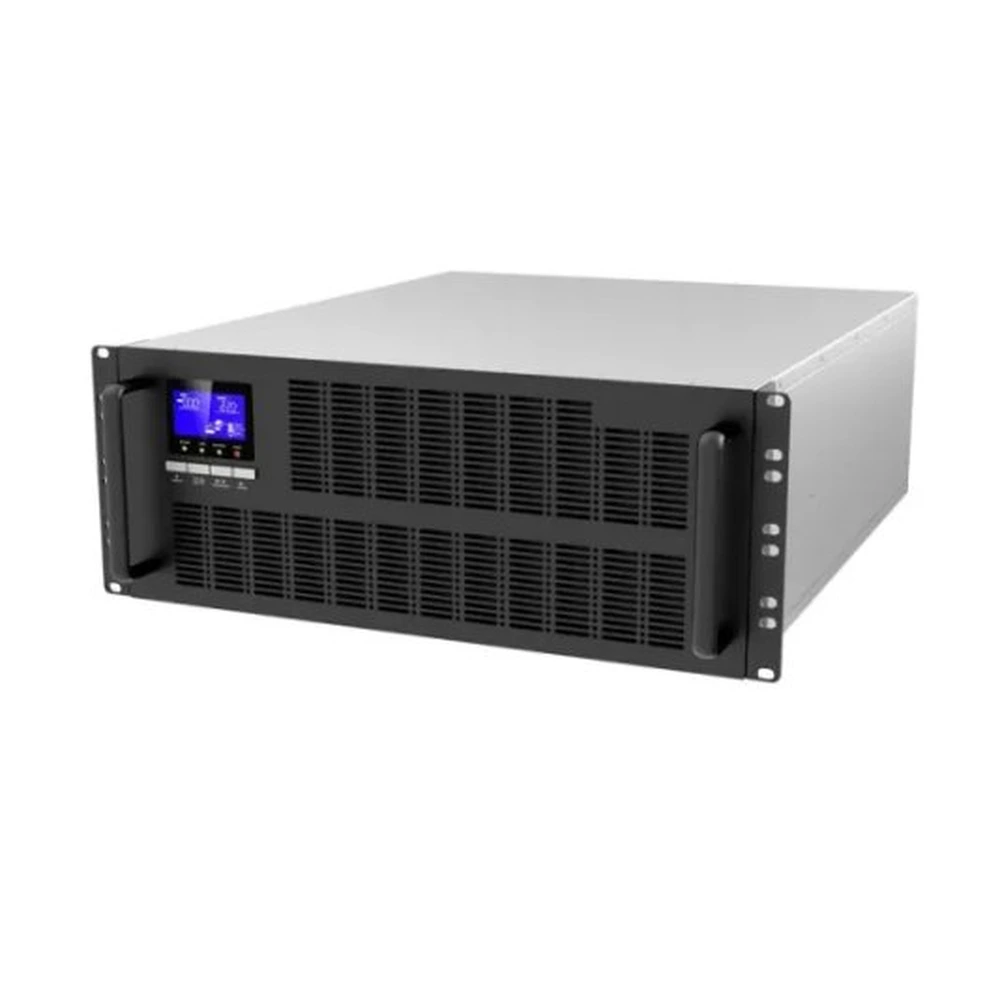
With these fundamentals in place, you can now evaluate how a purpose-built unit addresses the requirements described above. Our online rack mount UPS is engineered for networking rooms and data-intensive environments, delivering stable, clean power in a compact 1U-to-3U form factor.
Frequency Conversion Built In
The unit supports a frequency converter mode that accepts 50 Hz input and delivers 60 Hz output, or 60 Hz input and 50 Hz output. Combined with 50 Hz / 60 Hz automatic frequency sensing, this makes the UPS adaptable to different power environments without manual reconfiguration. A wide input frequency range of 40 to 70 Hz further ensures stable operation even when the supply is irregular or generator-fed.
Double-Conversion Online Design
As an online double-conversion UPS, the unit continuously regenerates the output waveform. The transfer time between AC mode and battery mode is zero, and the switch from inverter to bypass is also zero, so the connected load never experiences an interruption. The output is a pure sine wave, which makes it suitable for sensitive equipment including servers, storage, and precision devices.
High Frequency Architecture and Efficiency
The high frequency design contributes to a compact, lightweight form factor that fits standard racks. The unit achieves high operating efficiency in AC mode and even higher efficiency in ECO mode, helping to reduce both energy consumption and heat output in the room. A high input power factor reduces harmonic impact on the utility supply.
Broad Input Tolerance for Longer Battery Life
The ultra-wide input voltage range reduces how often the UPS must transfer to battery, which protects the battery from unnecessary discharge cycles and extends its service life. The system can work with either single-phase or three-phase mains input without complex setting or power derating, offering flexibility in how the unit is deployed.
Intelligent Management and Monitoring
The UPS includes a standard RS-232 interface and supports USB, MODBUS, RS-485, SNMP, and AS400 options, enabling both local and remote power management. An intelligent slot accepts optional communication cards for network-based monitoring, while a comprehensive alarm system and an LCD display provide clear, real-time status on load, battery level, and input and output conditions.
Built for Reliability in Critical Environments
The unit is constructed on a strong fiberglass-based double-sided PCB with careful ventilation and conformal coating, contributing to long-term reliability. Protection against short circuit, overvoltage, and reverse connection safeguards both the UPS and the connected equipment. These attributes make the system well suited to data processing centers, computer servers, medical facilities, traffic systems, IT rooms, and industrial applications.
Conclusion
Frequency conversion is an important feature to consider when selecting a rack mount online UPS, especially for businesses operating across regions with different power standards or using equipment that requires a specific operating frequency. By combining double-conversion technology, automatic frequency sensing, and pure sine wave output, a high frequency online UPS can provide stable power while supporting different input and output frequency requirements.Banatton Rack Mount Online UPS integrates these capabilities with a compact design, flexible input compatibility, and intelligent monitoring options. Whether deployed in server rooms, data centers, medical facilities, or industrial environments, it provides a practical power protection solution for critical equipment.
Banatton Rack Mount Online UPS integrates these capabilities with a compact design, flexible input compatibility, and intelligent monitoring options. Whether deployed in server rooms, data centers, medical facilities, or industrial environments, it provides a practical power protection solution for critical equipment. Contact Banatton to learn more about our rack mount online UPS solutions and find a suitable model for your power requirements.
FAQs
1. What is frequency conversion in an online UPS?
Frequency conversion allows an online UPS to accept power at 50 Hz and output 60 Hz, or accept 60 Hz and output 50 Hz. It is useful when operating equipment designed for a different power frequency.
2. Why choose a high frequency online UPS?
A high frequency online UPS offers a compact, lightweight design, high power density, and improved operating efficiency, making it suitable for server rooms, data centers, and other space-limited environments.
3. Why is pure sine wave output important for a rack mount UPS?
Pure sine wave output provides clean, stable power for sensitive equipment such as servers, storage systems, and networking devices, helping ensure reliable operation and reduce electrical stress.