 26Sep

Battery charging methods control the current, voltage, and when charging stops. Common profiles use constant current, constant voltage, CC-CV, or float. Matching the voltage on a charger to a battery label is only the start. The battery type and model decide which profile is suitable.
Two batteries sold for a similar voltage class can need different settings. That makes a replacement project harder than comparing connectors or ampere-hour ratings. You need to know what the charger holds steady, what changes as charge builds, and what happens when the battery reaches its limit.
This guide compares battery charging methods for uninterruptible power supply (UPS) and energy storage uses. It explains charging stages, separates float from trickle, and shows how to estimate a recharge window without promising a fixed completion time. Guidance from battery makers supports the advice. Worked examples use assumed values to show the math.
Start with the battery’s approved charging instructions. Then check the complete system, including its temperature controls, connected loads, and any battery management system (BMS). You’ll have a clear plan for choosing the equipment and talking through the change with a supplier.
Key Takeaways
- CC-CV charging limits current first, then holds voltage while current falls; the end-of-charge rules depend on the battery.
- Lead-acid standby service can use regulated float charging; continuous trickle current is unsuitable for conventional lithium-ion cells.
- A BMS provides monitoring and protection, but it doesn’t make an incompatible charger suitable.
- Dividing missing ampere-hours by available charging current gives an ideal time estimate, not a guaranteed recharge window.
Battery charging methods compared
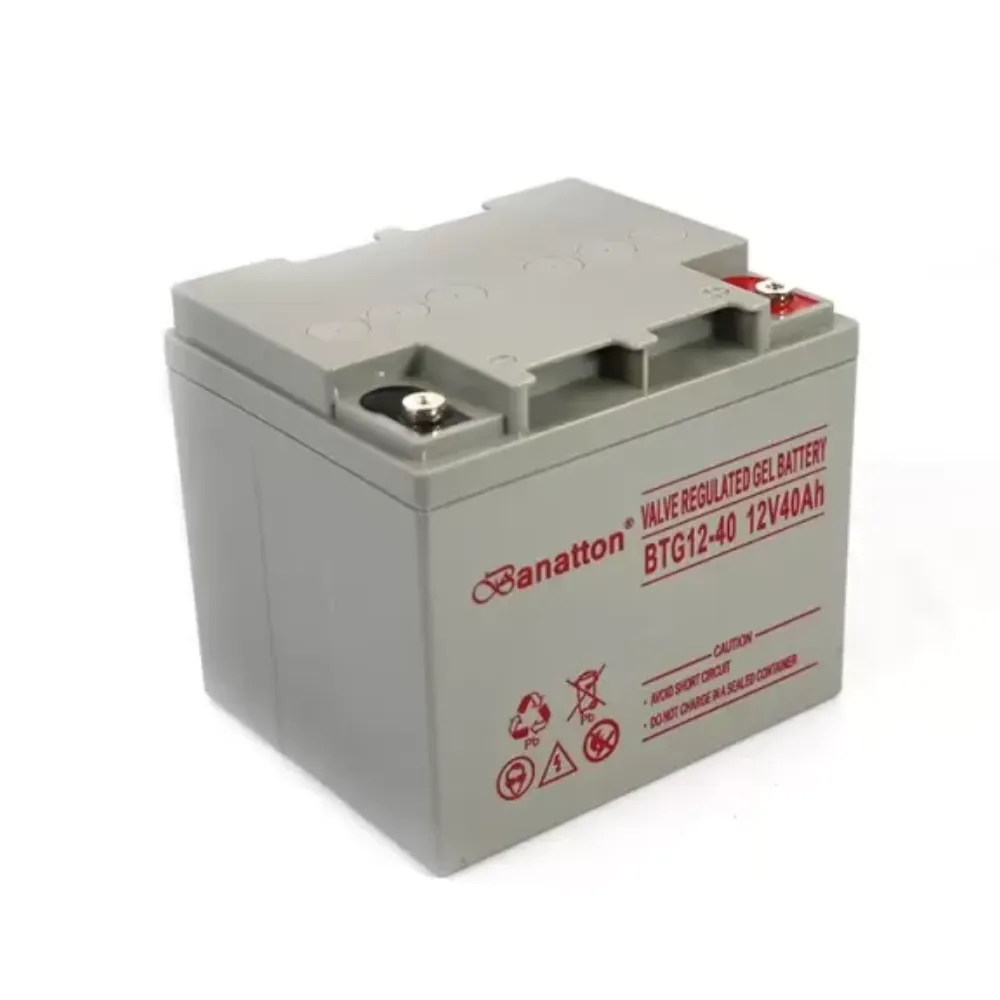
Battery charging methods describe how a charger controls its output as a battery takes in charge. Constant current controls amperes; constant voltage controls volts. A full profile sets the limits, stage changes, and stopping rules. These must suit the battery type, model, temperature, and use.
For help choosing a battery type, use the storage battery guide before comparing charger options.
| Method | What the charger controls | Where it fits | What to check |
|---|---|---|---|
| Constant current (CC) | Current stays at a set value as voltage changes | A charging stage; nickel systems with suitable stopping rules | Voltage, temperature, and stopping rules |
| Constant voltage (CV) | Voltage stays at a set value as current changes | Lead-acid charging with an starting current limit; the CV stage of lithium charging | Initial current limit and allowed voltage |
| CC-CV | Current limit first, voltage limit second | Lithium-ion charging and current-limited lead-acid profiles | Chemistry-specific transition and completion rules |
| Float | A regulated standby voltage maintains charge | Compatible lead-acid standby batteries | Approved float voltage and temperature correction |
| Trickle | A small continuous current replaces charge losses | Only batteries and uses that permit it | Whether continuous current is allowed |
| Pulse | Current arrives in controlled intervals | Purpose-designed, validated chargers | Battery approval and evidence for claimed benefits |
Solar and mains describe energy sources, so they aren’t competing battery charging methods in this table. Either source can feed a charger that applies a suitable profile. Likewise, “smart” and “fast” labels don’t specify the current limit, voltage limit, or charge stopping rules.
Hypothetical example: Alex’s replacement check. Alex compares an existing 12 V lead-acid battery with a lithium replacement for a small equipment cabinet. Both appear to fit the available space, but the charger manual lists only a lead-acid profile. Alex asks the supplier to confirm the exact pairing in writing before buying. A matching voltage label alone does not settle the choice.
How CC-CV and multi-stage charging work
What changes during a charge? Start there when reading a profile. A stage name alone doesn’t tell you when the charger should move on or stop. Read the profile as a sequence of controlled limits.
Current control at the start
During constant current charging, the charger aims to hold a selected current while battery voltage rises. The source must have enough available power to maintain that current. A deeply discharged battery may first need a low-current stage. Use that stage only as set out in its manual.
Constant current charging needs a voltage limit or another suitable stopping rule. Leaving the same current flowing indefinitely can overcharge a battery. The charger must check the limits set out in the approved profile.
In a lead-acid multi-stage charger, the early recovery stage is commonly called bulk charging. The current may sit at its limit, but it can fall below that limit if the input source cannot supply enough power. Solar conditions can make that difference visible.
Voltage control near the limit
Constant voltage charging holds the approved voltage while the battery’s accepted current falls. In a lead-acid profile, this controlled finishing period is commonly called absorption. The charger then follows its specified completion rule, which can involve current, time, or both.
For lithium-ion cells, CC-CV charging also changes from current control to voltage control. The charger ends or changes charging according to the approved profile as the current tapers. Reaching the voltage limit doesn’t by itself mean the finishing stage is complete.
Battery University’s lithium-ion charging guide explains this distinction and why continuous trickle charging is unsuitable for conventional lithium-ion cells. Its example cell voltages should not become settings for an unidentified pack.
Float is a separate standby decision
Float charging holds a suitable maintenance voltage rather than forcing the same small current through every battery. Current responds to the battery’s condition and the voltage applied. Trickle charging describes a small continuing current, so the two terms aren’t interchangeable.
A lower maintenance voltage can follow absorption in a compatible lead-acid system. Use the manual to check how a lithium system stays ready. Some specify a lower float setting. Other profiles stop the charge.
Don’t copy the lead-acid behavior simply because both chargers use the label CC-CV.
For a classroom explanation of lead-acid charging terminology, this lesson is an additional learning resource. Use the battery manual for actual settings.
Match battery charging methods to chemistry

The same charge stages can serve different battery types. Their limits and stopping rules still differ. To compare the methods, first identify the exact battery. Check its chemistry, cell layout, and intended duty.
Lead-acid: separate cyclic and standby service
Lead-acid batteries used for repeated discharge cycles need their specified recovery profile. A battery waiting to support a UPS load needs an approved standby strategy as well. Constant voltage charging with a current limit can serve either duty when the settings match the battery.
Power-Sonic’s lead-acid charging guidance distinguishes cyclic charging from float charging. Its table lists 2.25-2.30 V per cell for float service at 25°C. These values come from Power-Sonic’s guide. They are not a universal setting or a Banatton product specification.
Absorbed glass mat (AGM), gel, and flooded batteries belong to the lead-acid family, but their manuals can specify different limits. Don’t apply a flooded-battery equalization routine to AGM or gel without explicit approval. Equalization is a controlled procedure for suitable batteries, not a required final stage for all battery charging methods.
Lithium-ion and LiFePO4: confirm the whole profile
Lithium iron phosphate (LiFePO4) is a lithium-ion chemistry with its own cell voltage characteristics. A profile for another lithium type can be wrong for the pack. A lithium label alone does not identify the right settings. Check charge voltage, maximum current, allowed temperature, and BMS needs together.
CC-CV charging describes the broad sequence, not every setting. The BMS can monitor cells and stop charging when a limit is reached, but that protective action shouldn’t replace normal charger control. Confirm how the charger responds to a charge-disable signal and how charging resumes.
The Victron Lithium Battery Smart manual illustrates why model-specific instructions matter. It specifies absorption and float settings for that family and permits charging only from +5°C to +50°C. Those instructions apply to the named Victron product family; other batteries need their own documented limits.
For lead-acid batteries, use the temperature correction set out in the manual. It can call for a lower charge voltage as the battery gets warmer. A lithium pack may instead need charge blocking outside its allowed range; do not copy lead-acid voltage correction into its profile.
Nickel batteries need their own stopping rules
Nickel-cadmium and nickel-metal hydride batteries also need chemistry-specific charging equipment. Constant current charging is used, but voltage behavior, temperature, and time can inform stopping rules. An adjustable output current does not make a lithium charger suitable for nickel batteries.
A site with several battery types needs a clear way to keep chargers matched to each type. Identify the chemistry first, then select the charger and stopping controls that its maker approves.
Size current and allow for recharge time
The charge profile and the current rating both need to fit the job. A profile can be suitable while the charger is too small for the required recovery window. A larger charger must still respect the battery’s current limit.
Translate C-rate into amperes
C-rate relates the current to the rated charge capacity. For a 100 Ah battery, 0.2C corresponds to 20 A: multiply 100 Ah by 0.2 per hour. This arithmetic explains the unit; it doesn’t recommend 0.2C for every battery.
Use the battery’s allowed charge current and the charger’s actual capability. Check whether a published current is a continuous value, a peak value, or a limit that changes with temperature. For parallel batteries, confirm the approved arrangement and how current shares between branches.
Calculate an ideal bound, then account for taper
Hypothetical example: Morgan’s recharge estimate. Morgan plans recovery for a 100 Ah bank from an estimated 30% to 80% state of charge. The missing amount is 50 Ah, and an assumed constant 20 A would replace that charge in 2.5 hours. Morgan treats the result as an ideal estimate. They ask the battery maker for recovery data that fits the real charger, temperature, and charge stages.
The calculation is:
Missing charge = capacity × change in state of charge.
Ideal time = missing charge ÷ net current entering the battery.
CC-CV charging includes a stage where current falls. The starting current may not last to the charge level you need. Charge losses, battery condition, and current limits can also increase time. Judge the result against the required duty and charge stages.
If a shared DC supply provides 20 A and a connected load takes 5 A, only 15 A remains for charging. Replacing 50 Ah then needs about 3.3 hours under ideal constant-current conditions. This subtraction applies to that shared-output arrangement; a dedicated battery charger may have a different power path.
State the charge level you need
State what the recharge must restore. It could be a stated charge level, a required runtime, or full charge as defined by the battery maker. Those are different goals. A display that says charging has started does not show how much charge will be ready for the next outage.
To assemble the control needs alongside that calculation, use the battery management system guide and record the charger-to-BMS interface in your plan.
Check the complete UPS or storage system
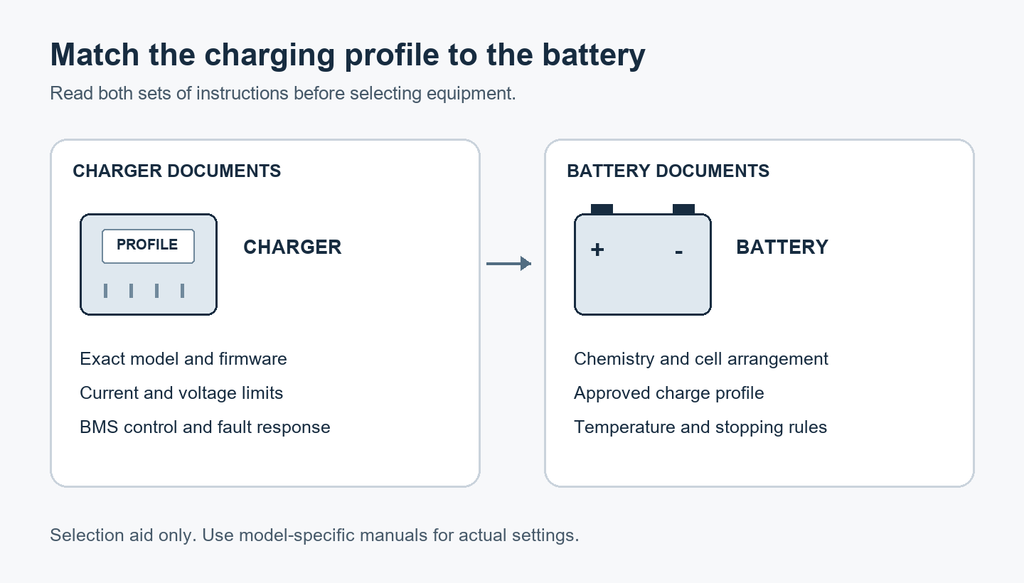
The charge profile is only one part of the equipment match. The charger, battery, controls, connected equipment, and installation conditions must work together. Treat a new battery type as a system change until the makers of the affected equipment approve the change.
Build a charging checklist
Collect these items before comparing quotations or approving a replacement:
- Battery identity: maker, exact model, chemistry, capacity, and series/parallel arrangement.
- Charging limits: approved voltage stages, current limits, timing, stopping rules, and any maintenance mode.
- Temperature needs: sensing location, allowed range, charge inhibition, and any compensation specified by the maker.
- Control interface: BMS signals, communication needs, contactor behavior, and fault recovery.
- Power budget: input limits, connected load, simultaneous charging sources, and available recharge current.
- Acceptance criteria: required runtime recovery, alarm response, and records needed after commissioning.
Use these records to compare what each supplier offers. Ask for written approval that names the exact battery, charger or UPS model, and firmware version. A category page listing lithium batteries doesn’t establish that every charger supports every lithium pack.
Banatton Group’s storage battery range provides a starting point for product discussions. Select a battery and its charging needs together, then check the proposed equipment pairing against the relevant manuals.
Check the charge cycle under the intended load
Hypothetical example: Sam’s cabinet upgrade. Sam is reviewing a cabinet with a 48 V nominal battery system and a charger configured for its existing batteries. A replacement proposal specifies a different chemistry but leaves the charger profile unidentified. Sam holds the purchase until the supplier confirms the profile, temperature controls, and BMS interface. The new battery cannot yet be treated as a drop-in replacement.
For service planning, connect the charging plan to stationary battery maintenance. Keep records of charge settings, battery temperature, alarms, and the time taken to restore charge. Have trained staff check the charge stages and fault response under an approved test plan.
Don’t infer battery health from charger voltage alone. A normal total voltage can hide differences between cells or blocks, and reaching a float setting doesn’t prove the required runtime is available. Use the battery maker’s inspection and capacity-test guidance when assessing readiness.
Battery charging questions
What is the difference between constant current and constant voltage charging?
Constant current charging holds current steady while voltage changes; constant voltage charging holds voltage steady while current changes. CC-CV charging combines the stages. The approved profile sets when stages change and when charging stops. Neither mode alone is a full charge plan for every battery.
Is float charging the same as trickle charging?
No. Float charging regulates a maintenance voltage, while trickle charging describes a small continuing current. Do not copy a lead-acid standby profile to lithium-ion cells. Follow the exact battery-system instructions, including any approved lower-voltage standby setting.
Can solar and mains chargers charge the same battery bank?
They can in a system designed for both sources. Each charger must use compatible settings, and their combined current must remain within battery and system limits. Check coordination, reverse-current protection, and BMS control; don’t assume independent smart chargers automatically coordinate with each other.
What should I do with a completely dead battery?
Identify the battery and use the checks in its manual before trying to restore charge. A low terminal voltage can reflect deep discharge, a protective disconnect, or a failed battery. Don’t bypass a BMS or force a charge into a damaged pack. Its maker needs to define whether recovery is safe.
Choose the profile before the charger
Choose battery charging methods by chemistry, model, and duty before comparing charger power or price. Start by identifying the battery. Get its approved limits, then match them to the charger and controls. Then check whether the available current restores the capacity you need within the required window.
Keep the distinctions clear. Constant current sets the rate, constant voltage sets the voltage limit, and CC-CV combines the two. Float charging is a standby decision for a compatible battery, while charge stopping rules and temperature controls protect the battery at each stage.
Record the assumptions behind every estimate. Matching the rated voltage is not enough. A BMS does not replace a suitable charger, and an ideal time estimate does not prove that charge is fully restored. Written instructions for the exact models make the discussion more useful.
To discuss battery charging methods for a UPS or storage project, request a quote with your battery model, system voltage, load, temperature range, and recharge target. Ask for the proposed charging profile and compatibility documents alongside the equipment selection.