What is an industrial UPS?—How to choose an industrial UPS?
An industrial UPS is a device that provides temporary power to large electrical equipment during power outages. Because it uses three-phase power, which is common...

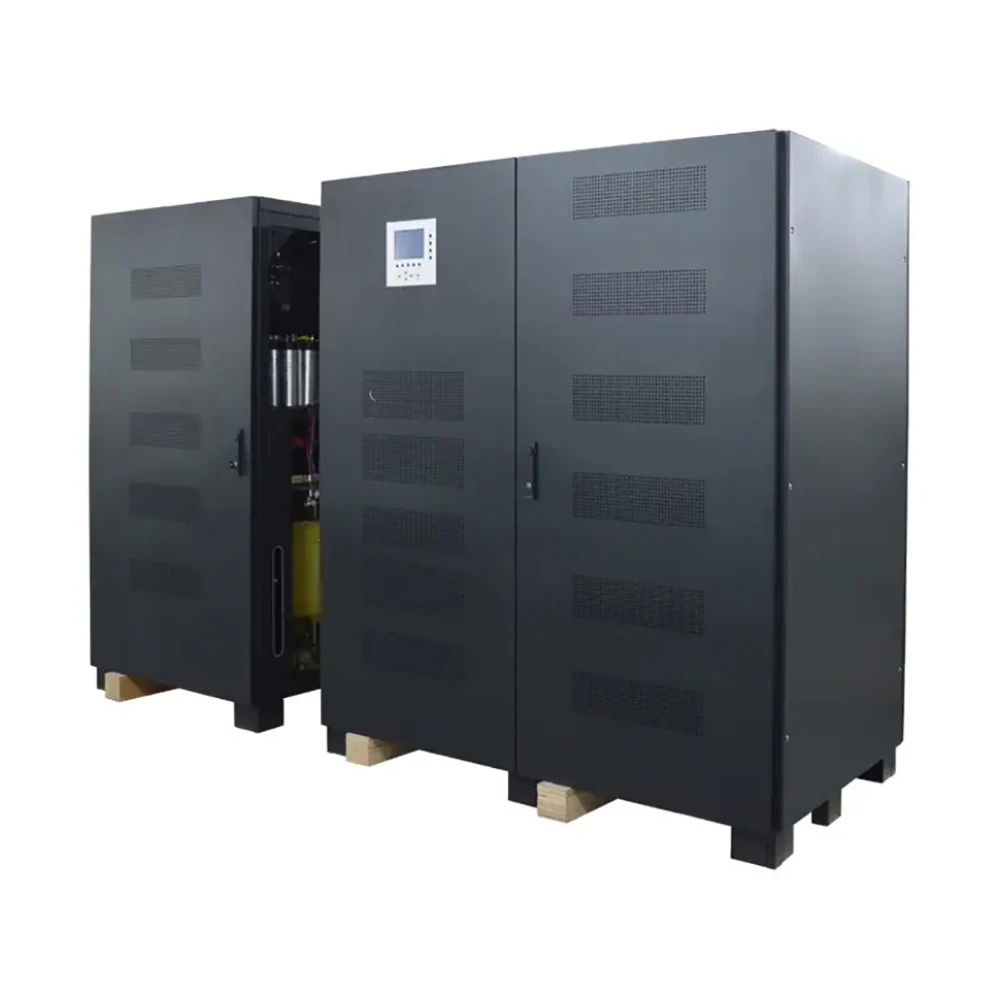
An Industrial UPS is a heavy-duty power protection system designed for mission-critical applications where power reliability and equipment protection are essential. Unlike commercial UPS systems, industrial UPS units are built with ruggedized components, advanced thermal management, and high-performance electrical topologies to withstand demanding operating environments.
As a professional industrial UPS manufacturer, our BT8010H-33 to BT8200H-33 series adopts an online double-conversion topology, completely eliminating power grid interference and delivering a pure sine wave output with stable voltage and frequency, low distortion, and effective noise filtering. The BT80 series provides capacities from 10KVA/8KW to 200KVA/160KW per unit and supports parallel expansion for larger installations. Typical applications include manufacturing plants, hospitals, airports, oil and gas facilities, data centers, military installations, and other critical infrastructures where power interruptions are unacceptable. A key feature is its separable main input and bypass power supply design, allowing two independent utility sources to be connected simultaneously for enhanced reliability.
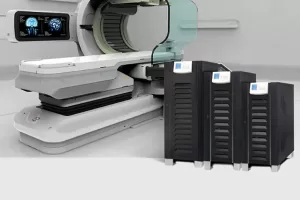
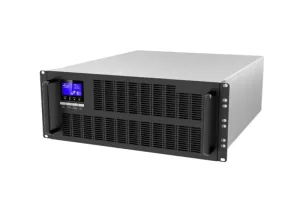
A Commercial UPS is primarily designed for offices, retail stores, small server rooms, and light commercial environments. These systems focus on affordability, compact size, and basic backup protection rather than industrial-level durability or power conditioning.
Commercial UPS products typically use offline or line-interactive topologies. Offline UPS systems switch to battery only during outages, while line-interactive models add basic voltage regulation. However, both designs still allow utility power to reach the load during normal operation and cannot completely isolate equipment from grid disturbances.
Commercial UPS capacities usually range from 500VA to 10KVA, operate on single-phase power, use lower-voltage battery systems, and are intended for clean indoor environments with temperatures between 0°C and 40°C.
Industrial UPS systems protect mission-critical loads such as production lines, medical equipment, process control systems, security infrastructure, and emergency systems. Even a brief power disturbance can lead to equipment damage, production losses, or safety risks.
Commercial UPS systems are commonly used for office computers, POS terminals, network devices, and small IT equipment where short interruptions are less critical.
The BT80 series offers capacities from 10KVA/8KW to 200KVA/160KW in a single unit. By adding optional parallel modules, up to eight UPS units can operate in parallel, enabling total system capacities of up to 1.6MW.
Commercial UPS systems rarely exceed 10KVA and generally provide limited scalability.
Industrial UPS systems are designed with multiple layers of redundancy. The BT80 series supports dual power inputs through separate main and bypass sources, static bypass operation with zero transfer time, and maintenance bypass for uninterrupted servicing.
Parallel systems use a non-fixed master-slave architecture. If one UPS fails, the remaining units continue supporting the load, ensuring continuous operation.
Commercial UPS systems typically use a single power input and provide minimal redundancy.
The most significant difference is topology.
The BT80 industrial UPS uses online double-conversion technology. Incoming AC power is continuously converted to DC and then back to AC, completely regenerating the output waveform. This process removes voltage fluctuations, frequency variations, harmonics, spikes, surges, and electrical noise.
Commercial offline and line-interactive UPS systems allow utility power to pass directly to connected equipment during normal operation and therefore provide only limited protection against power quality problems.
The BT80 series incorporates Intelligent Battery Management (ABM) technology and advanced constant-current automatic charging technology to maximize battery lifespan, reduce maintenance requirements, and shorten charging time.
The battery system uses 12VDC × 32 batteries (29–32 adjustable) with a nominal battery voltage of 384VDC and charging currents up to 40A on larger models.
Commercial UPS systems generally use simpler charging methods and often require more frequent battery replacement.
Industrial UPS systems are engineered for demanding environments. The BT80 series utilizes intelligent fan speed control based on load, ambient temperature, and actual temperature rise to ensure effective heat dissipation and reliable operation.
Commercial UPS systems are intended only for climate-controlled indoor environments.
The BT80 series delivers a pure sine wave output with THDV below 2% for linear loads and below 5% for non-linear loads. Stable voltage, frequency regulation, and low distortion make it suitable for sensitive industrial and medical equipment.
Because the inverter continuously supplies the load, utility power failures result in zero transfer time. The static bypass also provides zero-transfer-time switching when necessary.
This level of protection is critical for applications that cannot tolerate interruptions.
The online double-conversion design isolates equipment from voltage sags, surges, frequency drift, harmonics, transient spikes, and electrical noise, ensuring stable operation even when utility power quality is poor.
The UPS supports independent main and bypass power sources, significantly improving output reliability. The online topology provides pure sine wave output with frequency tracking, phase locking, voltage regulation, and noise filtering.
ABM technology extends battery life while reducing maintenance requirements. Advanced charging technology helps maximize battery performance and reduce total ownership costs.
Up to eight UPS units can operate in parallel, providing both scalability and redundancy. The non-fixed master-slave architecture ensures continuous operation even if one unit experiences a fault.
Fan speed is automatically adjusted according to operating conditions, improving cooling efficiency while reducing energy consumption and noise.
The system incorporates green rectifier and inverter technologies together with non-circulating current control circuits to improve power conservation and reduce operating costs.
The BT80 series supports 3 × 380VAC/400VAC/415VAC input voltage with an input range of 165VAC–280VAC (phase-neutral) and 285VAC–485VAC (phase-phase).
Output voltage accuracy reaches ±1% under stable conditions and ±5% during transient load changes. Output frequency is synchronized to the utility source or maintained at ±0.1Hz during battery operation.
The UPS supports:
The system also supports a crest factor of 3:1 and load power factors from 0.6 to 1.
The static bypass provides zero transfer time and automatically activates when operating conditions exceed allowable limits.
Bypass overload capability includes:
Maintenance bypass allows servicing without interrupting power to connected loads.
The BT80 series uses 12VDC × 32 batteries with a nominal battery voltage of 384VDC. Charging utilizes a constant-current/constant-voltage method with ±1% precision.
Efficiency performance by model range:
Industrial UPS systems are widely used in:
Industrial and commercial UPS systems serve very different purposes. Commercial UPS products are suitable for offices and light-duty applications, while industrial UPS systems are engineered for environments where reliability, power quality, and uptime are essential.
For applications requiring three phase UPS systems with online double-conversion technology, dual-input redundancy, parallel scalability, advanced battery management, and zero-transfer-time protection, the BT8010H-33 to BT8200H-33 Industrial UPS series provides a dependable solution for mission-critical operations.
Q1: Is industrial UPS worth the extra cost?
Yes. It prevents costly downtime, equipment damage, and data loss in critical environments—far outweighing the higher upfront price.
Q2: Does the BT80 series have true zero transfer time?
Yes. The online double-conversion design means the inverter always powers the load, so battery takeover is instantaneous with zero interruption.
Q3: Can multiple BT80 units be paralleled? Does it reduce reliability?
Up to 8 units can be paralleled (1.6MW total). Using a non-fixed master-slave architecture, it removes single points of failure and actually enhances reliability via N+1 redundancy.
 26Sep
26Sep
 26Nov
26Nov
 28Jan
28Jan
 29Jan
29Jan