 20Nov
20Nov

1. Introduction
Unstable power is one of the biggest hidden threats to any server room. Blackouts, voltage sags, and harmonic distortion—all have the potential to corrupt data or damage hardware before you even notice. It’s not a matter of if a power issue will strike, but when. For this reason, a rack-mount UPS is an essential piece of equipment. An online UPS provides a seamless power barrier, ensuring your servers operate continuously on a clean, stable power supply regardless of grid conditions. This guide introduces rack-mount UPS systems and their importance to data centers, and explains how the BT900-RT series (1kVA–30kVA) meets the stringent reliability requirements of modern IT environments.
2. What Is a Rack Mount UPS?
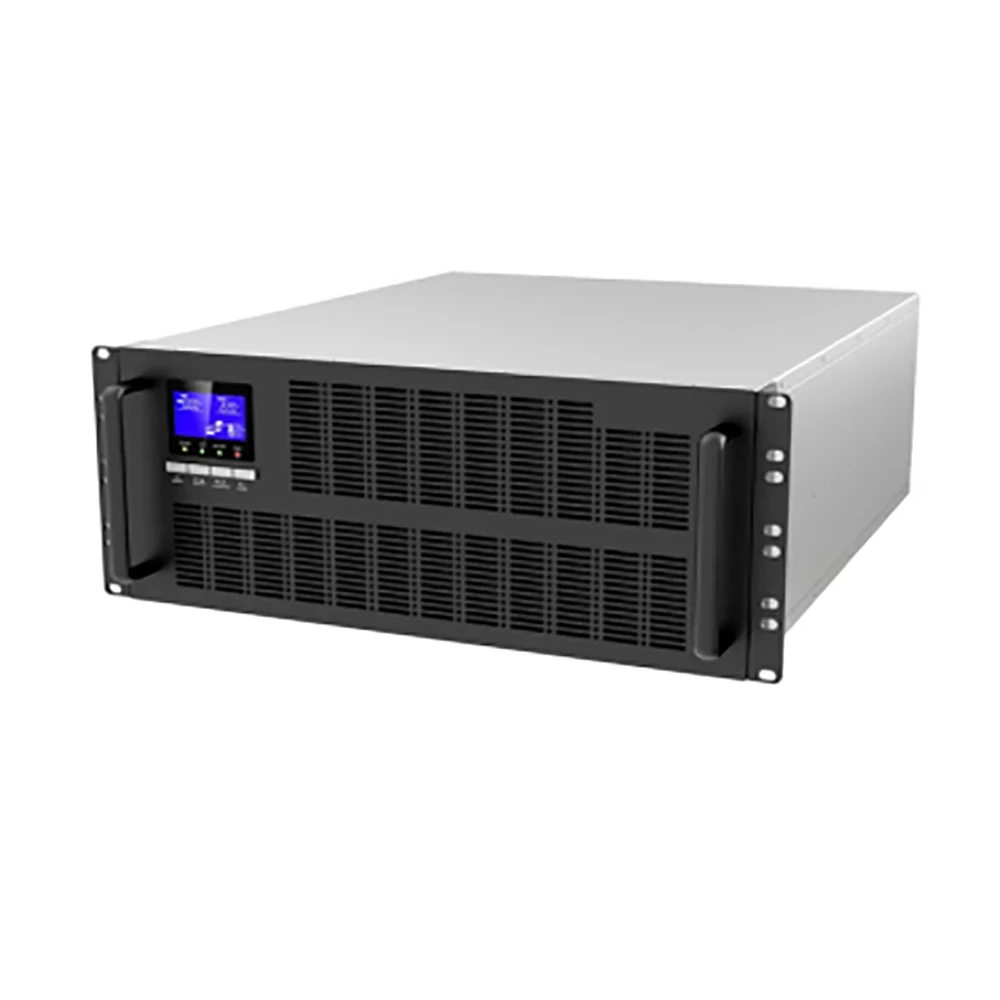
Rack-mount UPS units fit standard 19-inch racks. They take no floor space and don’t block airflow. Bulky tower units can’t do the same. This form factor is critical in professional server rooms where space is at a premium. Taking the BT900-RT series as an example, this series offers compact 3U and 6U chassis options—with dimensions as small as 668 x 438 x 133 mm—enabling system integrators to maximize rack space for server deployment while maintaining fully integrated power protection capabilities.
2.1 Rack Mount vs. Tower UPS: Key Differences
The fundamental difference between a rack mount UPS and a tower UPS goes beyond aesthetics. Tower units take up floor space and can block heat dissipation. Rack-mount units support high-density deployment—centralize power, reduce clutter, simplify maintenance—making them the go-to for high-density server rooms.
2.2 Core Applications in IT Ecosystems
- Data processing centers and colocation facilities.
- Host systems and high-performance computing clusters.
- Network cabinets housing switches, routers, and firewalls.
- Edge computing nodes deployed in remote or semi-outdoor environments.
3. How Does an Online Double-Conversion UPS Work?
3.1 The Principle of Zero Transfer Time (0ms)
To understand online UPS and its role in server rooms, you need to start with transfer time. A standby UPS has a 2–10 ms switching delay before the battery takes over. While this seems minuscule, modern server power supplies can experience resets during this gap. An online double-conversion UPS eliminates this risk by continuously converting AC to DC and back to AC. This means that the output power is always provided by the inverter, rather than directly from the mains power. Therefore, once the mains power is interrupted, the inverter will immediately draw power from the battery, achieving zero conversion time (0 milliseconds). The BT900-RT series ensures zero-latency switching, thereby guaranteeing that servers, storage arrays, and network switches do not experience power interruptions.
3.2 Pure Sine Wave Output for Sensitive Equipment
Not all UPS units are equal. Budget or offline models produce a stepped sine wave, which can lead to compatibility issues with power supplies in modern servers that utilize Active PFC (Power Factor Correction) technology. The BT900-RT Online UPS, however, delivers a pure sine wave (with ≤ 2% THD on linear loads and ≤ 5% THD on non-linear loads). This clean, smooth waveform is identical to—or better than—the utility grid. Sensitive medical equipment, laser printers (customizable on the BT900-RT), and high-end server motherboards all require pure sine wave output.
4. Essential Features to Look for in a Server Room UPS
4.1 Wide Input Voltage Range for Unstable Grids
Not all regions have stable power. In many areas, the grid fluctuates frequently. A UPS with a narrow input range constantly switches to battery, prematurely aging batteries and generating excess heat. The BT900-RT series is engineered for harsh electrical environments. Its single-phase models accept a wide input range of 90V~300V and frequency range of 40~70Hz, while the three-phase models accept 190-520VAC at 100% load. This broad threshold range allows the UPS to remain in bypass or online mode during minor voltage fluctuations, thus protecting battery health to handle real emergencies.
4.2 High Efficiency and ECO Mode for Energy Savings
Energy consumption is a major operational expense in data centers.Traditional UPS systems waste a significant amount of electrical energy in the form of heat. The BT900-RT series solves this with advanced three-level inverter technology, achieving AC mode efficiency up to 91% and ECO mode efficiency up to 96%. For a 20 kVA unit, 96% efficiency translates to significant annual savings on electricity and cooling costs. The ECO mode allows the UPS to run on a highly efficient bypass path while monitoring input power; only switching to double-conversion when power quality degrades.
4.3 Intelligent Battery Management for Extended Runtime
Battery runtime is a critical factor, but so is battery health. The BT900-RT series offers flexibility in both standard and long-run models. Standard models come with internal 12V/9Ah batteries, with typical recharge times of 9 hours to 90% capacity. To meet requirements for extended runtime, long-runtime models are equipped with external battery terminals, support a maximum charging current of 4A, and allow for an adjustable number of batteries (18–20 units*).This allows system integrators to pair the UPS with external battery cabinets—such as the BT900 battery packs, which provide 63kg of battery capacity in a 3U form factor—to achieve hours of backup time for critical loads. Additionally, the DSP control ensures precise charging voltage (273 VDC ± 1% for 20 pcs), protecting batteries from overcharging.
4.4 Advanced Communication for Remote Monitoring
Server rooms are often unattended, especially on weekends. Remote monitoring is a necessity. The BT900-RT series supports RS232 (standard) , with optional USB, MODBUS, RS485, SNMP, and AS400 cards. With an SNMP card installed, the UPS can be integrated seamlessly into network management systems, allowing IT staff to monitor input/output voltage, battery levels, load percentage, and fault conditions via a web browser or central management console.
5. Choosing the Right Capacity: 1KVA to 30KVA Rack UPS
5.1 Calculating Your Total Load (Wattage vs. VA)
To calculate your load, sum the wattage of all servers, switches, and storage devices you intend to protect. Ideally, you should operate the UPS at 60-80% of its maximum capacity to leave room for future expansion and to allow the UPS to operate at its peak efficiency. For small branch offices, a 1kVA unit may suffice; however, for high-density server racks, a model like the BT9020S(H)-R-31 (20kVA / 18000W) provides the necessary capacity headroom.
5.2 Single-Phase vs. Three-Phase Input Flexibility
Small cabinets typically use single-phase 110V or 220V power, whereas large data centers rely on three-phase 380V/400V power. The BT900-RT series uniquely offers single-phase and three-phase input compatibility. The 10-20kVA models (BT9010S-R-31, BT9015S-R-31, BT9020S-R-31) offer 3-phase in / 1-phase out—take 3 x 400VAC input, deliver stable 208/220/230/240VAC single-phase output, ideal for high-density racks. It can balance three-phase power distribution and provide standard single-phase power to the equipment without complicated setup or derating.
5.3 Planning for Future Server Room Expansion
Server rooms rarely shrink; they grow. When choosing a rack mount UPS, scalability is key. The BT900-RT series supports battery expandability and is available in capacities up to 30KVA. Choosing a model with external battery capability (the “long-run” models with 4A charging current) ensures that as you add more servers, you can simply add external battery packs (like the 580 x 438 x 133mm battery cabinets) instead of replacing the entire UPS. Furthermore, the adjustable battery numbers (18–20 pcs) offer flexibility to fine-tune the DC bus voltage, accommodating different battery configurations to meet specific runtime targets.
6. FAQ
Q: What is a rack-mounted UPS system?
A: A rack-mount UPS provides backup power and protects equipment during outages. These systems are commonly used in data centers and network cabinets and can be installed in 19-inch server racks.
Q: How do rack-mounted UPS systems ensure reliable power for critical applications?
A: Rack-mounted UPS systems utilize energy storage systems, DC power supplies, and a range of backup power solutions to maintain power supply during outages. They also employ an online interactive topology, providing superior energy and voltage control efficiency.
Q: Usage and Maintenance Recommendations
A: Environment: Ensure good cabinet ventilation to prevent the UPS from overheating and derating or triggering alarms.
Load: Never operate at full load or overload for extended periods, as this will significantly shorten the lifespan of the UPS and batteries.
Testing: Perform a battery self-test regularly (e.g., quarterly) to simulate a mains power outage and verify the battery’s actual discharge capacity.
Lifecycle: Remember, the UPS main unit may last for 10 years, but the battery is a consumable with a limited lifespan. Once it reaches its lifespan, even if it doesn’t break down, its performance will have significantly degraded and must be replaced promptly; otherwise, it’s essentially useless.
7. Conclusion
The server room is the heart of modern business. Protecting it requires more than a surge protector—it demands a reliable rack-mount online UPS. The benefits are clear: data protection, hardware safety, business continuity, and remote management. As we’ve seen, the ideal server room UPS must combine high efficiency, pure sine wave output, wide input voltage tolerance, and flexible communication—exactly what the BT900-RT series delivers. Whether you are securing a small network closet or a high-density data center, choosing the right capacity and understanding the technical advantages of features like DSP control, three-level inverter technology, and zero transfer time will ensure your critical infrastructure remains resilient against any power disturbance. If you are interested in our products, please feel free to contact us for a quote.