 26Nov
26Nov

Industrial UPS vs commercial UPS is a comparison of site requirements, critical loads, and service needs. An industrial application may need protection against harsh conditions, while a commercial installation can also require online power protection and redundancy.
An uninterruptible power supply (UPS) should meet the actual installation requirements. The building name alone doesn’t tell you its capacity, battery runtime, or fault response. A server room inside a factory and a control cabinet beside a production line can need different solutions.
This industrial UPS vs commercial UPS guide helps you compare those needs without treating one label as a universal quality rating. Start with the table, then use the evidence checklist to compare quotations on the same basis.
Key takeaways
- Commercial applications can use online UPS systems and three-phase configurations.
- Environment, load behavior, and maintenance access require model-specific checks.
- Installed capacity and capacity remaining after a fault are different figures.
- Battery runtime, service life, and warranty answer different questions.
Industrial UPS vs commercial UPS: comparison table
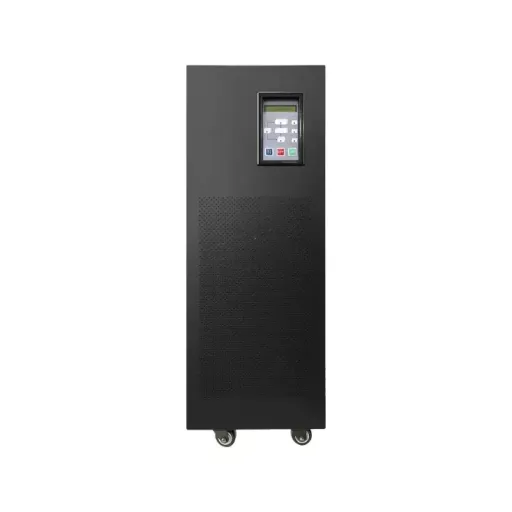
Industrial UPS vs commercial UPS: comparison table
Use this industrial UPS vs commercial UPS table as a requirements template. The columns describe questions to investigate, rather than promises about every product in either category.
| Decision | Controlled commercial installation | Industrial installation | Evidence to request |
|---|---|---|---|
| Environment | Confirm conditions inside the equipment room | Measure conditions at the cabinet location | Temperature limits, enclosure rating, ventilation requirements |
| Protected load | Identify IT, communication, or other critical circuits | Separate controls and instruments from large process loads | Load schedule, measured demand, startup behavior |
| Power architecture | Select topology and phase arrangement for the load | Select topology and phase arrangement for the load | Diagram, input/output ratings, operating modes |
| Fault response | Define acceptable interruption and recovery | Define process behavior during interruption and recovery | Overload curves, bypass limits, protection study |
| Battery | Define shutdown or bridging time | Define shutdown or bridging time | Runtime curve for the proposed battery and load |
| Service | Plan access, spares, and maintenance windows | Plan access, spares, and maintenance windows | Service scope, maintenance procedure, replacement terms |
The overlap is deliberate. Industrial UPS vs commercial UPS doesn’t mean reliable versus unreliable. It means checking which proposed system fits a particular operating environment and consequence of failure.
Schneider Electric’s critical power overview describes online UPS equipment for commercial and industrial settings, including single-phase and three-phase options. It also distinguishes controlled commercial environments from harsh industrial process environments. That supports an application-based comparison, rather than a rule that commercial UPS systems must be small or offline.
Need to narrow the options? Review Banatton Group’s UPS systems with your load schedule beside you, then request documents for the configurations that fit. A category listing is a starting point, not proof of suitability.
When a commercial UPS can meet the requirement
The first industrial UPS vs commercial UPS question is where the equipment will operate. An office, retail site, laboratory, or factory IT room may offer a controlled environment. A commercial system can be considered there if its documented limits match the load and site.
Don’t assume an industrial address requires the same UPS in every room. List temperature, moisture, dust, vibration, access restrictions, and supply conditions at each installation point. Record what happens when cooling or ventilation stops, not just the conditions during a normal shift.
Industrial UPS vs commercial UPS also depends on what must keep running. A process controller may need enough time for a controlled stop. A communications system may need continuity while another power source becomes available. A large motor circuit requires a separate load assessment; protecting the control circuit doesn’t automatically protect the whole machine.
Illustrative scenario: a factory IT room
A facilities team is comparing a UPS for network equipment in an air-conditioned room. The production floor outside is dusty, but the proposed cabinet sits in a separate space. The team measures that room’s conditions and defines the network’s shutdown needs before reviewing commercial and industrial options.
This industrial UPS vs commercial UPS scenario illustrates a decision process, not a Banatton customer result. The next step is to verify temperature limits, load ratings, alarms, and service access. No savings or uptime outcome is assumed.
Where the industrial case becomes stronger
Industrial UPS requirements become more specific when the equipment sits near heat, contamination, vibration, or a process that cannot tolerate a particular interruption. Ask for a documented solution to each condition. An industrial label alone doesn’t establish the enclosure rating or permitted operating temperature.
Falcon’s industrial-environment selection guide discusses how industrial locations differ from temperature-controlled spaces. Use that environmental distinction to frame your assessment; confirm the limits of the actual proposed model separately.
An industrial UPS vs commercial UPS shortlist should show the requirements each candidate meets, the conditions it cannot meet, and any installation changes needed. A cooler room or different cabinet location may change the choice, but those changes need their own scope and cost.
Industrial UPS vs commercial UPS: topology, phase, and isolation
Industrial UPS vs commercial UPS: topology, phase, and isolation
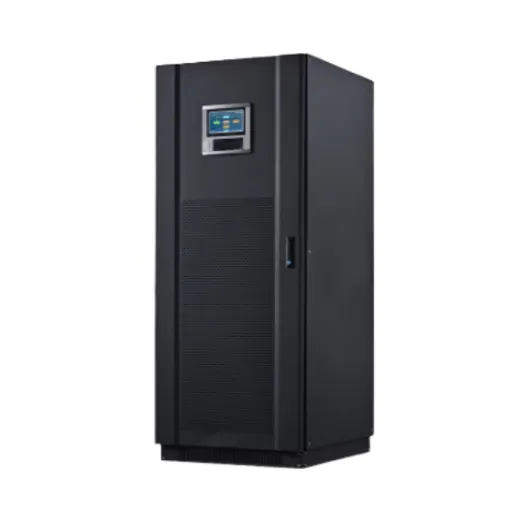
Keep three choices separate in an industrial UPS vs commercial UPS comparison: the application, the conversion topology, and the input/output arrangement. None of those terms can substitute for the other two.
Online UPS equipment uses a rectifier and inverter in its normal double-conversion path. However, product behavior depends on the operating mode and available power paths. Request a diagram showing normal operation, battery operation, static bypass, and maintenance bypass where fitted.
For industrial UPS vs commercial UPS proposals, ask which mode the supplier’s efficiency and transfer claims describe. A normal-mode statement must not silently become a promise covering every bypass or fault event. Record permitted transfer conditions and the protected equipment’s interruption tolerance.
Match phase arrangements to the installation
Confirm the incoming supply and the required output for each protected circuit. Three-phase input doesn’t by itself define an industrial system. Likewise, a single-phase load in a factory doesn’t become three-phase because the wider facility has a three-phase supply.
The three-phase online UPS listing is one product route to investigate. Request the exact model’s input/output configuration and current datasheet before including it in a tender.
Industrial UPS vs commercial UPS specifications should state whether the protected equipment needs AC or DC. This comparison concerns AC UPS proposals. A DC control-power requirement needs its own supply, battery, and load review.
Ask what isolation means
Power conditioning and galvanic isolation are distinct requirements. Don’t interpret double conversion as proof of a transformer-based isolation barrier. If isolation matters to your installation, request the circuit arrangement, transformer location where applicable, and grounding details for engineering review.
Industrial UPS vs commercial UPS quotations should also identify bypass sources and transfer conditions. Avoid a blanket promise of zero interruption during every fault. Ask what happens when the bypass source is unavailable, outside its permitted range, or not synchronized.
Capacity, overload, and batteries: compare the evidence
An industrial UPS vs commercial UPS rating comparison needs both real power in kW and apparent power in kVA. Check the proposed unit against both load requirements, then add the separately justified allowance for growth. Don’t substitute one rating for the other.
Eaton’s UPS sizing guide separates capacity from runtime and discusses growth and redundancy. Use those as separate inputs when requesting quotations. A larger battery doesn’t establish that the inverter can support a larger load.
Illustrative scenario: comparing parallel capacity
Assume, for arithmetic only, that eight compatible units are each rated 200 kVA and 160 kW. Their summed nameplate ratings are 1,600 kVA, or 1.6 MVA, and 1,280 kW, or 1.28 MW. Those are different units of measurement.
If one unit must remain spare, seven units provide an arithmetic total of 1,400 kVA and 1,120 kW. This industrial UPS vs commercial UPS example does not verify a Banatton model’s parallel limit or usable system rating. It assumes equal units and ignores installation limits that the supplier must document.
In an N+1 arrangement, N units are needed to support the load and one additional unit provides redundancy. Installed total capacity therefore isn’t automatically the load capacity available after losing a unit. Common bypass, battery, or distribution elements also need review.
Check the load events
Industrial UPS vs commercial UPS assessments should include startup, step changes, and fault behavior. Ask for the proposed unit’s overload duration and its response when that duration expires. Compare those conditions with the protected load, not with a different model’s marketing table.
Ask the design team to review protection coordination: which protective device operates during a downstream fault, and which healthy circuits remain supplied? A parallel feature or dual input doesn’t by itself answer that question.
Keep battery questions separate
For industrial UPS vs commercial UPS battery comparisons, specify the required runtime at a stated load. Request the battery type, quantity, configuration, temperature assumptions, and runtime curve. Also ask how aging is addressed in the proposed design.
Runtime is the time the battery supports the load under stated conditions. Service life concerns replacement over time. Warranty describes the supplier’s contractual coverage. No one of these establishes the other two, and an industrial label doesn’t prove a longer battery life.
Bring the evidence into the discussion. Use the industrial UPS category to identify candidate ranges, then ask for a model-specific runtime curve, overload data, and operating limits with your quotation.
Compare maintenance, cost, and quotations on the same basis
Compare maintenance, cost, and quotations on the same basis
Industrial UPS vs commercial UPS cost comparisons should include the installation and service scope. Purchase price alone leaves out batteries, cooling, electrical work, access, testing, and replacement requirements. Ask suppliers to price the same defined load and runtime requirement.
Request maintenance procedures, access clearances, spare-part availability, and the service terms applicable to your location. Clarify what can be serviced while the load remains supplied, and under which power-path conditions. Don’t assume every maintenance bypass arrangement provides equivalent protection.
An industrial UPS vs commercial UPS efficiency comparison also needs the operating mode, load level, battery-charging condition, and test basis. Request the curve for the selected configuration. A peak efficiency figure from another range isn’t a useful basis for estimating this installation’s energy cost.
Illustrative scenario: a control cabinet near production
A buyer receives two quotations for a cabinet serving process controls. One proposal has a lower equipment price, but neither includes the measured cabinet temperature or a defined shutdown interval. The buyer gathers those inputs and asks both suppliers to revise their scope.
This industrial UPS vs commercial UPS scenario makes no claim about which proposal wins. It shows why an apparently cheaper offer cannot be compared fairly while key requirements remain undefined. The decision follows the evidence and complete scope.
Send a usable request for quotation
For industrial UPS vs commercial UPS enquiries, provide:
- Installation location and measured environmental conditions.
- Supply voltage, frequency, phase arrangement, and available alternative sources.
- Protected circuits, measured kW/kVA, and relevant startup or load changes.
- Required runtime and the intended shutdown or source-transfer sequence.
- Acceptable interruption, redundancy objective, and maintenance constraints.
- Battery space, ventilation, monitoring, documentation, and service requirements.
The low-frequency industrial UPS listing and standby UPS listing represent different product routes. Review them only against their intended load and documented limits. Their presence in a catalog doesn’t establish suitability for a critical process.
For the wider selection process, use the industrial UPS selection guide. This comparison page focuses on choosing between application requirements, rather than reproducing the full sizing guide.
Frequently asked questions and your next decision
Is a commercial UPS always offline or line-interactive?
No. Commercial applications can use online UPS equipment, including three-phase systems. In industrial UPS vs commercial UPS comparisons, specify the topology of each candidate rather than assuming it from the application label.
Does an industrial UPS always need three-phase output?
No. The protected equipment determines the required output arrangement. Check its supply needs, the installation diagram, and the exact UPS configuration. The phase arrangement of the wider building doesn’t answer every individual circuit requirement.
Does double conversion guarantee complete electrical isolation?
No. Don’t treat conversion topology as proof of galvanic isolation. Ask for the proposed circuit and transformer arrangement when isolation is part of the requirement. Include grounding and bypass paths in that review.
Can eight 200 kVA units be described as 1.6 MW?
Not from that kVA rating alone. Eight times 200 kVA equals 1.6 MVA. If each unit is separately rated 160 kW, the summed real-power figure is 1.28 MW. Compatible parallel operation and usable capacity require additional verification.
Is an industrial UPS always worth a higher price?
No universal answer applies. Compare documented fit, installation changes, maintenance, battery replacement, service, and the consequences of interruption. A higher purchase price doesn’t establish better fit, and a lower price doesn’t establish acceptable protection.
Industrial UPS vs commercial UPS should end with a requirements-based choice. Compare the same environment, load events, runtime, fault conditions, and service scope. Keep unresolved requirements visible until a supplier provides matching evidence.
Ready to compare configurations? Contact Banatton Group with the request-for-quotation inputs above and ask for the exact model documents. Build the final decision around a verified configuration, not a category label.