 26Nov
26Nov

Industrial-grade UPS systems can withstand extreme temperatures, electrical noise, heavy motor loads, and unstable grid power. A true industrial-grade UPS system uses online double-conversion technology: incoming AC power is first converted to DC, then converted back to clean, stable AC power.
How Industrial UPS Systems Differ from Standard UPS Solutions
| Feature | Industrial UPS | Commercial UPS |
| Topology | Low-frequency UPS, online double-conversion | High frequency UPS or line-interactive UPS |
| Input voltage range | Very wide (165–280V phase-to-neutral) | Narrow (184–276V) |
| Overload capacity | 150% for 60+ seconds | 125–150% for 10–30 seconds |
| Parallel capability | Up to 8 units, non-fixed master-slave | 2–4 units, fixed master |
| Battery management | ABM (Autonomous Battery Management) | Basic float charging |
| Design life | 10–15 years | 5–8 years |
Industrial UPS systems also feature separable main and bypass inputs (two independent power feeds) and low-frequency design for motor and transformer startup surges.
Why Is Reliable Power Critical in Industrial Environments?
The Cost of Unexpected Downtime. A single voltage sag can trip a PLC or VFD. Getting the line back up may take hours, costing scrapped product, damaged equipment, idle workers, and missed deadlines.
Risks to Sensitive Equipment. Modern control systems (DCS, SCADA, PLC) are highly susceptible to interference. Even brief power fluctuations can lead to data corruption, component damage, or the triggering of false safety alarms.
Maintaining Operational Continuity. For hospitals, airports, and power plants, electricity is a safety necessity.
Key Features of an Industrial UPS
Online Double Conversion Technology. Isolates the load from the grid, eliminating sags, surges, spikes, frequency drift, and harmonics. Output is always pure, stable sine wave.
Low-Frequency Design. Handles motor starts and inrush currents that high-frequency UPS units struggle with. Essential for pumps, fans, compressors, and conveyors.
Features three-phase input and output with an independent bypass. This design balances the load and ensures efficient power delivery. The main input and bypass input are independent, supporting dual utility power feeds—allowing one to immediately take over if the other fails.
Intelligent Battery Management (ABM). Instead of constant float-charging, ABM rests batteries periodically. Result: longer battery life, fewer replacements, lower cost.
Parallel Redundancy and Scalability. UPS units can be paralleled for capacity or redundancy. In N+1, if one fails, the others instantly carry the full load.
High Overload Capacity. Handles inrush currents: 110% for 10 min, 150% for 60 sec, >160% for 200 ms.
Energy-Efficient Cooling. The intelligent fan control function adjusts fan speed based on load and temperature, thereby saving energy and extending the fan’s service life.
Product Spotlight: BT8000 Series Three-Phase Industrial UPS
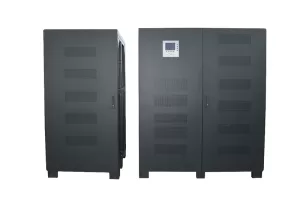
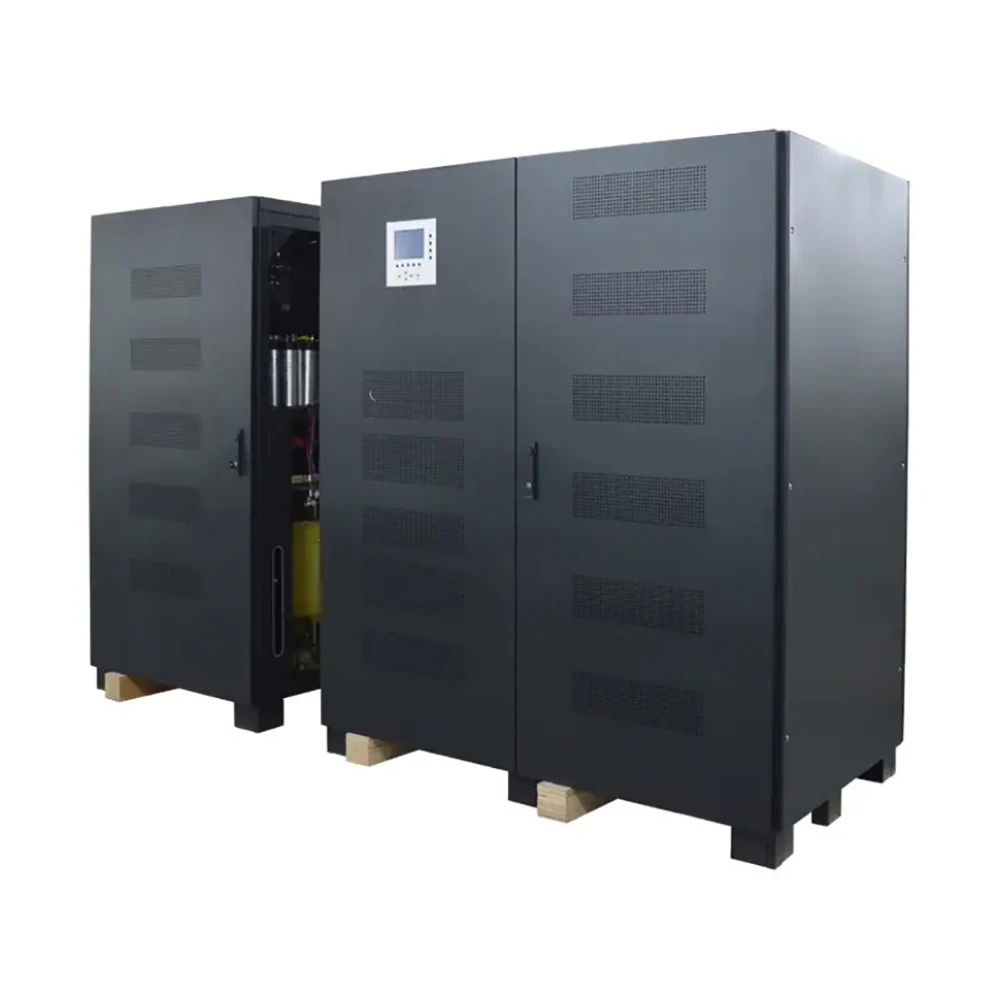
The BT8000 series embodies the features described above. It is an online double-conversion, low-frequency, three-phase input/output industrial UPS backup power for applications from manufacturing plants to military installations.
Power range spans 10KVA/8KW to 200KVA/160KW, with custom configurations up to 50KW, 200KW, and 500KW.
Key differentiators:
Separable main and bypass inputs – Two independent utility feeds for maximum reliability.
Low-frequency topology – Superior handling of motors, pumps, compressors, and transformers.
ABM battery management – Extends battery life by 30–50%.
Parallel capability up to 8 units – Non-fixed master-slave relationship. The first unit powered on becomes master; masters and slaves can interchange. If one unit fails, it shuts down automatically; the remaining units continue supplying the load.
High overload capacity – 150% for 60 seconds (inverter); 180% for 30 seconds (static bypass).
Intelligent fan control – Speed adjusts based on load and temperature.
Detachable design – Easier maintenance and resource conservation.
Green rectifier/inverter – Non-circulating current control for energy savings.
| Model | Capacity | Line/Battery Efficiency | Dimensions (D×W×H mm) | Weight (kg) |
| BT8030H-33 | 30KVA/24KW | 89%/90% | 656×405×941 | 145 |
| BT8060H-33 | 60KVA/48KW | 90%/91% | 975×554×1286 | 278 |
| BT8200H-33 | 200KVA/160KW | 92%/93% | 1051×705×1646 | 735 |
Benefits of Industrial UPS Systems for Critical Power Applications
Continuous power protection – Zero transfer time between utility, battery, and bypass modes.
Improved equipment reliability – Clean, regulated power reduces stress on downstream equipment.
Reduced downtime and maintenance costs – Fewer unplanned outages and longer battery life through ABM.
Enhanced power quality – THDV <2%(linear) / <5%(non-linear) actively improves delivered power.
Lower total cost of ownership – Energy efficiency (90–93% battery mode), intelligent fan control, detachable design, and longer battery life.
How to Choose the Right Industrial UPS
Determine your real power requirements – Measure both kW and kVA. For motor loads, account for starting inrush current. Use the crest factor (3:1 is typical) and overload tables. As a practical example, a 60KVA UPS can support approximately 48KW of continuous load while handling motor starting surges of up to 150% for 60 seconds.
Evaluate battery backup time. Extending runtime requires more battery capacity. Determine the duration you need—whether it is simply enough to handle common power outages or to start a generator.
Consider redundancy from the start. The N+1 parallel configuration adds an extra UPS module. Although the initial cost is high, the resulting improvement in reliability is worthwhile.
Assess environmental conditions. Make sure the UPS’s temperature rating, ingress protection, and physical dimensions fit your site.
Review efficiency and maintenance. A 1–2% efficiency difference adds up over 24/7/365 operation. A detachable design makes maintenance easier.
Conclusion
Industrial-grade UPS systems are designed to handle wide voltage fluctuations, heavy inductive loads, high overloads, and harsh environments, and offer extremely high reliability. Products such as the BT8000 series fully embody these characteristics, employing a power frequency topology, ABM battery management technology, parallel redundancy configuration of up to 8 units, and intelligent fan control function. With the right selection, industrial-grade UPS systems can protect critical processes, extend equipment lifespan, minimize downtime, and reduce long-term operating costs. Without such equipment, the resulting costs—including production losses, equipment damage, and safety risks—would far exceed the initial investment.
Frequently Asked Questions (FAQ)
How do I determine the correct UPS size for my facility?
Measure both kW and kVA—they are not the same. For motor loads, account for inrush current by using the crest factor (e.g., 3:1) and overload tables. Also plan for future expansion and N+1 redundancy.
Can industrial UPS systems operate in parallel?
Yes. The BT8000 series supports up to 8 devices, and the master-slave relationship is not fixed. If one unit fails, it shuts down automatically; the remaining units continue supplying the load.
Which industries benefit the most from industrial-grade UPS systems?
Manufacturing, oil/gas/petrochemical, hospitals, power generation, water treatment, airports, mining, defense, and semiconductor manufacturing.