 26Nov
26Nov

For a factory, a data center, or a hospital, a few seconds of power loss carries real consequences — scrapped product, dropped control signals, compromised safety systems. It is for this reason that the question of industrial UPS vs generator recurs so often: which solution does a facility actually require?
The two technologies serve different purposes. A generator produces power; an industrial UPS conditions it and ensures it never drops. Once these roles are understood, the rest of the decision follows naturally.
What Is an Industrial UPS and How Does It Work?
An industrial UPS (uninterruptible power supply) is positioned between the utility feed and the equipment that cannot tolerate interruption. Its function is not long-duration generation, but the delivery of clean, continuous power the instant the mains supply fails or becomes unstable.
Most industrial units employ an online double-conversion topology. The incoming AC is rectified to DC and then inverted back to AC, meaning the load is always powered through the inverter and never exposed to the raw, noisy input from the grid. The result is a pure sine-wave output with stable frequency and voltage, low distortion, and no trace of grid fluctuation.
These are three-phase systems. A typical industrial UPS system accepts a three-phase input and delivers a three-phase output, with a frequency that tracks the mains and remains stable even when the supply is absent.
How Does a Generator Work?
A generator is a source of power. A diesel or gas engine drives an alternator to produce AC electricity, and it operates for as long as fuel remains available.
The limitation is twofold: time and quality. A generator requires anywhere from several seconds to over a minute to start, stabilize, and accept the load. Its output is only as clean as the engine permits — voltage and frequency drift as the load varies. This raw output is precisely what sensitive equipment cannot accept.
Industrial UPS vs Generator: Key Differences at a Glance
The comparison reduces to four dimensions.
Response Time
An online double-conversion UPS transfers with zero interruption. The load is unaffected by the switch, and even the bypass path is solid-state and transfers instantly.
A generator must start, settle, and synchronize before it can accept the load. That interval, however brief, is sufficient to trip a control system or interrupt a process.
Power Quality
This is where the UPS is fundamentally stronger. Its inverter output is a pure sine wave with very low harmonic distortion and tight voltage regulation, holding the output stable even as the load varies.
A generator cannot match this. Its output tracks engine speed, so frequency and voltage vary with every load step. Delivering that directly into precision machinery invites premature wear and failure.
Backup Duration
A UPS is a bridge rather than a power source. Its runtime is determined by the battery bank, and that reserve exists to cover short outages — and to carry the load just long enough for a generator to start.
A generator, once running, can supply power for hours or days. The two technologies operate on different timescales.
Maintenance and Running Cost
A generator requires ongoing engine maintenance — oil, filters, cooling, fuel — and consumes fuel for as long as it runs. A UPS has few moving parts; its recurring cost is concentrated in the batteries, which proper management can extend significantly.
When to Choose an Industrial UPS
The clearest case is any load that cannot tolerate even a millisecond of interruption or a small percentage of voltage deviation. In such environments, the cost of downtime far exceeds the cost of the UPS itself.
This applies to industrial process control — manufacturing and control systems, industrial machinery, instrumentation and measurement, and process monitoring — where a clean, stable sine wave is a requirement rather than a preference. The same holds for critical infrastructure such as hospitals, airports, semiconductor facilities, water treatment plants, and power plants, and for heavy sectors including oil and gas, mining, and metallurgy. For all of these environments, a UPS power supply is the difference between continuous operation and a costly interruption.
When to Choose a Generator
A generator earns its place in extended-outage scenarios. Remote sites with unreliable grids, construction projects, and operations that must continue for long periods independent of the mains are the classic cases.
The trade-off is power quality. A generator alone is rarely adequate for loads that require tightly regulated voltage and frequency, which is why it is seldom deployed as the sole layer of protection on critical equipment.
Industrial UPS vs Generator: The Verdict for Your Facility
The practical answer is rarely a choice between the two. For most critical facilities, the technologies are designed to operate in sequence rather than compete.
A standard architecture covers both requirements: the utility feeds the UPS, which feeds the load continuously and conditions the power at every instant. If the mains fail, the batteries carry the load with zero interruption. The generator then starts, stabilizes, and takes over as the input source, while the UPS continues to condition its output until the grid is restored. Short outages are handled by the batteries; extended ones by the generator. Neither leaves a gap on its own.
This is also why redundancy and scalability should weigh heavily in any comparison. A UPS that can be paralleled — several units sharing a single load — allows capacity to grow with the facility and keeps the load running even if one unit fails.
Banatton Industrial UPS Systems: Engineered for Critical Loads
The principles described above are reflected directly in our own product line.
Banatton Group is a high-tech Industrial UPS Manufacturer focused on power-electronics core technology. By combining this expertise with innovative digital-technology R&D, the company delivers comprehensive solutions for data centers, smart power, and clean energy. The company serves customers in more than 100 countries and regions, supporting the digital and low-carbon transition across government, finance, industrial manufacturing, healthcare, public transportation, and the Internet industries.
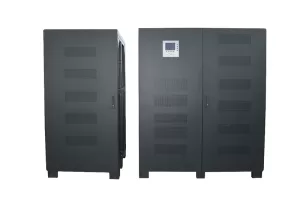
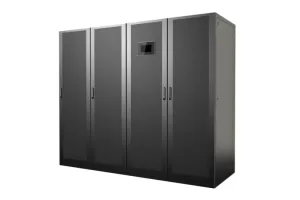
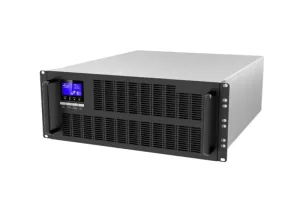
Our industrial UPS range is built around the online double-conversion topology described above. The three-phase series spans 10 kVA to 200 kVA, with nominal 3 × 380/400/415 VAC input and output, a pure sine-wave inverter output, total harmonic distortion below 2% on linear loads, and steady-state voltage regulation within ±1%.
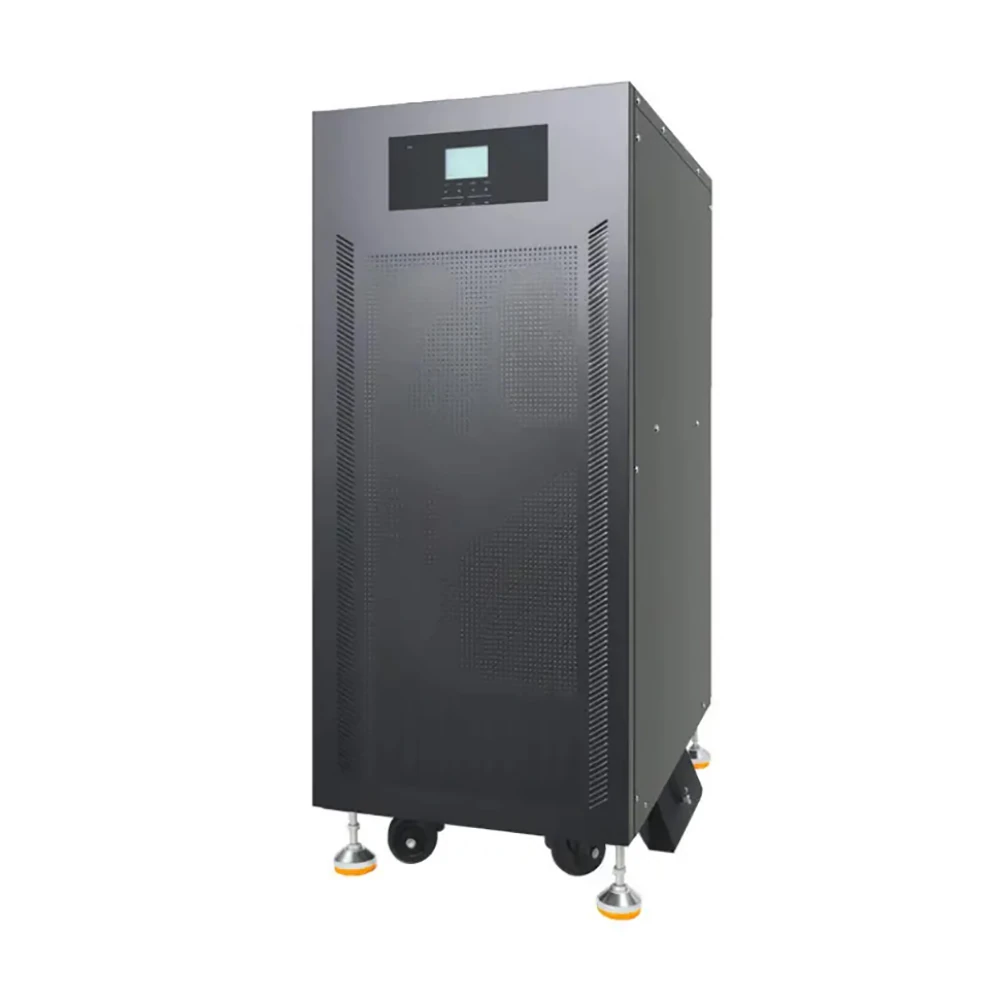
Several features deserve particular attention, as they are the ones that matter in operation:
- Reliability by design. The main input and bypass power supplies are separable, allowing two independent mains lines to be connected and improving output reliability.
- Smarter battery management. Intelligent battery management (ABM) and constant-current charging extend battery life, shorten charging time, and reduce maintenance.
- Redundancy and scalability. Up to eight units can be paralleled with an optional module, using a non-fixed master-slave relationship — if one unit fails, it shuts down automatically and the remaining units continue to power the load.
- Built for serviceability. A detachable design, intelligent fan-speed control that responds to load and temperature, and a maintenance bypass allow service without interrupting the load.
In terms of efficiency, line mode reaches 89% to 92% across the range and battery mode 90% to 93% — figures that translate directly into lower energy cost and reduced heat load.
Behind the products is a supply chain built for the task. Banatton is headquartered in Beijing, with manufacturing and R&D based in Guangdong Province, forming a digital, customized, and integrated supply chain that moves from R&D through to rapid production. Quality is managed end to end: the company operates under ISO9001, ISO14001, and ISO45001, implements ROHS environmental directives, and maintains professional quality-assurance teams and intelligent testing systems that track every unit from raw-material inspection through to delivery.
Conclusion
An industrial UPS and a generator are not competing answers but complementary halves of a single solution. The uninterruptible power supply delivers what a generator cannot: instant, clean, regulated power for loads that cannot blink. The generator delivers what a UPS cannot: hours of runtime when an outage persists. Combined, and supported by a system designed for redundancy and a manufacturer that stands behind it, they form the foundation of a facility that continues to operate through almost any disruption the grid presents.
Looking for a reliable power protection solution for your facility? Banatton offers industrial UPS systems designed for critical loads, with three-phase configurations, intelligent battery management, and scalable parallel operation. Contact our team to discuss your power requirements and find an industrial UPS solution suited to your application.
FAQs
What is the main difference between an industrial UPS and a generator?
A UPS conditions power and delivers it instantly without interruption. A generator produces power for extended durations but requires time to start and does not condition its output.
Can a UPS replace a generator?
No. A UPS rides through short outages on battery; a generator covers extended outages. The two are typically deployed together.
What is an online double-conversion UPS?
A topology in which the load is always powered through the rectifier-inverter path, isolating it from grid disturbances and producing a clean pure sine wave.
How long can an industrial UPS run on battery?
Runtime depends on battery-bank size. The UPS is designed to bridge short outages and cover the time required for a generator to start.
Why does power quality matter for industrial equipment?
Process and control equipment is sensitive to voltage and frequency variation. Poor quality causes downtime, data corruption, and premature failure.