 26Sep
26Sep

As data centers become more dependent on servers, networking equipment, storage systems, and other sensitive loads, the UPS needs to do more than provide backup power. It must deliver stable power, respond quickly to power interruptions, and allow the power system to adapt as the facility changes.
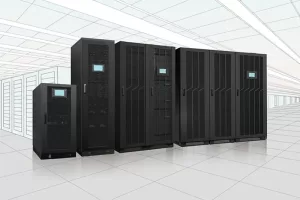
The BT9300-M Modular UPS is an online UPS designed for data center and IT infrastructure applications, with capacity configurations from 20kVA to 300kVA. Developed by Banatton Group, a Modular UPS Manufacturer specializing in power electronics and digital power solutions, the BT9300-M features a modular architecture, three-phase input and output, pure sine wave output, and flexible battery configuration for applications where continuous and stable power is required.
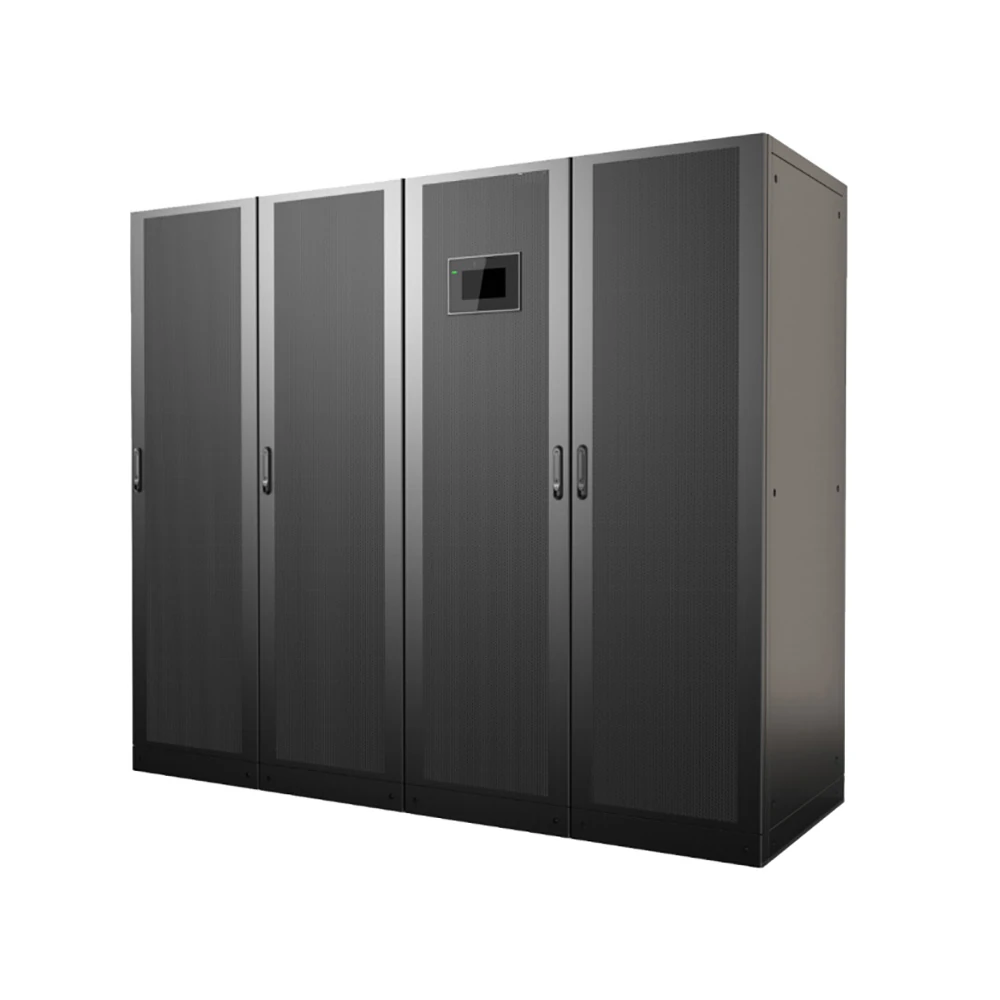
How the BT9300-M Modular UPS Supports Data Center Power Needs
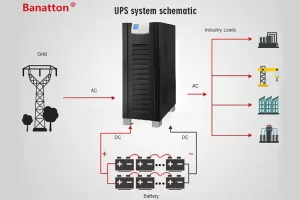
The BT9300-M uses an online double-conversion design with a 0ms transfer time. This means the UPS does not need a switching interval when the input power fails or moves outside the acceptable range. For data center equipment that is sensitive to power interruptions, this operating design provides continuous UPS output without a transfer delay.
The UPS also provides a pure sine wave output with an output power factor of 1. These characteristics are relevant to modern IT and electronic equipment because the UPS is designed to deliver a stable AC output while making full use of its rated power capacity.
For system control, the BT9300-M uses DSP-based full digital control technology. The system also supports distributed active parallel operation, allowing up to four UPS units to operate in parallel. This provides a practical way to build a larger power system without relying on a centralized bypass cabinet.
Modular Design and Capacity Flexibility
The main advantage of a modular UPS is that the power system can be built around individual power modules instead of relying on a single large UPS unit.
The BT9300-M series uses power modules rated at 20kW, 25kW, or 30kW, depending on the configuration. A cabinet can accommodate up to 10 modules, allowing the system to cover capacity requirements from 20kVA to 300kVA.
This structure is useful when power requirements may change over time. The UPS supports online capacity expansion, so additional modules can be added as the required capacity increases. The power modules are also hot-swappable, allowing a failed module to be replaced without shutting down the entire UPS system under supported operating conditions.
For data centers with changing loads, this modular approach can provide more flexibility than selecting a fixed-capacity UPS at the beginning of a project.
Efficiency and Power Quality
Efficiency and power quality are important when a UPS operates continuously. According to the product specifications, the BT9300-M achieves more than 96% efficiency at 50%–75% load and more than 95% at 25% load.
The UPS also has an input power factor of at least 0.99 and input THDi of no more than 3% at full load. Power factor describes how effectively electrical power is used, while THDi indicates the level of harmonic distortion introduced into the input current. Keeping these values within the specified range helps the UPS work with the incoming power supply in a more controlled way.
On the output side, the voltage regulation is specified at 380/400/415V ±1%. Output THDv is specified at no more than 2% with a linear load and 3% with a nonlinear load. These specifications are relevant when the UPS supplies electronic equipment that requires a stable power source.
The BT9300-M also supports generator access and provides short-circuit and over-voltage protection. Its overload capability is specified as 110% for up to one hour, 125% for up to 10 minutes, and 150% for up to one minute.
Maintenance and Battery Management
Maintenance is another consideration for a UPS installed in a data center or industrial environment. The BT9300-M uses a front-access design, which allows maintenance work to be carried out from the front of the cabinet.
The battery system can also be configured with different numbers of battery cells. The supported nominal battery voltages range from ±180V to ±300V DC, corresponding to 30 to 50 battery cells. This flexibility can be useful when the UPS needs to be integrated into different battery configurations or when an existing system is modified.
The online UPS also includes intelligent battery management. Each UPS module provides charging capacity of 4 × 5kW, with a specified maximum battery charging current of 18A. The battery management system automatically maintains the batteries to help extend battery service life.
BT9300-M Capacity Options from 20kVA to 300kVA
The BT9300-M series covers several cabinet configurations:
| Configuration | Cabinet Capacity | Power Module Capacity | Maximum Modules |
| BT990-M | 20–90kVA / 20–90kW | 20kVA / 20kW | 3 |
| BT9150-M | 25–150kVA / 25–150kW | 25kVA / 25kW | 5 |
| BT9180-M | 30–180kVA / 30–180kW | 30kVA / 30kW | 6 |
| BT9300-M | 30–300kVA / 30–300kW | 30kVA / 30kW | 10 |
This range allows the same modular UPS platform to cover different power requirements, from smaller installations to larger data center power systems.
Technical Specifications
| Item | Specification |
| Product Type | Online Modular UPS |
| Capacity | 20kVA–300kVA |
| Phase | 3-phase input / 3-phase output |
| Input Voltage | 380/400/415Vac |
| Input Voltage Range | 138–485Vac |
| Input Frequency | 40–70Hz |
| Input Power Factor | ≥0.99 |
| Input THDi | ≤3% at 100% load |
| Output Voltage | 380/400/415Vac ±1% |
| Output Power Factor | 1 |
| Output Waveform | Pure sine wave |
| Output THDv | ≤2% linear load; ≤3% nonlinear load |
| Transfer Time | 0ms |
| Efficiency | Up to >96% at 50%–75% load |
| Battery Voltage | ±180V to ±300V DC |
| Operating Temperature | 0°C to 40°C |
| Relative Humidity | 0–95% |
| Altitude | <1500m |
| Protection | Short circuit, over-voltage, reverse connection |
Where the BT9300-M Modular UPS Can Be Used
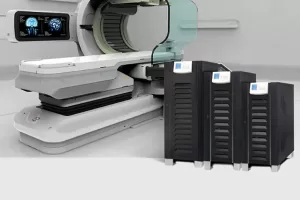
The BT9300-M is designed for applications where power interruptions can affect equipment operation or production. Its stated applications include:
- Medium and large data centers
- Workstations and departmental facilities
- Industrial automation equipment and SMT placement machines
- Transmitter stations and control rooms
- Medical equipment
- Factory production equipment
- Monitoring and security systems
- Information centers
- Mining, chemical, and petrochemical production equipment
For data center projects, the system can be configured as a Data Center UPS for centralized power protection. Its three-phase architecture also makes it suitable for Three Phase Online UPS applications in industrial and infrastructure environments.
Conclusion
The BT9300-M combines modular architecture with online UPS technology to provide a flexible power protection solution for data centers, industrial facilities, and other critical applications. Its configurable capacity, online expansion, front-access maintenance, and flexible battery configuration allow the system to adapt to different power requirements and operating environments.
If you are planning a new data center power system or upgrading an existing UPS installation, contact Banatton Group to discuss your capacity requirements and find a suitable BT9300-M configuration for your application.