 10Dec
10Dec

Why Choosing the Right UPS Matters in Heavy Industrial Applications
Power interruptions and voltage instability can have serious consequences in heavy industrial environments. Manufacturing plants, metallurgy facilities, oil and gas operations, mining sites, power plants, and water treatment systems all depend on continuous, high-quality power to keep critical equipment operating safely. Even a brief power disturbance can interrupt automated production lines, damage sensitive control systems, or lead to costly downtime.
For these applications, selecting the right Industrial UPS is not simply about backup power. It is about ensuring long-term equipment protection, operational reliability, and business continuity.
Among industrial users, one of the most common questions is whether a Low Frequency UPS or a High Frequency UPS is the better choice. Both technologies use online double-conversion technology to provide uninterrupted power, but they differ significantly in their circuit design, operating characteristics, and application scenarios.
This article compares the two technologies and explains which solution is better suited for demanding industrial environments.
What Is a Low Frequency Online UPS?
A Low Frequency UPS (also called a line-frequency UPS) is built around traditional power conversion technology. Its design typically includes a thyristor (SCR) rectifier, an IGBT inverter, a static bypass, and a line-frequency isolation transformer operating at the standard 50/60 Hz utility frequency.
Like other online UPS systems, it uses double-conversion technology to continuously convert incoming AC power to DC and then back to clean AC output. This process isolates connected equipment from voltage fluctuations, frequency variations, electrical noise, and other power disturbances.
Because of its transformer-based architecture, a low frequency online UPS is widely used in applications where power reliability, overload capability, and equipment protection are more important than minimizing system size.
Typical industries include:
- Manufacturing and industrial automation
- Metallurgy and steel production
- Oil and gas facilities
- Mining operations
- Power generation
- Water treatment plants
- Military installations
- Transportation infrastructure
What Is a High Frequency UPS?
A High Frequency UPS also adopts an online double-conversion topology but uses high-frequency IGBT rectifiers and advanced digital control technology instead of traditional SCR rectifiers.
The higher switching frequency allows manufacturers to reduce the size of magnetic components, making the system more compact and lightweight. Modern high frequency UPS systems also achieve excellent input power factor correction and low input harmonic distortion, improving energy efficiency and reducing the load on upstream electrical infrastructure.
Because of these advantages, high frequency UPS systems are widely used in commercial buildings, offices, data centers, communication rooms, and other environments where space efficiency and modular expansion are important.
Low Frequency UPS vs High Frequency UPS: Key Differences
Although both technologies provide continuous power protection, their design priorities are different.
Reliability and Surge Resistance
Reliability is often the most important consideration for heavy industrial applications.
Low frequency UPS systems typically use SCR rectifiers, a technology that has been widely applied in industrial power electronics for decades. SCR devices are known for their strong current surge resistance and stable performance under demanding operating conditions.
High frequency UPS systems use IGBT rectifiers, which offer faster switching speeds and higher efficiency. However, IGBT devices generally operate within stricter voltage and current ranges and may have lower tolerance to severe electrical surges compared with SCR-based designs.
For industrial environments with frequent load changes or harsh electrical conditions, many engineers continue to prefer low frequency UPS systems because of their proven reliability.
Isolation and Equipment Protection
One of the most significant differences between the two technologies is transformer isolation.
A low frequency UPS incorporates a line-frequency isolation transformer that helps isolate connected equipment from electrical disturbances while improving protection against abnormal operating conditions.
Many high frequency UPS systems adopt transformerless designs to reduce weight and improve efficiency. While this approach offers important advantages in commercial environments, transformer isolation remains valuable in many industrial applications where maximum equipment protection is required.
Overload and Short-Circuit Capability
Heavy industrial equipment often places demanding loads on power systems.
Large motors, industrial machinery, pumps, compressors, and manufacturing equipment may experience temporary overload conditions during startup or production.
Low frequency UPS systems are generally recognized for their strong overload capacity and short-circuit protection, making them suitable for applications with high inrush currents and demanding electrical environments.
High frequency UPS systems also provide overload protection but are typically optimized for applications where efficiency, compact size, and modularity are higher priorities.
Efficiency and Input Power Performance
High frequency UPS systems have advantages in power quality at the input side.
With advanced power factor correction technology, many high frequency UPS units achieve an input power factor close to 0.99 while maintaining low input harmonic distortion. This reduces the impact on generators and upstream power distribution systems and can lower installation costs in some projects.
Low frequency UPS systems traditionally prioritize robustness and system reliability. Although they may have lower efficiency than transformerless designs, they continue to be selected where operational stability is considered more important than achieving the highest possible efficiency.
Installation and Maintenance
Because they include line-frequency transformers, low frequency UPS systems are generally larger and heavier than comparable high frequency models.
High frequency UPS systems are more compact and easier to install in locations where floor space is limited. Their modular architecture also simplifies future capacity expansion and online maintenance in many commercial installations.
For industrial facilities with sufficient equipment rooms and demanding operating requirements, however, the larger footprint of a low frequency UPS is often considered an acceptable trade-off for enhanced protection and reliability.
Which UPS Is Better for Different Applications?
The choice depends on the operating environment and the priorities of the project.
Low frequency UPS systems are commonly selected for:
- Heavy manufacturing plants
- Metallurgy facilities
- Mining operations
- Oil and gas projects
- Power generation
- Water treatment plants
- Industrial automation systems
- Military and transportation infrastructure
High frequency UPS systems are often preferred for:
- Office buildings
- Commercial facilities
- Data centers
- Telecommunications rooms
- IT infrastructure
- Applications where space savings and energy efficiency are primary considerations
Rather than asking which technology is universally better, buyers should evaluate the actual operating conditions, required reliability level, load characteristics, and long-term maintenance requirements of their project.
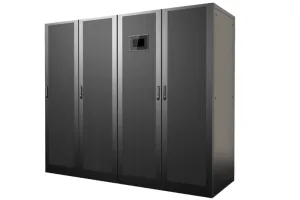
Features of Our Three-Phase Low Frequency Industrial UPS
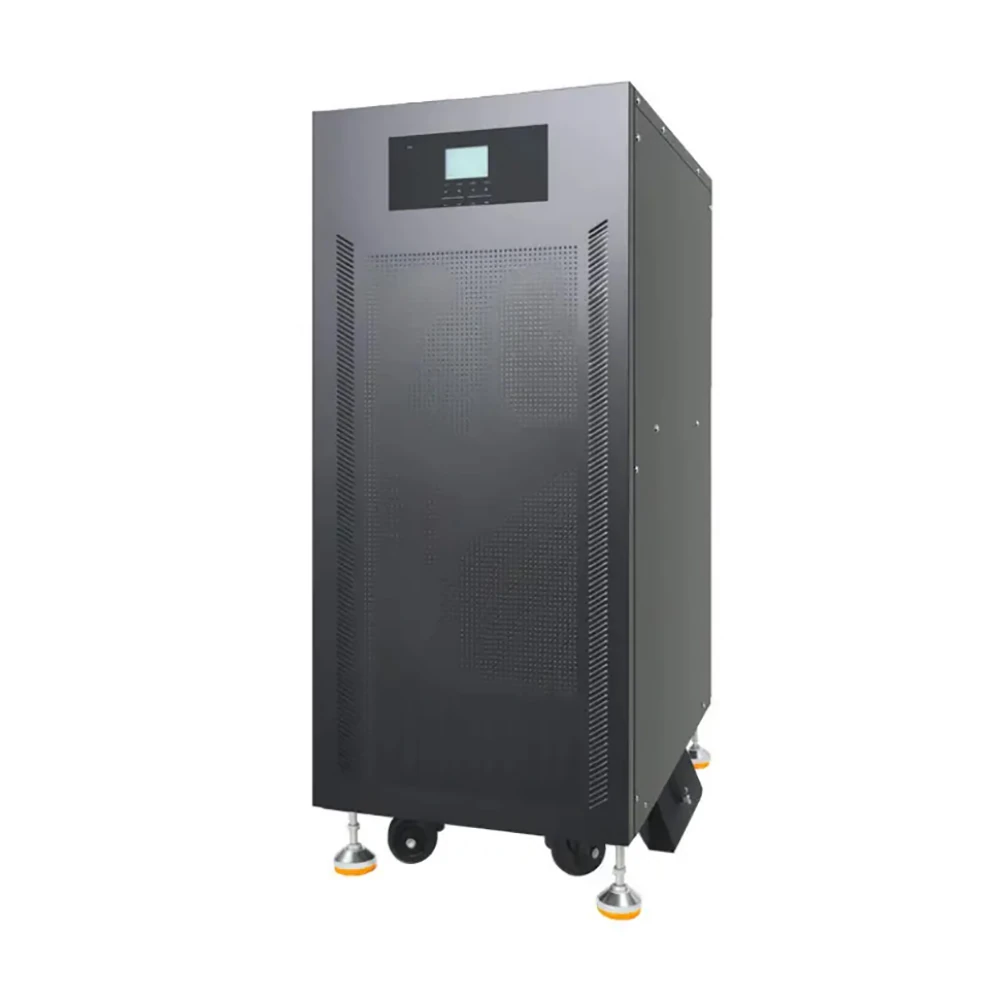
After comparing the characteristics of low frequency and high frequency UPS systems, it is easier to understand what features are most valuable in demanding industrial environments. The following industrial-grade UPS incorporates online double-conversion technology, high system reliability, and flexible scalability to support critical applications across manufacturing, energy, infrastructure, and other heavy industries.
Online Double Conversion Power Protection
The system adopts an online double-conversion topology that completely isolates connected equipment from power grid disturbances.
It delivers a pure sine wave output with stable voltage and frequency while filtering electrical noise and minimizing the impact of voltage fluctuations. This helps provide reliable power for industrial machinery, process control systems, instrumentation, and other critical equipment.
Dual Power Inputs for Higher Reliability
The UPS supports separate main input and bypass input connections, allowing two independent utility power sources to be connected.
This dual-input configuration improves output power reliability and provides additional protection for mission-critical industrial applications.
Intelligent Battery Management
The system incorporates Intelligent Battery Management (ABM) technology to help optimize battery performance.
Advanced constant-current and constant-voltage charging automatically manages battery charging, helping extend battery service life, shorten charging time, and reduce maintenance requirements.
Parallel Expansion for Increased System Availability
As power demand grows, the UPS supports parallel operation of up to eight units through an optional parallel module.
Its non-fixed master-slave architecture allows the system to automatically adjust if one UPS unit experiences a fault. The remaining units continue supplying power to the connected load, improving overall system reliability and scalability.
Designed for Industrial Operation
The UPS is available in capacities from 10 kVA to 200 kVA, supporting three-phase input and three-phase output.
It provides:
- Pure sine wave output
- Zero transfer time through the static bypass
- High overload capability
- Intelligent fan speed control for efficient cooling
- Detachable design for easier maintenance
- Clean power output with voltage regulation and noise filtering
These features make it suitable for continuous operation in demanding industrial environments where stable power quality is essential.
Typical applications include manufacturing control systems, industrial machinery, process monitoring, hospitals, airports, semiconductor facilities, water treatment plants, power stations, metallurgy, petrochemical plants, mining operations, and military installations.
Conclusion
Both Low Frequency UPS and High Frequency UPS technologies provide reliable online power protection, but they are designed to meet different operational needs.
High frequency UPS systems offer compact size, high input power factor, and efficient operation, making them well suited for commercial buildings, IT infrastructure, and other space-sensitive applications.
For heavy industrial environments, however, reliability, overload capability, equipment protection, and long-term operational stability are often the highest priorities. In these situations, a Low Frequency Online UPS with transformer isolation and industrial-grade design remains a dependable solution for protecting critical equipment and maintaining continuous operations.
By understanding the strengths of each technology and matching them to the specific demands of your application, businesses can select an Industrial UPS that delivers the level of performance, reliability, and protection their operations require.
FAQ
Q1. What is the main difference between a Low Frequency UPS and a High Frequency UPS?
The main difference lies in their circuit design. A Low Frequency UPS typically uses an SCR rectifier and a line-frequency isolation transformer, while a High Frequency UPS uses an IGBT rectifier and is usually transformerless. These design differences affect reliability, size, efficiency, and application suitability.
Q2. Is a Low Frequency UPS better for industrial applications?
For many heavy industrial environments, a Low Frequency UPS is often preferred because it offers strong overload capability, transformer isolation, and reliable performance for critical equipment. However, the best choice depends on the application’s power requirements and operating conditions.
Q3. Which industries commonly use Industrial UPS systems?
Industrial UPS systems are widely used in manufacturing, metallurgy, oil and gas, mining, power generation, water treatment, hospitals, airports, semiconductor facilities, and other applications that require continuous and stable power protection.