 26Sep
26Sep

In modern manufacturing environments, Computer Numerical Control (CNC) machine tools have become the backbone of precision production. These machines rely on stable and uninterrupted power to operate accurately and efficiently. Even a brief power outage can lead to errors, component damage, or costly downtime. This is where three-phase industrial-grade CNC machine tools play a crucial role.
I. Why Do CNC Machine Tools Need Three-Phase Industrial UPS?
At its core, a UPS is a device that provides backup power during power failures. It fills the gap until a generator or mains grid is restored. Industrial three-phase UPS systems take this concept to heavy-duty applications. Unlike single-phase devices suitable for office environments, three-phase UPS provide power via three-phase AC. They support the high-voltage, high-capacity loads common in factories.
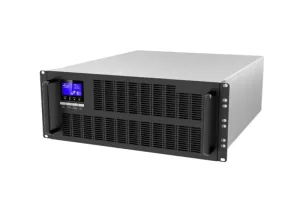
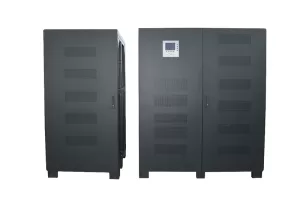
Banatton UPS systems typically range in voltage from 10 kVA to 500 kVA. They employ a three-phase input and output configuration to meet the power requirements of large machinery. An online double-conversion topology is a common design. It rectifies the input AC power to DC power. It then reverses the power supply back to a clean AC output. This isolation from grid anomalies ensures zero transmission time during power outages. This feature is crucial for CNC machine tools that cannot tolerate even milliseconds of downtime. Many models integrate isolation transformers to enhance surge protection and harmonic filtering, making them ideal for noisy industrial environments.
Lithium-ion battery series are gaining increasing attention for their durability and fast charging. Runtime varies from minutes to hours depending on the load and battery pack. For example, a 10 kV online UPS may have a built-in battery. These batteries can be expanded with external battery packs, providing scalable backup for different production scales.
II. Why Choose a Three-Phase Industrial UPS for CNC Machine Tools?
CNC machine tools are not only power-hungry; they are sensitive. They typically pull non-linear loads. These loads have high peak factors, meaning peak values can reach 3-4 times the effective value. This behavior is caused by servo motors, spindles, and variable speed drives. Brief power outages can cause spindle misalignment. This can lead to tool damage or controller data loss. These problems can result in high downtime costs, estimated at thousands of dollars per hour in high-volume stores.
Regenerative braking in CNC systems occurs when the motor feeds energy back to the power supply. This process can cause voltage spikes. These spikes can overwhelm standard UPS equipment. Dedicated industrial UPS systems can handle these regenerative loads without derating, maintaining stable output even under impact.
- Power Stability: CNC machine tools require stable, unfluctuating power. Three-phase industrial UPS systems ensure uniform power distribution, reducing the risk of interruptions that could affect machining accuracy.
- Load Handling: Three-phase systems can handle higher loads than single-phase systems. CNC machine tools typically have high power demands, which three-phase UPS systems efficiently meet.
- Reduced Electrical Noise: CNC machine tools are sensitive to electrical noise, which can affect their operation. Dedicated UPS systems minimize these disturbances, thereby improving machine performance.
- Longer Backup Time: In the event of a power outage, a dedicated three-phase UPS system can provide longer backup power. This allows CNC to continue operating without interruption. This continuous operation is crucial for preventing production losses.
- Surge Protection: These UPS systems are typically equipped with surge protection. This feature protects the precision electronic components in CNC machine tools from power surges. These spikes can cause damage.
- Extended Equipment Lifespan: UPS filters power fluctuations and peaks. This reduces wear and tear on CNC electronics and motors, extending mechanical lifespan.
- Beyond Backup, Achieving Operational Excellence: Investing in a three-phase UPS for CNC machine tools yields benefits far exceeding downtime survival. It reduces unplanned downtime by 99%, protecting against $50 billion in global costs annually related to power-related manufacturing losses. For CNC shops, this translates to longer tool life, lower scrap rates, and compliance with ISO power quality standards.
Energy Savings Reduce Utility Costs—Online UPSs with ECO mode can achieve 96% efficiency under light loads. Furthermore, data logging helps optimize processes, identify power consumption patterns, and better schedule operations. In regenerative systems, it prevents grid feedback penalties from utilities.
III. Choosing the Right Three-Phase UPS for CNC Machine Tools?
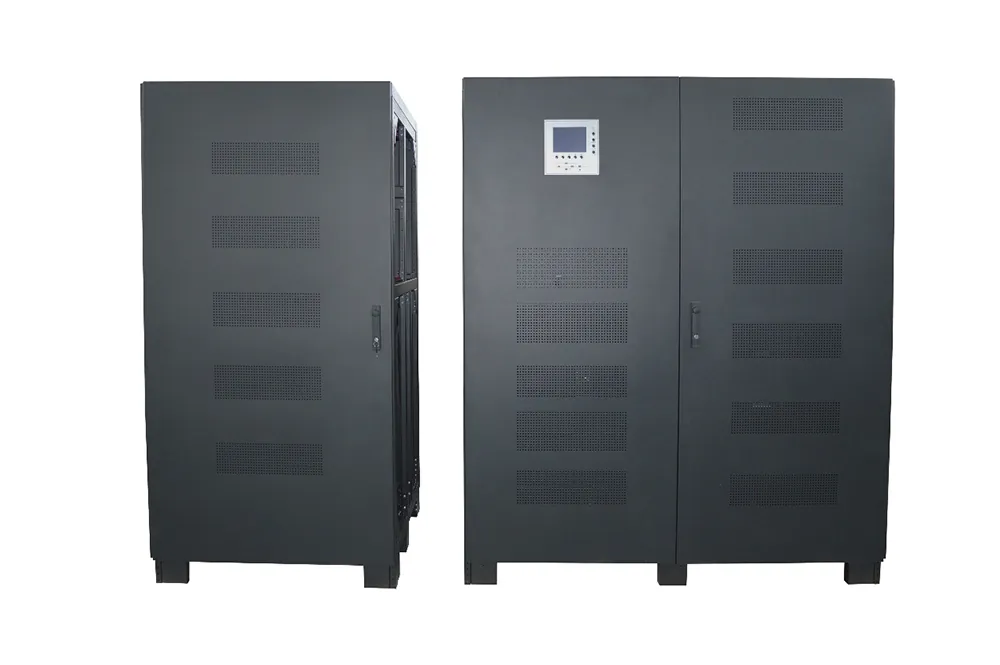
Choosing the right three-phase industrial UPS for CNC machine tools requires considering several factors to ensure optimal performance and protection.
- Power Rating: Determine the total power requirements of your CNC machine tools. Calculate the required power, considering all machines that will be connected. Choose a UPS with a power rating slightly higher than this total power.
- Output Waveform: Select a pure sine wave output. Many CNC machine tools require clean power to operate effectively; a pure sine wave ensures compatibility and smooth operation.
- Runtime/Backup Time: Evaluate the time the UPS will need to keep the CNC machine tools running during a power outage. Consider your production schedule to determine the optimal battery life.
- Input/Output Voltage: Ensure the UPS voltage matches your CNC machine tool specifications (e.g., 380V/400V). Compatibility is crucial for proper operation and efficiency.
- Scalability: Consider future expansion plans. Modular designs or larger capacity UPSs can accommodate more machines or increased loads.
- Features and Protection: Evaluate additional features such as surge protection, noise filtering, and remote monitoring network management interfaces. These features enhance overall reliability and performance.
- Regular Maintenance: Once selected, a regular maintenance plan should be established to ensure the UPS remains functional and at optimal calibration.
- Testing and Verification: After installation, use a CNC machine tool to test and verify the UPS performance under load conditions.