What makes uninterruptible power supply indispensable to modern electrical equipment?
In an era when enterprises rely on continuous power supply, blackouts, voltage fluctuations and surges will pose costly threats. From data centers to medical equipment, even a few seconds of interruption will cause economic losses and irreversible damage.70% of industrial facilities face monthly power disruptions, costing $ 200,000 on average. Uninterruptible power supply is the most effective relief method-generators can’t provide immediate power. [source: Schneider Electric Cost of Downtime]. This is the highlight of Uninterruptible Power Supply (UPS) shines—a solution to keep the electrical equipment running seamlessly when there is power failures. But what exactly is a UPS power supply, how does it work, and why is it a must-have for industries? This guide breaks down the core of UPS systems, their key advantages, specs, applications, and data-backed insights.
What isUninterruptible Power Supply (Uninterruptible Power Supply)?
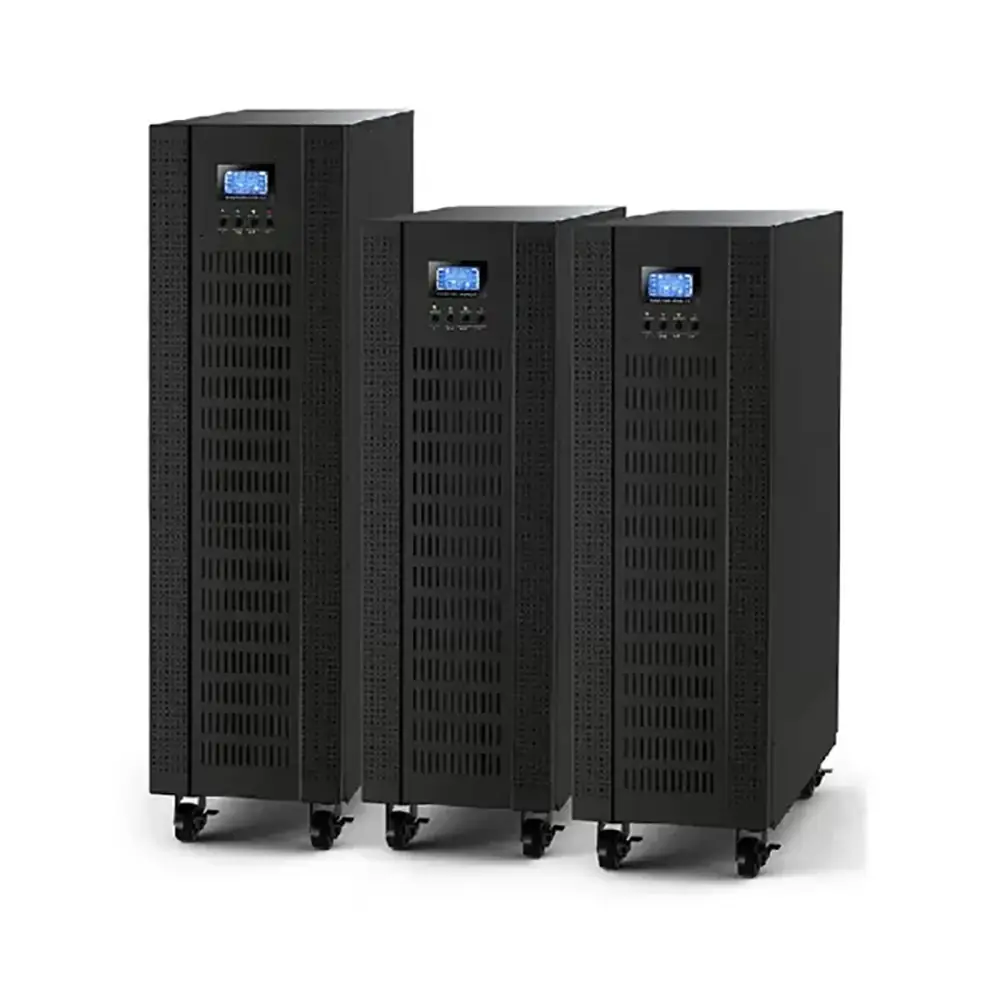
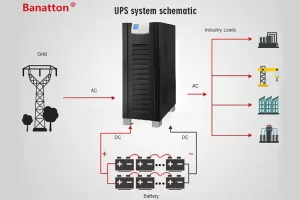
Uninterruptible Power supply (UPS power supply) provides instant backup power for electrical equipment in case of power failure, voltage sag or surge. Unlike generators that require start-up time, UPS systems can be switched to battery power supply in a few milliseconds with zero interruption.
Our UPS power supply uses high frequency and true double conversion technology-constantly converting alternating current into DC, and then back to alternating current to obtain stable and clean power. With DSP (digital signal processing) technology, it ensures the highest performance for sensitive electrical equipment. In addition to backup, it can also act as a power regulator, filtering noise and correcting voltage irregularities, which is very important for operations that can not stand downtime.
Unique advantages of our UPS power supply.
1. Excellent power quality and performance.
Real double conversion eliminates voltage fluctuations; DSP technology enables instant grid response, vital for data centers and medical devices where micro-interruptions risk data loss or safety hazards.
2. Energy efficiency and cost savings.
When the power grid is stable, the ECO mode can reduce energy consumption by as much as 30%. Active power factor correction (all phases) minimizes waste, meeting global efficiency standards.
3. Flexibility and reliability
A wide input voltage range (110-300 VAC) is suitable for unstable power grids. The compatibility of dual power inputs and generator increases redundancy, ensuring uninterrupted operation during long power failure.
4. Advanced battery management
The battery life can be extended by 50% and the maintenance costs can be reduced by extending the charging in-3 stage. Adjustable battery quantity and customized backup time; Maintenance bypass allows maintenance without turning off the electrical equipment.
5. remote monitoring and security.
The communications of SNMP+USB+RS-232 realizes the real-time remote monitoring of UPS power status and battery health. Emergency power failure adds a layer of safety guarantee for fast shutdowns.
Specifications of product
specification
details
core technology
High-frequency true double conversion; Digital signal processor
Input voltage range
110-300 V AC.
Output power factor
0.9.
Power factor correction
active (all phases).
Frequency mode
50 Hz/60 Hz converter.
operation Mode
Energy Saving, Standard, Bypass.
power supply input
Double.
Safety features
Emergency power failure; Maintenance Bypass
compatibility
Generator-compatible.
communication
SNMP+USB+RS-232.
Battery management
3 stage charging; Adjustable Battery Count
certification
ce certificate (no: m.2021.206.C 67628).
Key Applications of UPS Systems.
1. Data centers and information centers.
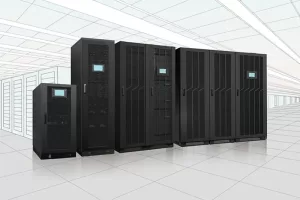
Medium/large data centers rely on UPS power supply for centralized workstation power, shielding servers and storage from costly outage-related data loss.
2. industrial automation and manufacturing.
Industrial automation equipment, SMT placement machines, and factory lines use UPS systems to maintain production consistency, avoiding ruining batches from fluctuations.
3. Health care and medical facilities.
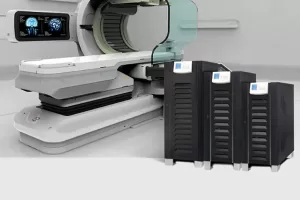
The transmitting stations, control room and medical equipment (MRI machine, ventilator) rely on uninterruptible power supply to protect the safety of patients during power failure.
4. Safety and heavy industries.
The monitoring/safety systems requires 24/7 power supply to prevent violations. Mining, chemical and petrochemical equipment use UPS power supply to avoid accidents caused by power failures.
Real-World Project: Uzbekistan Oil Group Data Center.
We provided 80 KVA uninterruptible power supplies, 30 KVA uninterruptible power supplies, 20 KVA uninterruptible power supplies and 12 lead-acid batteries of 200 AH/250 AH. UPS system has withstood the fluctuation of power grid and protected sensitive petroleum exploration data.
How to select the right UPS power supply?
1. Calculate Power Needs: Sum your Electric Equipment’s total power consumption; Choose a 20-30% higher UPS power capacity for future growth.
2. Determine the backup duration: a smaller units (20 KVA/30 KVA) provides 5-30 minutes; Larger models (80 KVA) can last for several hours with additional batteries.
3. Check the compatibility: choose the reinforced UPS systems in harsh environment; If the standby time needs to be extended, ensure the compatibility of generators.
4. Verify Certification: Choose CE-certified models; Determine the priority of multiple communication interfaces to facilitate monitoring.
UPS capacity and backup duration chart.
uPS capacity
50% load standby
80% load standby
Typical applications.
20 kVA
4 hours
2.5 hours
small data centers and clinics.
30 kVA
6 hours
3.5 hours
Industrial lines, mid-sized offices.
80 kVA
12 hours
7 hours
large data centers and petrochemical plants.
With extra/higher AH batteries, the backup duration is extended.
Frequently asked questions about uninterruptible power supply (UPS power supply).
Q 1: What are the advantages of an online UPS?
A 1: continuous power supply, high quality output and power failure protection. Our true double-conversion UPS systems deliver maximum protection via constant power regulation.
Q 2: How long can 2: UPS supply power?
A 2: The Duration depends on the power capacity and load of the UPS. Small shares last for 5-30 minutes; Larger models (80 KVA) can run for several hours with a suitable batteries.
Q3: Do I need to maintain the UPS?
A3: Yes-test the batteries regularly, replace it every 3-5 years, and keep the UPS power supply clean and properly ventilated.
Q 4: What should I do if my UPS battery is dead?
A 4: The Uninterruptible Power Supply won’t provide backup but may still act as a surge protector until battery replacement..
Sum up
Uninterrupted power supply (UPS) is an important investment for modern enterprises. Our UPS power supply has real double conversion, DSP technology and energy-saving characteristics, which provides reliability for electrical equipment in all walks of life.Backed by CE certification, the success of the real world (for example, Uzbekistan Oil Group Data Center), and outage cost-saving data, it ensures smooth operations.
Don’t let power outage affect your business-choose a UPS system with a balance of performance and practicality.
An uninterruptible power supply (UPS) is an electrical device that provides emergency power to loads when the main power source (usually utility power) fails. When...
Today, businesses rely heavily on uninterruptible power to protect their critical infrastructure. To meet this demand, modular uninterruptible power supply (UPS) systems are becoming increasingly...
An industrial UPS is a device that provides temporary power to large electrical equipment during power outages. Because it uses three-phase power, which is common...
The supply of electricity has brought us great convenience and provided energy security for social development, people’s livelihoods, and industrial growth. However, power supply has...