 26Sep

What Is a Dual-Input UPS?
A dual-input UPS is an Uninterruptible Power Supply whose main input and bypass input are wired to two separate power sources rather than a single feed. To understand why that distinction matters, it helps to picture how a conventional UPS is connected.
In an ordinary single-input unit, the rectifier — the stage that draws power to keep the unit running and charge the batteries — and the static bypass share the same incoming line. There is only one cable bringing power into the machine. A dual-input design breaks that dependency: the main input power and the bypass power are separable, so two independent mains lines can be connected to the same unit. The machine has two distinct electrical paths in, each with its own job.
The second input is not a spare socket or a cosmetic extra. It is a live, independent bypass source that the UPS can switch to automatically. The moment the main feed fails, the unit carries the load first on battery power, and later — if the outage outlasts the battery — onto that second mains line through the bypass. The load is never left with only a failed line to fall back on.
Why a Second Input Changes Everything
The value of this architecture comes down to a single idea: it removes a single point of failure.
In a single-input UPS, one fault on the supply line — a tripped breaker, a blown feeder, a loose connection — removes both the conversion path and the bypass path at the same time. When the one cable goes dead, there is no second route for the load, and the unit is reduced to waiting out the outage on its batteries. That is a fragile position for equipment that cannot be allowed to stop.
A dual-input UPS keeps a second, independent feed alive, so the loss of one line does not strip the unit of its protection. And this is not a theoretical benefit. Many industrial sites already have more than one incoming supply available — a primary utility feed and a second feeder from another substation, or a utility line alongside a generator-backed circuit. The dual-input arrangement simply lets a single unit use both of them, turning infrastructure that is often already on site into real redundancy.
The payoff shows up in how an outage actually plays out. Suppose the primary line fails. The UPS transfers to battery mode seamlessly — the inverter keeps running through the event, so the load never sees the fault. If the outage lasts longer than the batteries, the unit then transfers to the bypass on the second mains line instead of dropping the load. From start to finish, the output stays alive, which is exactly what a dual-input design exists to guarantee.
Why Industrial Systems Rely on Dual-Input Protection
Every UPS protects against power problems, but the dual-input feature matters most in the industrial world, where a dropped load is measured in damaged product, stalled production lines, and unsafe conditions rather than minutes of inconvenience.
Industrial processes — a running manufacturing line, a process-control system, a safety circuit, or instrumentation on a continuous process — cannot be left dependent on a single supply path. A fault anywhere on that path stops the process and may leave equipment in an unsafe state.
Two independent inputs mean the failure of one feed does not, by itself, interrupt the output. This is particularly important for:
- Continuous production lines: Help prevent power interruptions from disrupting manufacturing operations or affecting product quality.
- Process-control systems: Maintain power to control equipment that monitors and regulates industrial processes.
- Safety circuits and instrumentation: Support the continued operation of critical monitoring and protection equipment.
- Critical plant equipment: Reduce dependence on a single power supply path.
This is the same logic that leads industrial facilities to feed critical equipment from two separate sources in the first place, and the dual-input industrial UPS brings that logic inside the power protection equipment itself.
The arrangement also supports a practical reality of plant life: maintenance has to happen without stopping production. Because the bypass runs on its own feed, a dual-input unit can be serviced while still protecting the load. In practice, this allows:
- Separate input maintenance: Work on one input path while the system continues to draw power from the other, provided the power arrangement supports this operation.
- Interruption-free servicing: Use the maintenance bypass to isolate the UPS for servicing without dropping the connected load.
- Continuous plant operation: Carry out necessary maintenance without requiring a complete production shutdown.
For a plant that runs around the clock, that is the difference between a power system that can be maintained and one that has to be shut down to be touched.
What to Look For in a Dual-Input UPS
Not every unit labelled “dual-input” delivers the redundancy described above. A few specifications separate a genuine dual-input design from one that merely has two terminals on its cabinet.
The first is that the inputs must be truly separable. The datasheet should state plainly that the main input and the bypass input can be fed from independent sources, with each input carrying its own voltage rating. The bypass in particular should have its own acceptable voltage window — typically a wide range that lets it ride through a disturbed or degraded second line rather than refusing to transfer.
The second is transfer behaviour. A dual-input unit is only as good as the switch between its feeds, so the transfer to bypass should be effectively zero-time and microprocessor-controlled, ensuring a move between sources never interrupts the load.
Finally, look at the battery management and efficiency figures. The battery is the bridge that carries the load during the gap between the two inputs, so intelligent battery management that keeps it healthy and ready matters more here than on a single-input unit. And because an industrial UPS runs for years, line-mode and battery-mode efficiency have a direct effect on running cost over a long service life.
A Dual-Input Industrial UPS for Critical Loads
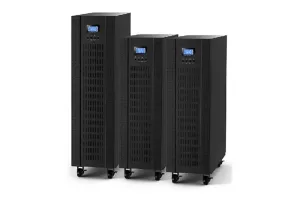
Our customizable low-frequency three phase UPS series puts the dual-input architecture at the centre of its design, so two separate mains lines can be connected to a single unit from the outset.
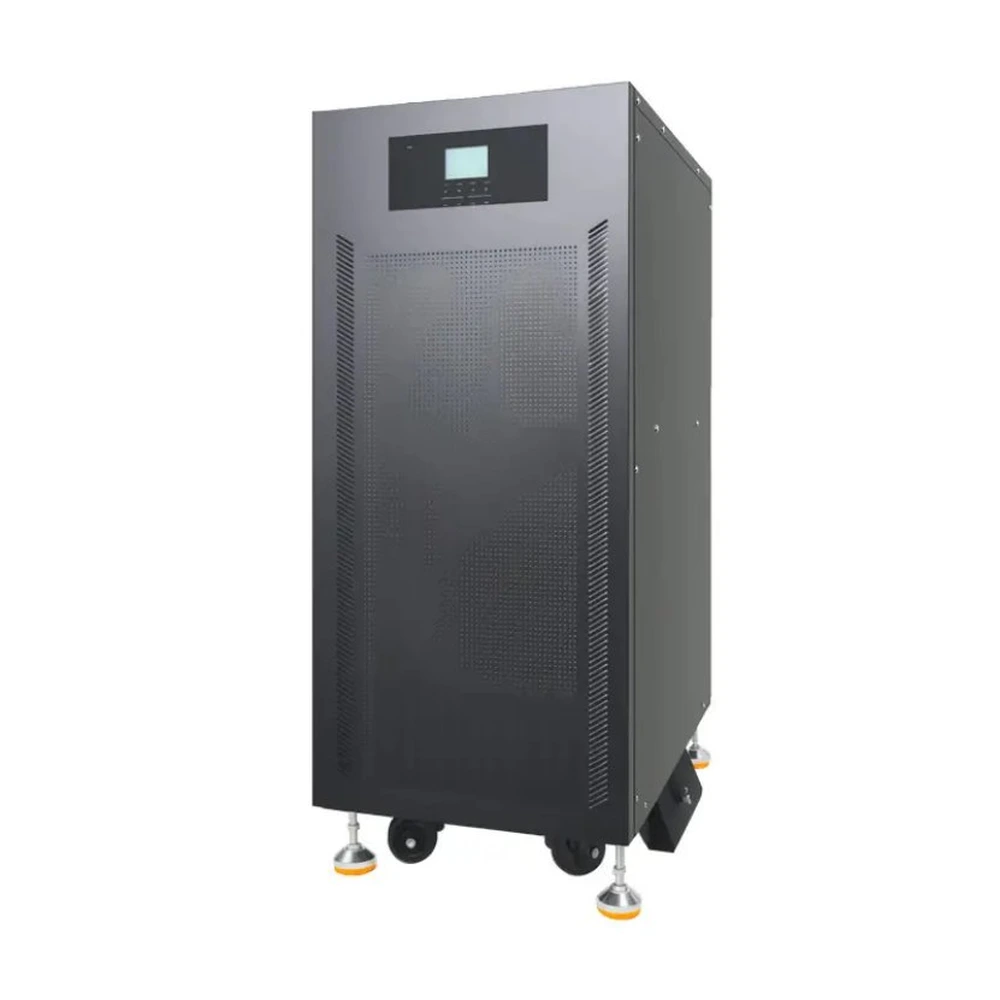
The main input power and the bypass power are separable, providing dual power inputs that improve output power reliability. In normal mode, mains power undergoes a two-stage conversion that produces pure, sinusoidal output with frequency tracking, phase locking, voltage regulation, and noise filtering, leaving connected equipment immune to grid fluctuations.
The way the system responds to a loss of supply shows the dual-input design at work:
- Second mains line failure: The unit continues operating in normal mode and maintains its power output.
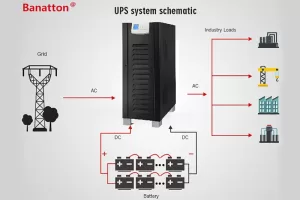
- Primary mains line failure: The UPS switches to battery mode and continues supplying the load.
- Battery depletion: Once the battery energy is exhausted, the UPS transfers to the second mains line through the bypass or maintenance switch.
- Both input lines fail: If both inputs fail and the battery is also exhausted, the output is interrupted.
This arrangement allows one input line to fail completely without affecting the load, provided the other power source remains available.
That reliability is reinforced by supporting capabilities built for industrial duty:
- Intelligent battery management: ABM technology extends battery life and reduces maintenance through constant-current automatic charging.
- Parallel operation: An optional parallel module allows up to eight units to run in parallel using a non-fixed master–slave relationship. If one unit fails, it shuts down while the remaining units continue supplying the load.
- Hot-swappable power modules: Power modules can be replaced during operation, supporting online maintenance without interrupting the load.
- Energy-saving design: Intelligent fan speed control and a non-circulating-current circuit help maintain high efficiency during long-term operation.
The main specifications of the series are summarized below:
| Parameter | Specification |
| Capacity range | 10–200 kVA |
| Input/output configuration | Three-phase input and output |
| Nominal input voltage | 3 × 380/400/415 VAC (three-phase plus neutral) |
| Input voltage range | 165–280 VAC (phase-to-neutral) |
| Bypass type | Solid-state bypass |
| Bypass input voltage | 176–264 VAC (phase-to-neutral) |
| Transfer time | Zero transfer time |
| Efficiency (line mode) | Up to 92% |
| Efficiency (battery mode) | Up to 93% |
The larger units achieve efficiency levels of up to 92% in line mode and 93% in battery mode. These systems are designed for industrial process control and machinery, infrastructure such as hospitals and power plants, the energy industry, and military applications.
Conclusion
A dual-input UPS earns its place in industrial power systems by removing the single point of failure that a shared feed creates. By separating the main input from the bypass and connecting each to its own mains line, it keeps a critical load running through an outage — first on battery, then on the second feed — without ever depending on the one line that failed.
For any facility where a dropped load carries serious consequences, choosing a UPS power system engineered around dual-input architecture is a practical way to turn existing power feeds into real redundancy. If you are planning power protection for an industrial process or critical infrastructure, get in touch to discuss a dual-input Uninterruptible Power Supply configured to your load and site requirements. Contact us today to specify a dual-input UPS for your application.
Frequently Asked Questions
What is the difference between a single-input and a dual-input UPS?
A single-input UPS feeds both its rectifier and its static bypass from one mains line, so a fault on that line removes both paths at once. A dual-input UPS separates the main input from the bypass, allowing two independent mains lines to be connected so the failure of one line does not interrupt the output.
What happens if one mains input fails on a dual-input UPS?
The UPS continues to protect the load. If the second line fails, it stays in normal mode; if the primary line fails, it switches to battery mode and then, if the outage outlasts the battery, transfers to the second mains line through the bypass. The load is only interrupted in the low-probability case that both inputs fail at once.
Can a dual-input UPS be used with two different power sources?
Yes. The two inputs are designed to be independent, so a site can connect a primary utility feed and a second line from another substation, or a utility line alongside a generator-backed circuit, using a single unit to take advantage of both sources.