 26Sep
26Sep
Introduction
For factories running CNC equipment, even small voltage changes can affect daily operations. Unstable power supply may lead to control system errors, machining problems, and unnecessary production downtime.
A Servo Automatic Voltage Regulator helps solve these issues by continuously adjusting voltage through a servo motor-controlled system. It continuously adjusts voltage fluctuations to provide a more stable power supply for CNC machines, servo drives, and industrial automation equipment.
This article discusses the working principle of Servo Automatic Voltage Regulators, their role in protecting CNC machines and automation equipment, and their typical industrial applications.
What Is a Servo Automatic Voltage Regulator
A Servo Automatic Voltage Regulator, also known as a Servo AC Voltage Stabilizer, is an electromechanical voltage regulation device designed to automatically maintain a stable output voltage despite fluctuations in the incoming power supply.
Relay-based stabilizers regulate voltage in steps, while servo voltage stabilizers use continuous adjustment to maintain the desired output voltage. This makes them more suitable for applications that require stable and accurate power supply.
How a Servo Voltage Stabilizer Works
Servo-type AC voltage stabilizers control voltage regulation via a carbon brush system driven by a servo motor. They adjust the output voltage to the desired level by varying the position of the carbon brushes on the transformer windings. Utilizing continuous voltage regulation, servo-type stabilizers provide a stable output for industrial applications.
The main performance characteristics are:
- Voltage regulation accuracy of ±1% to ±3%
- Wide input voltage range and good load adaptability
- No additional waveform distortion during adjustment
- Built-in protection against overvoltage, undervoltage, overload, and overheating
With these characteristics, servo voltage stabilizers are suitable for CNC machines, industrial automation systems, and other applications where stable voltage is required.
Servo Voltage Stabilizer vs Relay and Static Voltage Stabilizers
Relay-type voltage stabilizers adjust voltage by switching transformer taps through relays. They are a cost-effective solution for general applications, but the step-by-step adjustment method may not provide the stable voltage control required by precision industrial equipment.
Servo voltage regulators provide continuous voltage regulation and stable output, making them suitable for CNC machine tools, industrial automation systems, and other equipment requiring a reliable power supply.
Compared with servo models, electronic contactless stabilizers respond faster and operate more quietly due to their solid-state control design. Servo regulators are often used in factories where power fluctuations and changing loads are common.
Key Benefits of Servo AC Voltage Stabilizers for Industrial Equipment
High Voltage Regulation Accuracy
Servo-type regulators typically maintain voltage regulation accuracy within ±1% to ±3%, which helps provide stable power for equipment with strict voltage requirements. Stable output voltage helps maintain the performance of CNC controllers, servo drives, PLC systems, and other sensitive electronic equipment.
Smooth Voltage Correction Without Waveform Distortion
Relay-type stabilizers adjust voltage through fixed steps, while servo regulators change the carbon brush position on the transformer winding to regulate voltage continuously.
The continuous adjustment process allows servo regulators to maintain stable voltage output without causing waveform distortion.
Wide Input Voltage Range for Unstable Power Grids
Factories located in remote industrial areas or regions with aging electrical infrastructure often experience large voltage fluctuations throughout the day.
Servo AC Voltage Stabilizers are designed to accommodate a wide input voltage range. Depending on the model, servo voltage stabilizers can handle a wide input voltage range while keeping the output voltage within the required level.
This makes them suitable for manufacturing facilities where incoming power quality cannot always be guaranteed.
Strong Load Adaptability for Heavy Industrial Loads
Industrial equipment does not always run at a fixed load. Motor startups, laser systems, compressors, and other high-power devices can create sudden current changes during operation.
Servo voltage regulators can adapt to these load changes and maintain stable output voltage during operation.
Built-in Protection Against Overvoltage, Overload and Overheating
In addition to voltage regulation, modern Automatic Voltage Stabilizers commonly incorporate multiple protection functions to improve equipment safety.
Typical protection features include:
- Overvoltage protection
- Undervoltage protection
- Overload protection
- Overtemperature protection
- Time-delay protection circuits
Some servo regulators also include intelligent automatic return circuits that help reduce high startup current, contributing to longer equipment service life and improved operational reliability.
How Servo Voltage Stabilizers Protect CNC Machines and Automation Systems
For manufacturers investing in CNC machining centers and automated production equipment, maintaining stable power is just as important as selecting high-quality machinery.
A Servo Voltage Stabilizer acts as the first layer of electrical protection by compensating for fluctuations before they reach sensitive equipment.
Protecting Servo Drives and PLC Control Systems
Servo motors, variable speed drives, PLC controllers, and industrial control electronics rely on stable voltage for accurate operation.
By maintaining consistent output voltage, a servo automatic voltage regulator helps minimize electrical disturbances that may interfere with control accuracy or equipment stability.
Reducing Downtime and Production Interruptions
Unexpected voltage fluctuations can stop production lines, trigger equipment alarms, or interrupt machining operations.
Maintaining stable voltage reduces the likelihood of unnecessary production interruptions, allowing manufacturers to improve equipment availability and maintain more consistent production schedules.
Extending the Service Life of Precision Equipment
Repeated exposure to unstable voltage increases stress on electrical components over time.
Providing a stable power supply helps reduce unnecessary electrical stress on industrial equipment, contributing to improved long-term reliability and potentially reducing maintenance frequency.
Applications of Servo Automatic Voltage Stabilizers Across Industries
Servo-type Automatic Voltage Stabilizers are widely used in industries where voltage stability directly affects equipment performance, operating accuracy, and production continuity. Their combination of high regulation accuracy, smooth voltage adjustment, and strong load adaptability makes them suitable for a broad range of industrial and commercial applications.
CNC Machine Tools and Industrial Automation
CNC machining centers, automated production lines, robotic systems, servo drives, and PLC-based control equipment all require a stable power supply to maintain precision and avoid unnecessary interruptions. A Servo Voltage Stabilizer helps compensate for fluctuations in the utility supply, supporting reliable operation in demanding manufacturing environments.
Medical and Laboratory Equipment
Medical imaging systems, such as CT scanners, along with laboratory instruments and precision testing equipment, are highly sensitive to voltage variations. Stable voltage helps these systems maintain consistent operating performance and measurement accuracy.
Data Centers and Communication Systems
Servers, communication base stations, and security monitoring centers depend on reliable electrical power for continuous operation. Servo-type regulators are commonly used to provide stable voltage where utility power quality may fluctuate.
Manufacturing Plants and Heavy Industrial Equipment
Factories operating motor-driven machinery, laser equipment, drying equipment, or other heavy electrical loads often experience changing power demands throughout the production cycle. Servo voltage stabilizers are well suited to these environments because of their ability to adapt to varying load conditions while maintaining stable output voltage.
Introducing Our SVC Series Three-Phase Servo Voltage Stabilizer
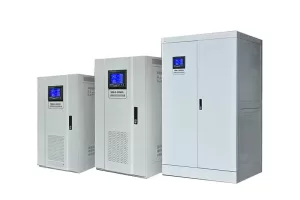
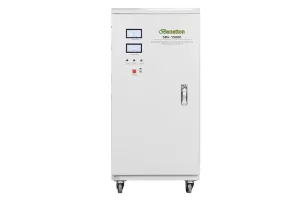
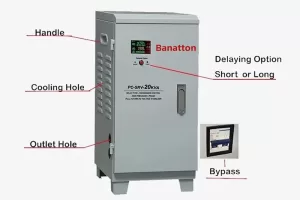
For industrial users seeking dependable voltage regulation, our SVC Series Servo Motor Control AC Voltage Regulator is designed to provide accurate voltage stabilization for a wide range of commercial and industrial applications.
The system adopts advanced international technology together with intelligent CPU centralized control. It combines a servo motor, control circuit, and compensator to achieve stable output voltage with high efficiency and reliable performance.
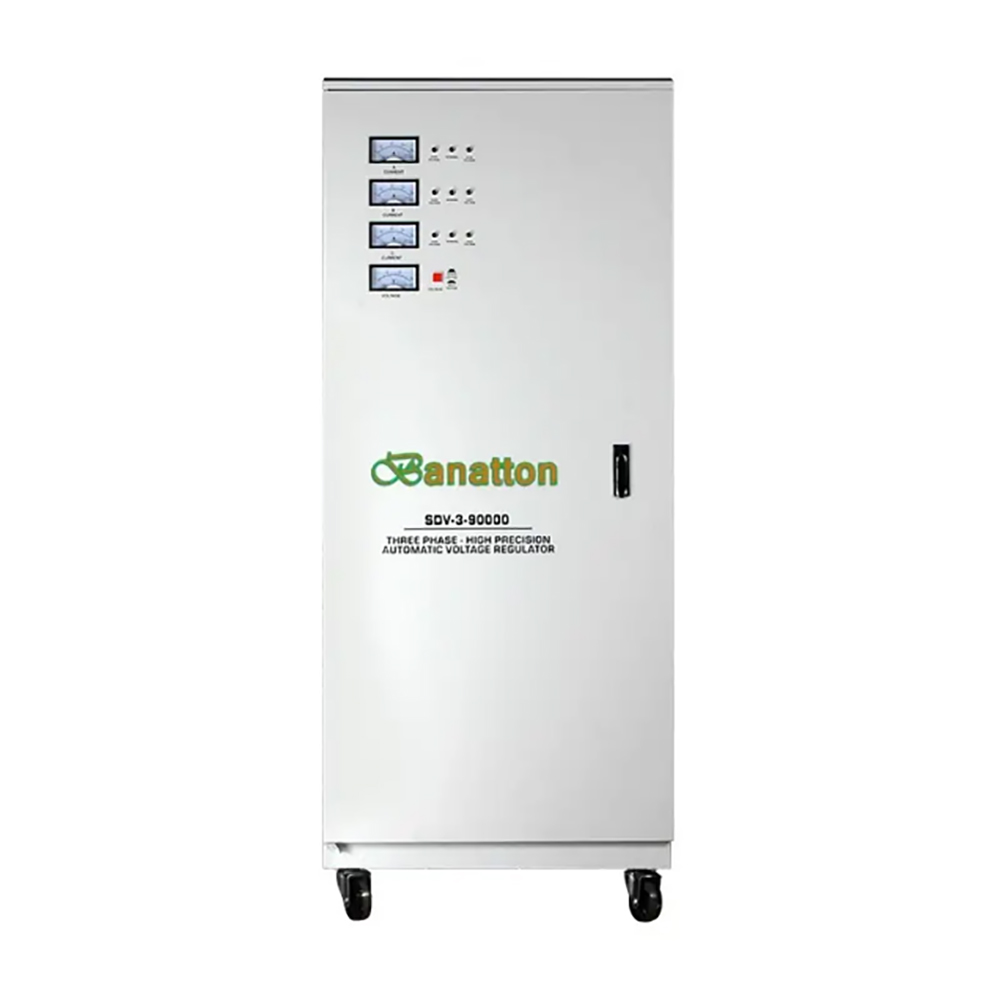
Available capacities include:
- 15kVA
- 20kVA
- 30kVA
- 45kVA
- 90kVA
The regulator supports:
- Input Voltage: Three-phase AC 240–450V
- Output Voltage: 380V ±2% or 380V ±4% (adjustable)
- Output Options: 380V / 400V / 415VAC
- Frequency: 50Hz / 60Hz
- Phase: Three Phase
- Efficiency: ≥95%
Certified to ISO, CE, and RoHS standards, the product also supports OEM and ODM services to meet different project requirements.
Key Features of the SVC Series
The SVC Series is engineered with features that address the power stability requirements of industrial users, including:
- Wide three-phase input voltage range (AC240–450V)
- Servo motor control with computerized programmed control
- High output voltage accuracy
- Compact structure with high operating efficiency
- No additional waveform distortion
- Built-in overvoltage, low-voltage, overload, over-temperature, and short-circuit protection
- Input/output voltage monitoring and operating status display
Main components such as transformers and PCBs manufactured in-house for quality assurance
These features make the regulator suitable for applications requiring dependable voltage regulation under continuously changing operating conditions.
Conclusion
Voltage fluctuations remain a common challenge in modern industrial facilities, particularly where CNC machine tools, automated production lines, and precision electronic equipment operate under continuously changing electrical loads.
A Servo Automatic Voltage Regulator provides an effective solution by delivering high voltage regulation accuracy, smooth continuous adjustment, a wide input voltage range, and strong load adaptability. These characteristics help improve power stability for industrial equipment while supporting reliable day-to-day operation.
For businesses seeking a dependable Three-Phase AC Voltage Stabilizer, the SVC Series combines servo motor control, intelligent programmed control, comprehensive protection functions, and multiple capacity options to meet the needs of a wide range of industrial power protection applications.
Frequently Asked Questions
What is a Servo Voltage Stabilizer?
A Servo Voltage Stabilizer is an electromechanical voltage regulation device that uses a servo motor and carbon brushes to continuously adjust transformer windings, maintaining a stable output voltage when the input voltage fluctuates.
How does a Servo Automatic Voltage Regulator protect CNC machines?
It automatically compensates for input voltage fluctuations before they reach sensitive equipment, helping provide stable operating voltage for CNC machines, servo drives, PLC control systems, and other industrial automation equipment.
Does a Servo Voltage Stabilizer require regular maintenance?
Yes. Because the servo motor operates by moving carbon brushes across transformer windings, periodic inspection is recommended. Under normal conditions, carbon brushes generally require replacement every 2–3 years, and the unit should be installed in a clean, dry environment for optimal performance.