 26Sep

Introduction
Voltage instability is one of the most common yet least visible threats to electrical equipment. In industrial facilities, commercial premises, and even home workshops, the incoming mains supply rarely stays at a stable level. Sudden spikes, deep sags, and slow drifts in voltage can damage sensitive electronics, shorten the service life of motors and compressors, and cause unexpected downtime. A servo voltage stabilizer is widely used to solve this problem, but not all models offer the same degree of safety. The protection functions built into a stabilizer are often more important than its rated capacity, because they determine how well the unit will safeguard both the load and itself when conditions turn abnormal.
Core Protection Functions to Evaluate
Over and Under Voltage Protection
The most fundamental safeguard in any automatic voltage regulator is the ability to respond to voltage that is either too high or too low. Input voltage can rise sharply during a lightning strike, a switching operation on the grid, or a fault in the distribution network. It can also fall when demand is heavy or when a phase is lost. A stabilizer should detect these conditions and act quickly, either by correcting the output within its regulation range or by disconnecting the load when the input moves beyond safe limits. High and low cut-off points should be clearly defined, and the unit should resume operation automatically once the supply returns to a healthy range.
Over-Temperature Protection
Voltage regulation involves continuous work, and continuous work generates heat. Transformers, motors, and control circuits all run warmer as the load increases. If internal temperature is not monitored, insulation can degrade, and components can fail prematurely. Good stabilizers include thermal protection that shuts the unit down when a set temperature threshold is reached. This prevents overheating damage and gives the system a chance to cool before resuming. A model that reports temperature on its display gives operators an extra layer of confidence, because they can spot a developing problem before it becomes a failure.
Overload Protection
Every stabilizer has a maximum rated load. Running beyond that limit, even for a short time, stresses the transformer and the servo mechanism. Overload protection detects when the connected load exceeds the safe threshold and takes corrective action. In most designs this means automatic shutdown, protecting both the stabilizer and the equipment it serves. This is especially relevant in industrial environments where additional machines may be connected over time, gradually pushing the system toward its ceiling without anyone noticing.
Short-Circuit Protection
A short circuit is an abrupt, severe fault that can release a great deal of energy in a fraction of a second. Protection against this condition must be fast and decisive. Short-circuit protection isolates the fault immediately, preventing damage to the stabilizer’s transformer, wiring, and connected devices. For a buyer evaluating different units, this is a non-negotiable feature, because the consequences of a short circuit without protection are serious and can include fire risk.
Voltage Regulation Accuracy
Protection is not only about shutting down in an emergency. It also includes how precisely the unit holds the output within an acceptable band. A stabilizer that maintains output within a narrow tolerance protects equipment from the slow, cumulative wear caused by even modest voltage variation. The regulation percentage, such as within 1.5% or 3.5%, tells the buyer how tightly the output is controlled. Tighter regulation means cleaner power delivered to the load.
Display and Fault Indication
Protection is more useful when it is visible. Modern stabilizers display input voltage, output voltage, and load conditions, and many also show temperature, delay time, and fault status. This information helps operators confirm that the unit is working correctly and diagnose problems quickly when something goes wrong. A clear display is a practical protection feature in itself, because it turns silent, invisible electrical conditions into information that people can act on.
Product Overview: Single-Phase 220V 15KVA / 20KVA / 30KVA Servo Motor Type AC Automatic Voltage Regulator
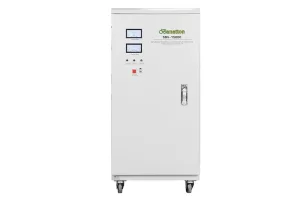
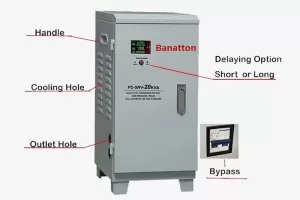
After looking at the common protection functions of a servo voltage regulator, it is useful to see how these features are applied in an actual product. The Banatton Single Phase Voltage Stabilizer uses servo-controlled technology to adjust the output voltage and includes several built-in protection functions. It is available in three power ratings: 15KVA, 20KVA, and 30KVA, making it suitable for different single-phase load requirements.
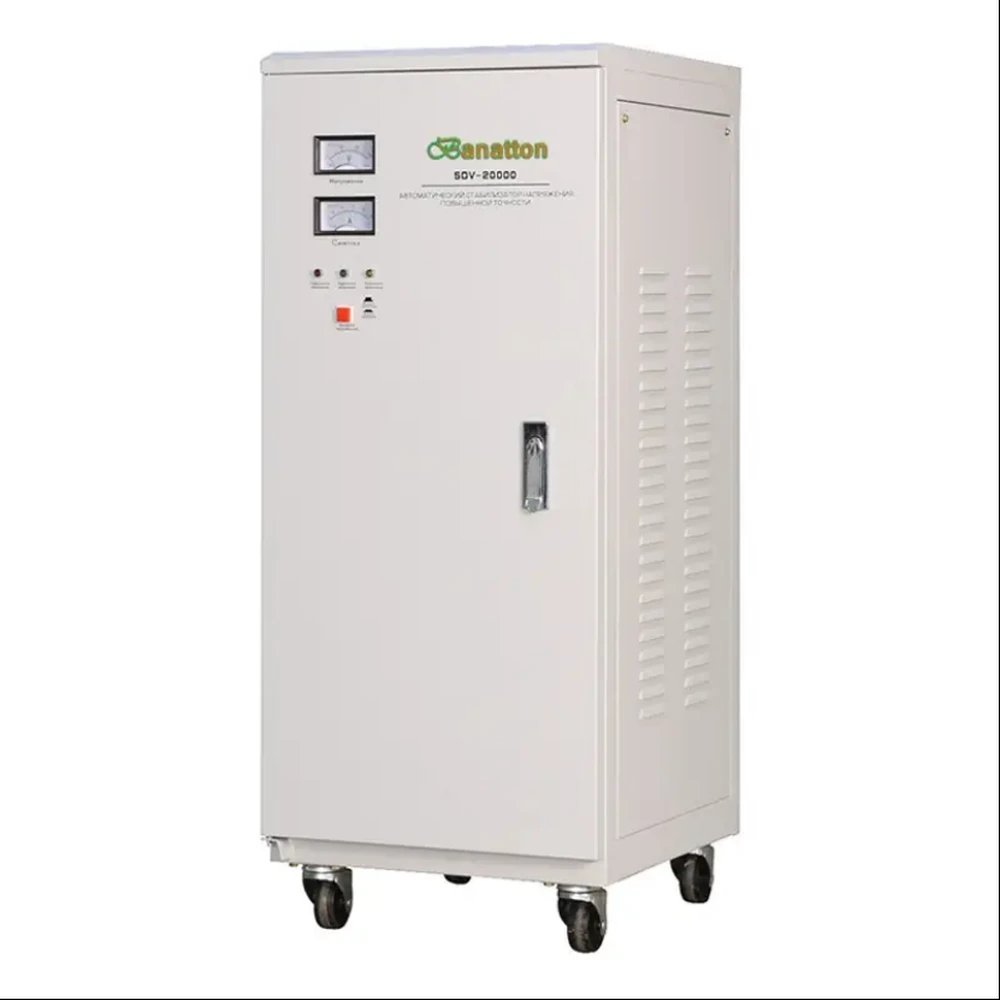
The main technical specifications are listed below:
| Parameter | Specification |
| Model | SVC-15000 / SVC-20000 / SVC-30000 |
| Nominal Power | 15000VA / 20000VA / 30000VA |
| Input Voltage Range | 140–260V (customizable) |
| Output Voltage | 220V |
| Regulation Accuracy | ±1.5% / ±3% |
| Transformer Type | Toroidal auto transformer |
| Regulation Type | Servo motor control |
| Efficiency | >95% |
| Frequency | 50Hz |
| Power Factor | 0.6–1.0 |
| Over / Under Voltage Protection | Automatic shutdown |
| Over-Temperature Protection | Automatic shutdown at 120°C |
| Overload Protection | Automatic shutdown |
| Short-Circuit Protection | Automatic shutdown |
| Certificates | ISO / CE / RoHS |
In terms of protection, the stabilizer is equipped with overvoltage, undervoltage, over-temperature, overload, and short-circuit protection. If the operating temperature reaches 120°C, the unit shuts down automatically. It also triggers automatic shutdown under abnormal voltage, overload, or short-circuit conditions, helping reduce the risk of damage caused by electrical faults.
The display makes it easier for users to monitor the stabilizer during operation. It shows the input voltage, output voltage, and load current, along with temperature, delay time, loading status, and fault conditions. Key components, including the transformer and PCB, are produced in-house, while a programmable computerized control system manages voltage regulation and protection functions.
An optional switching function is also available, allowing users to choose between stabilized output and direct mains supply. When the mains voltage is stable, users can switch to direct mains mode to avoid unnecessary voltage regulation. The unit uses input and output terminal block connections and can be used with computers, office equipment, test instruments, lighting systems, medical equipment, CNC machine tools, and industrial automation equipment.
With a monthly supply capacity of 10,000 pieces, the product is available in carton box packaging or customized packaging according to customer requirements.
Conclusion
Choosing the right servo voltage regulator involves more than checking its rated capacity and input voltage range. Buyers should also pay close attention to essential protection functions, including overvoltage and undervoltage protection, over-temperature protection, overload protection, and short-circuit protection. Accurate voltage regulation and clear fault indications are equally important for maintaining stable operation and reducing the risk of equipment damage.
For applications that require reliable voltage control, the right servo voltage stabilizer should match the actual load requirements while providing the necessary protection. Banatton offers single-phase 220V servo motor type automatic voltage regulators in 15KVA, 20KVA, and 30KVA ratings. Contact our team to discuss your voltage stabilization requirements and find a suitable model for your application.
FAQ
1. What is the difference between a servo voltage stabilizer and a relay-type stabilizer?
A servo voltage stabilizer uses a motor-driven variable transformer to adjust voltage in smooth, continuous steps, while a relay-type unit switches between fixed taps. Servo regulation is steadier and causes less abrupt change on the load, making it better suited to sensitive equipment.
2. Why is the input voltage range important?
The input voltage range defines how low and how high the incoming supply can go while the stabilizer still corrects it. A wide range, such as 140–260V, means the unit can handle deep sags and high spikes without disconnecting, protecting equipment through more of the grid’s fluctuations.
3. How do I choose the right power rating?
Choose a rating that comfortably exceeds the total connected load, allowing margin for start-up surges and future equipment. For a single-phase 220V supply, a model such as a 15KVA, 20KVA, or 30KVA AC voltage stabilizer should be matched to the actual load rather than selected by guesswork.