 26Sep
26Sep

What Is an Intelligent PDU?
A power distribution unit (PDU) provides electrical power to multiple devices within a server rack. As rack environments become more complex, simply distributing power is often not enough. Operations teams also need to understand how much power equipment is using and respond when electrical conditions change.
An Intelligent PDU adds monitoring and control capabilities to rack-level power distribution. Depending on the system and configuration, it can provide information about electrical loads, allow individual outlets to be controlled, and support remote management through a network.
These capabilities make intelligent power distribution useful in environments where operators need greater visibility and control over rack power. Common applications include data centers, IT rooms, cloud computing environments, industrial facilities, and other equipment-intensive locations.
How Intelligent PDUs Improve Power Monitoring
Real-Time Monitoring of Voltage, Current, and Power
Power monitoring provides operators with information about the electrical conditions of a rack rather than requiring them to rely on estimated or manually collected data.
Voltage and current measurements can show the electrical load being supplied to connected equipment, while power measurements provide a more direct view of consumption. Monitoring these parameters over time can help operators understand changes in rack demand and identify unusual load conditions.
For facilities with multiple racks or a large number of connected devices, this visibility can make routine power management more organized and easier to track.
Rack-Level Energy Consumption Tracking
Energy consumption is another important consideration in server rack management. In hosting and computing power rental scenarios, electricity usage may need to be verified for cost allocation.
Detailed power data can provide a basis for calculating electricity consumption at the rack or individual device level. This is particularly relevant when different equipment has different operating loads.
A Meter PDU focuses on measuring electrical usage and can provide the information needed to understand how power is being consumed. When monitoring is available at the outlet level, operators can obtain more detailed information about individual connected loads.
Capacity Monitoring and Overload Protection
Every rack has a defined electrical capacity, so operators need to understand how much of that capacity is being used.
Real-time load information can help identify conditions where power demand is approaching the available capacity. Monitoring can also provide useful information about load distribution in three-phase systems, including potential imbalance between phases.
Overload protection provides another layer of protection by responding when electrical demand exceeds the configured limit. Together, monitoring and protection can help reduce the risk associated with excessive rack loads.
How Intelligent PDUs Improve Power Control
Remote On/Off Control for Individual Outlets
Monitoring provides information about rack power, but control functions allow operators to take action without necessarily accessing the equipment physically.
Individual outlet control allows power to a connected device to be switched on or off separately. This can be useful when a specific piece of equipment needs to be restarted or temporarily disconnected from power.
For server environments, this function can simplify basic power-related operations and reduce unnecessary physical access to equipment.
Sequential Startup and Load Management
Starting multiple devices at the same time can create a sudden increase in power demand. Sequential startup provides a way to introduce equipment into operation according to a defined order.
Boot-time delay settings allow individual outlets to be started with a delay between them. This can help organize the startup process when multiple devices are connected to the same power distribution system.
These control functions are among the features that distinguish a Switched PDU from a basic power distribution unit, because the user can actively manage the power state of individual outlets.
Remote Management for Faster Rack-Level Operations
Network-Based PDU Management
Remote management allows operators to access power distribution equipment through a network instead of relying entirely on physical access.
Network-based management can support centralized monitoring, user access control, event logs, alarms, and remote outlet operation. For facilities with equipment distributed across multiple racks, these capabilities can simplify routine operations.
Depending on the system, network management may also support communication protocols and interfaces that allow the PDU to work within an existing infrastructure management environment.
Remote Power Cycling for Server Recovery
A server that has stopped responding may sometimes require a hard reboot. Without remote outlet control, an operator may need to enter the server room and manually disconnect and reconnect the device’s power.
Remote power cycling provides another approach. Authorized personnel can switch the relevant outlet off and then back on through the PDU’s management interface.
This can reduce the need for physical intervention and help shorten the time required for basic power-related recovery operations.
Centralized Monitoring and Alerts
As the number of racks increases, manually checking individual power connections becomes increasingly impractical.
Centralized monitoring allows operators to view electrical information through a management interface. Alarm functions can draw attention to conditions that require investigation, while logs can provide a record of relevant events.
When monitoring and control are combined, operators can move from simply observing rack conditions to taking action through the same management system.
Intelligent PDU Applications in Data Centers and Other Environments
Data Centers and Cloud Computing
Data centers contain large numbers of servers and network devices that depend on stable and manageable power distribution. Intelligent power management can provide visibility into rack-level electrical loads and support remote control of connected equipment.
In cloud computing and hosting environments, detailed energy information can also be useful for tracking power consumption and allocating electricity costs.
A Data Center PDU can therefore serve as part of the rack power infrastructure, connecting electrical distribution with monitoring and operational management.
Edge Computing and IoT
Edge computing environments may place computing equipment closer to where data is generated, resulting in equipment being distributed across different locations.
In these environments, remote monitoring can reduce the need for frequent physical checks. Parameters such as current, voltage, power, temperature, and humidity can provide useful information about local operating conditions when supported by the PDU configuration.
For IoT environments, network connectivity can also make it possible to integrate power-related information into broader monitoring and management processes.
Industrial and Mining Environments
Industrial facilities and mining environments can contain equipment that requires substantial and continuous electrical power. In such applications, remote power monitoring and outlet control can provide additional visibility and operational flexibility.
The requirements can vary considerably between applications, so input voltage, current capacity, outlet type, outlet quantity, and installation method need to be considered when selecting a rack power distribution solution.
Banatton Intelligent PDU for Data Center and Mining Applications
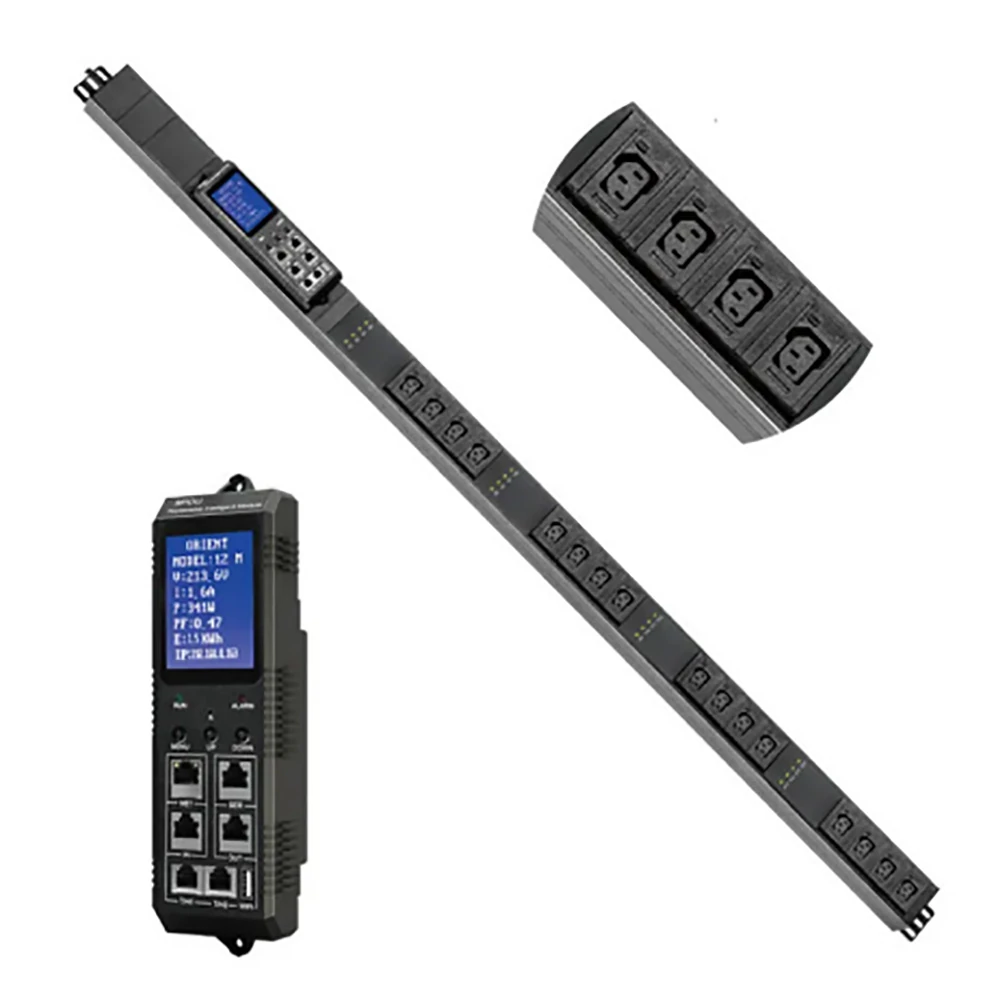
Banatton provides an intelligent rack PDU designed for IT rooms, data centers, industrial environments, and mining applications. The product combines power distribution with metering, monitoring, outlet-level control, network management, and overload protection.
The available configurations cover different voltage, current, outlet, and installation requirements, making the product suitable for different rack power distribution scenarios.
Flexible Input and Output Configurations
The Banatton Intelligent PDU supports AC110V, AC220V, and AC380V configurations, with rated current options of 10A, 13A, 15A, 16A, 20A, 25A, 32A, 50A, 64A, and 125A.
For input characteristics, the product supports configurations including 240V single phase, 380V three phase, 415V three phase, and 433V three phase, with corresponding output voltage options according to the configuration.
The maximum total current is 125A. The input connector can use a 150A 5-wire configuration, with a junction box and input breaker available as options.
For outputs, the product can be configured with 8, 10, 12, 16, 20, 24, or 32 outlets. C13 and C19 socket options are available.
The unit has a 1U–2U height and supports horizontal or vertical installation. It uses an aluminum alloy housing and is available in silver-white or black. The plastic material has a UL94V-0 flame-retardant rating.
Real-Time Monitoring and Remote Control
The monitoring and control functions are the core features of this Banatton Rack PDU.
The product can monitor input voltage, total load current, total power in kW, energy consumption in kWh, total power factor, and the power of individual outlets. It also supports monitoring of temperature and humidity.
For control, users can switch individual outlets ON or OFF, set ON/OFF times, configure boot-time delays, and set current limits for individual outlets. If an overload occurs, the PDU supports automatic power-off protection.
Remote management is supported through TCP/IP. The system provides SNMP V1, V2, and V3, Wi-Fi connectivity, user management, log storage, multiple alarm modes, and access management through Telnet, SSH, or Modbus-RTU.
The product also supports cascade management, allowing multiple units to be managed as part of a larger power distribution setup. Its graphical data display provides another way to view monitored information.
Rack Installation and Customization Options
The Banatton PDU is designed for rack-based environments and can hold 19-inch network switches. Units can also be stacked and connected to create different rack sizes.
C13 and C19 socket configurations provide flexibility for different equipment connections. The product can also be customized with a customer’s LOGO and supports OEM/ODM services.
The product has undergone hi-pot, salt spray, grounding, polarity, IR, socket life, and aging tests, with the listed test items marked as passed.
Depending on the selected configuration, certification options include ISO, CE, RoHS, TUV, and UL.
Conclusion
Intelligent power distribution combines electrical distribution with monitoring and control, giving operators greater visibility into rack-level power use and more options for managing connected equipment.
Real-time monitoring can provide information about voltage, current, power, energy consumption, and individual outlet loads, while remote outlet control, current limits, scheduled operation, and overload protection support day-to-day power management.
For data centers, IT rooms, industrial environments, and mining applications, the Banatton Intelligent PDU brings these functions together with flexible input and output configurations, network management, rack installation options, and OEM/ODM customization. It provides a practical solution for organizations looking to manage rack power distribution with greater visibility and remote control. Contact Banatton for product specifications, configuration options, and OEM/ODM solutions for your rack power distribution needs.