 26Sep

A 220V voltage stabilizer regulates changes in AC input voltage to provide an output around its specified 220 V level. Choose a model by checking the actual input range, connected load, output tolerance, phase and operating conditions together. The 220 V label alone does not establish whether it suits your equipment.
Voltage fluctuations are a common concern for electrical and electronic equipment. When the supply voltage is too low or too high, equipment may not operate under its intended conditions. A useful selection process starts with those conditions and ends with a model whose documented limits match them.
This guide explains how an AC voltage stabilizer works, where a single-phase model fits and how to compare the published SDR relay specifications. It keeps voltage regulation separate from backup power. For the broader choice between technologies and system functions, use the voltage stabilizer selection guide.
Key takeaways
- Check the equipment’s allowed input, not just its nominal 220 V label.
- Match the measured supply range to the model’s documented operating conditions.
- Review capacity and starting events alongside low-voltage operation.
- Compare output tolerance, protection and restart behavior separately.
- Request the exact configuration and current documents before approval.
Have a load list and voltage records ready? Send Banatton your application requirements, including supply phase and the connected equipment, for review against a proposed configuration.
What a 220V voltage stabilizer does
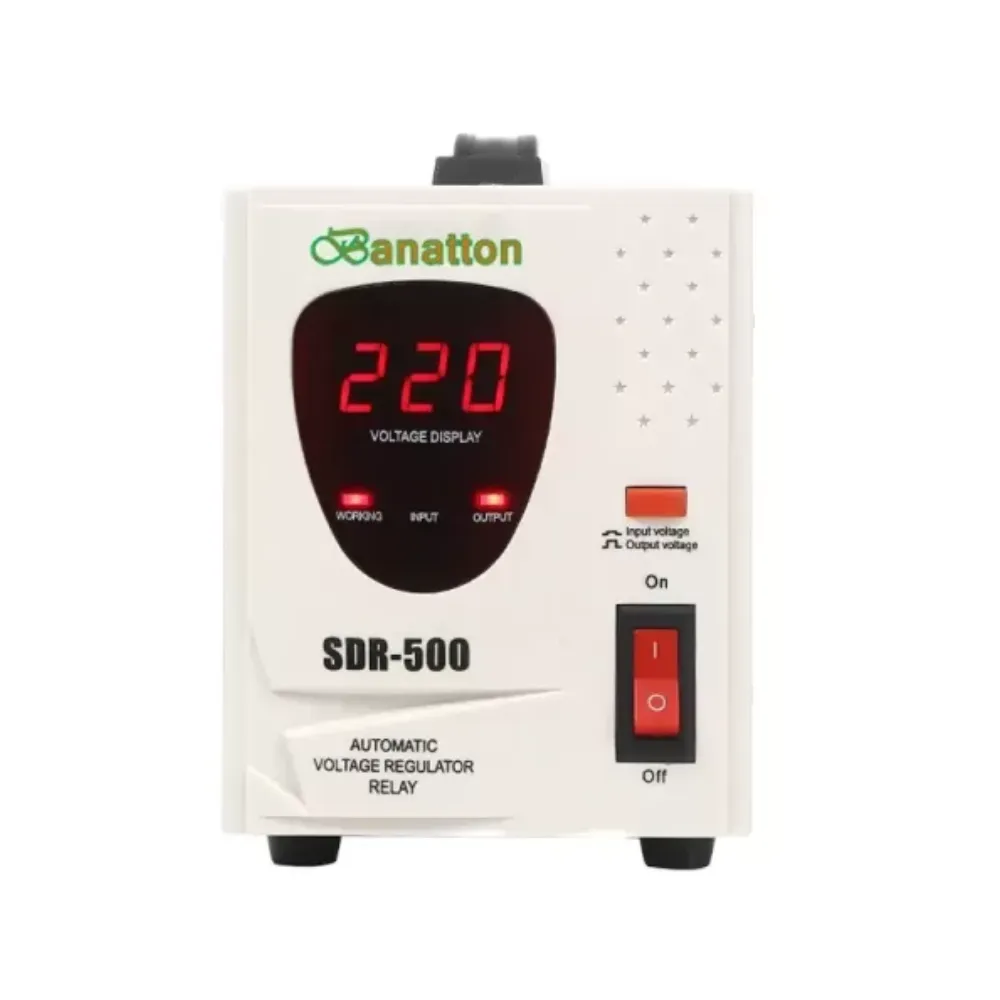
A voltage stabilizer detects voltage changes and uses a control system to adjust its output. The aim is regulation within a defined operating envelope. Outside that envelope, the output behavior depends on the model’s design and protection settings.
A 220V voltage stabilizer is not, by itself, an energy storage system. It does not provide continued power through a prolonged outage simply because it regulates voltage. If the equipment must keep running when the supply fails, define that continuity requirement separately.
Detection, control and correction
The sampling circuit provides voltage information to the controller. The controller compares it with the required operating condition and sends an adjustment signal. The correction mechanism then changes the output according to the product design.
Relay-controlled systems adjust through switched transformer connections. Servo-controlled systems use motor-driven adjustment. A 220V voltage stabilizer should be assessed using its actual correction behavior, rather than a claim that one mechanism is always best.
A response specification also needs context. Ask what was changed at the input, what load was connected and what the timing measure describes. Detecting an event and completing voltage correction are different parts of the process.
Regulation and protection are different functions
Regulation adjusts voltage within the specified conditions. Protection may disconnect the output when a limit is reached. Ask what the load receives during normal operation, a protective trip and the subsequent restart.
For a 220V voltage stabilizer, an output-tolerance figure is not the same as a cut-off threshold. Keep the two values separate in the comparison sheet. Do not assume that remaining inside a protection threshold means the output meets the connected equipment’s preferred range.
Match 220V voltage stabilizer input and output
Measure or confirm the voltage conditions at the installation site before selecting a stabilizer. Retain the measurement location, time and equipment state. A single display reading cannot describe every operating condition across a working day.
Ask a qualified person to plan suitable measurements where starts, transfers or other short events matter. The record should distinguish a sustained low supply from a brief dip or a complete interruption. These events do not necessarily require the same solution.
Check what the input range actually means
The required input coverage should include the conditions the proposed model must handle. For a 220V voltage stabilizer, also ask what output load and accuracy are supported at the limits of that coverage. An operating range alone does not prove full-rated output everywhere within it.
Some documents distinguish operating and regulation ranges. Request the manufacturer’s definitions instead of treating those labels as interchangeable. Identify what happens outside the range, including whether the output disconnects and how service resumes.
Illustrative scenario: A buyer records a low-voltage event and finds a product whose advertised input range includes that value. Before choosing the unit, the buyer asks whether the planned load is supported at that input and which output conditions apply. The range match is a useful first check, not a completed selection.
This distinction helps when comparing a 220V voltage stabilizer across suppliers. Request the same input and load conditions for each proposal. Otherwise, apparently similar headline ranges may describe different duties.
Compare output limits with equipment requirements
Use the equipment maker’s permitted voltage range and relevant operating modes. A machine, office load and household appliance need not accept the same variation. Avoid assigning one required accuracy to every device in an application category.
The SDR public product table lists output as 220 V ±8%, adjustable. Straight arithmetic gives 202.4–237.6 V around a 220 V reference. That calculation does not establish the actual adjustment settings or prove compatibility with a particular load.
For a 220V voltage stabilizer enquiry, ask how the stated tolerance is defined and under which input and load conditions it applies. Then compare the confirmed output with the equipment’s permitted input. Keep any remaining mismatch visible before purchase.
Check load, capacity and the installation
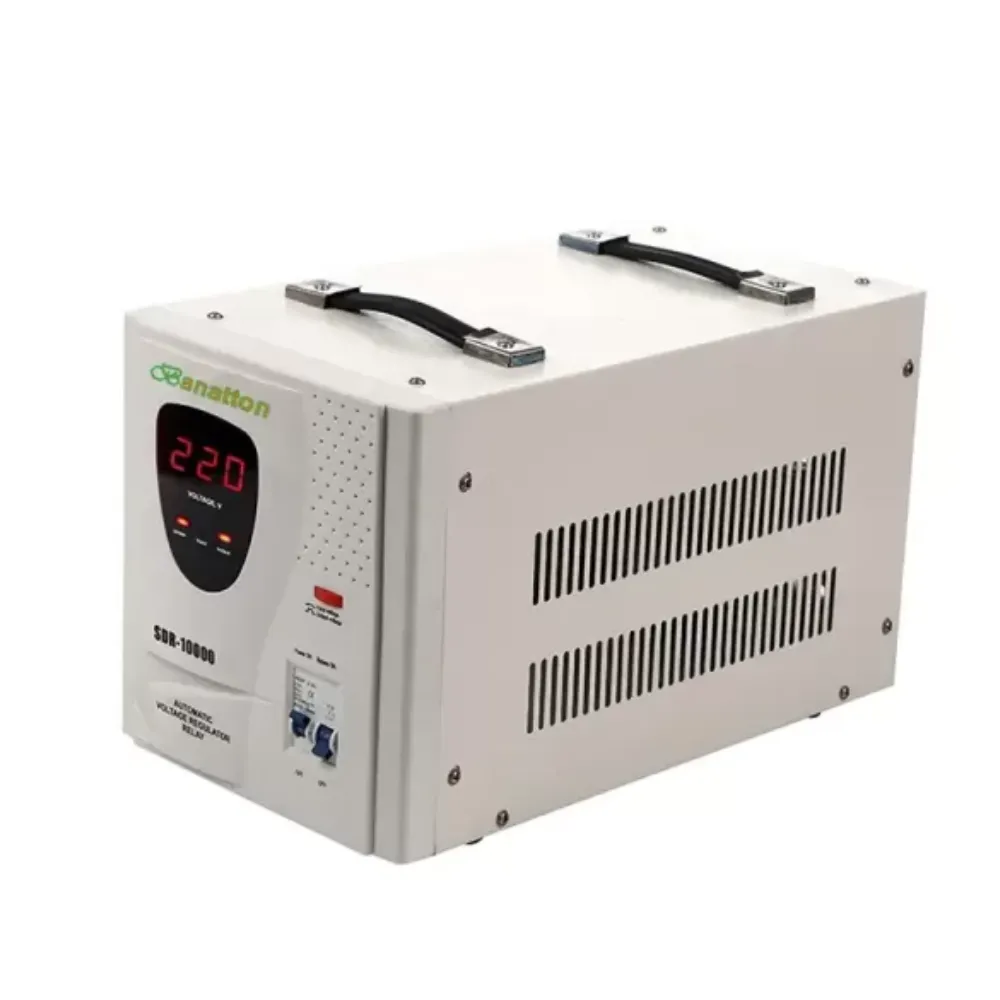
The 220V voltage stabilizer capacity needs to match the equipment it will supply. Identify which loads can run together and record their electrical demand. Include the source of each value, such as an equipment document, a measurement or an estimate.
Do not select a 220V voltage stabilizer only from its nominal voltage. Record running demand, starts, load changes and planned additions separately. An assumed power factor or a fixed spare-capacity percentage cannot replace those inputs.
Use electrical input data
Keep watts, volt-amperes and current distinct. If a motor rating describes shaft output, obtain the electrical input information needed for selection. A breaker rating alone also does not describe the load’s actual demand.
For a 220V voltage stabilizer, request both the applicable apparent-power rating and any stated real-power limit. The SDR public table has separate model VA labels and power values. They should not be treated as equal numbers or converted using one guessed factor for every model.
Record the expected input voltage with the load data. Ask the supplier about usable output at low input, applicable derating and event capability. A larger nominal capacity does not automatically demonstrate that a start or load step is supported.
Describe the site as well as the load
Confirm single-phase supply, frequency, required output and the relevant installation conditions. Temperature, ventilation, space and service access belong in the enquiry. Installation and protection coordination should follow the approved project design and applicable requirements.
Illustrative scenario: An office plans to add a copier to a group of existing loads. Instead of adding an unexplained margin, the buyer records which equipment runs together and asks for the copier’s input and start information. The supplier can then review the changed duty of the proposed 220V voltage stabilizer.
This approach also makes future changes easier to review. Keep the current demand and planned additions on separate lines. If a load or operating pattern changes, the reviewer can identify which earlier assumptions need another check.
Compare relay and servo options for the application
Relay and servo designs use different correction mechanisms. Their suitability depends on the model’s input window, output behavior, duty and service requirements. Compare those conditions rather than ranking every product by mechanism alone.
For context, Sinalda’s mSVR series information separates configuration, ratings and operating conditions in its selection tables. It is an example of the detail to request, not evidence of Banatton performance. Its own options and limits should stay attached to its own models.
Ask questions that resolve a choice
For a 220V voltage stabilizer shortlist, ask how the output changes during correction and after it settles. Confirm the permitted load and input conditions for each figure. Include the applicable maintenance requirements in the comparison.
The Arnav selection guide provides useful background on relating voltage events to load duty and input range. Use such guidance to frame the enquiry. The proposed Banatton configuration still needs its own documentation.
Keep applications conditional on their requirements
Single-phase regulation has applications in homes, offices, lighting, security systems, test equipment and industrial installations. These application names help describe the enquiry. They do not prove that every 220V voltage stabilizer suits every device in those groups.
For CNC equipment, obtain the machine’s input requirements and identify whether the proposal covers controls, drives or a wider load group. For medical or test equipment, obtain the equipment maker’s requirements and the project’s applicable approvals. Do not infer universal compatibility from a product-page application list.
If your shortlist is ready, ask Banatton to review the voltage and load requirements. Include the operating events and required output, so the proposed model can be assessed against the same stated duty.
Review the SDR 220V voltage stabilizer specifications
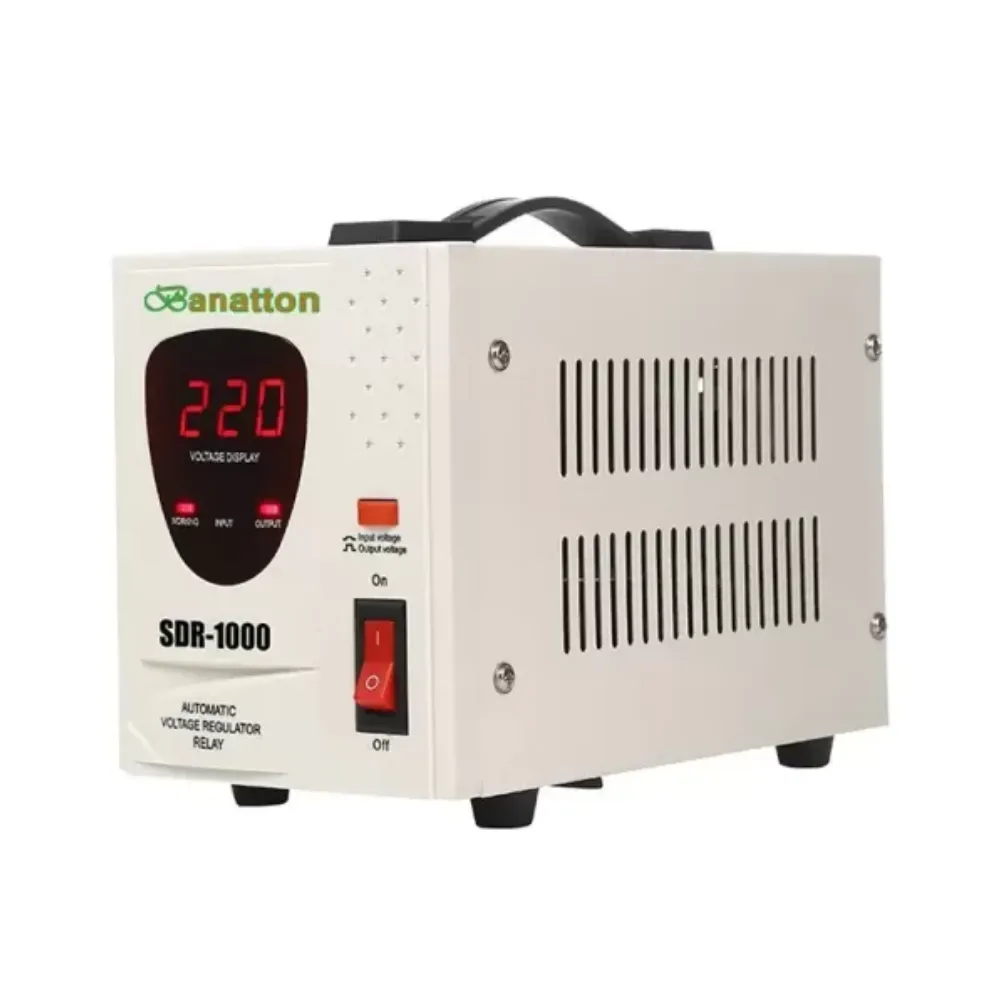
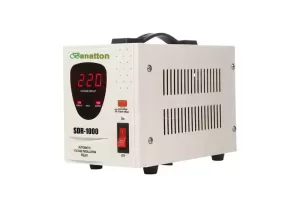
Banatton’s relay-controlled single-phase product page provides a public SDR reference table. Use it to identify questions for the quotation and current data sheet. A broad page title is not a substitute for the exact model and configuration being offered.
The table below preserves the relevant published information while separating it from the confirmation still needed. It does not approve a specific unit for a particular load.
| Published SDR item | Public table information | Confirm for the proposed unit |
|---|---|---|
| Regulation | Relay control system with electronic control | Model, configuration and correction behavior |
| Input | AC 140–260 V | Rated output and accuracy across the required range |
| Output | 220 V ±8%, adjustable | Reference, setting and applicable conditions |
| Supply | Single phase; 50/60 Hz | Required supply and equipment compatibility |
| Display information | Input/output voltage, load use, delay and status | Available display functions and their meaning |
| Capacity | Separate model VA and power entries | Applicable continuous and event limits |
| Protection | Overvoltage, overload and overtemperature entries | Settings, trip behavior and restart instructions |
Resolve document differences before ordering
For a 220V voltage stabilizer, request a versioned data sheet and applicable manual. If the article, product title and quotation list different options, ask which information applies to the proposed configuration. Do not assemble a specification by combining the most favorable figures from each source.
Treat customization in the same way. If a project needs a different input window or another option, obtain written confirmation of that configuration and its conditions. A general reference to OEM/ODM support is not confirmation that a specific requested variation has been supplied or tested.
Illustrative scenario: A buyer sees a wider input option described in an article, while the product table lists a standard range. The buyer asks for a quotation identifying the requested range, output and supported load together. That response, rather than the broad customization wording, becomes the basis for the next review.
The Banatton voltage stabilizer range helps identify related product families. Keep the 220V voltage stabilizer decision tied to a defined single-phase requirement. Move to a different configuration only after the supply and equipment needs have been checked.
Use a short 220V voltage stabilizer enquiry checklist
| Buyer information | Document or detail to attach |
|---|---|
| Equipment requirements | Nominal voltage, permitted range, phase and frequency |
| Site voltage | Recorded range, event timing and operating state |
| Load | Simultaneous electrical demand and known starts |
| Environment | Ambient conditions, location and ventilation needs |
| Required functions | Protection, restart behavior and any backup requirement |
| Supplier response | Exact model, options, data sheet and unresolved assumptions |
Keep this 220V voltage stabilizer record with the quotation. A 220V voltage stabilizer selection is easier to review when each requirement has a response and a document reference. Missing information should remain an open item, not become an assumed capability.
Questions before choosing a model
What is a 220V AC voltage stabilizer?
It regulates AC input changes to provide an output around the stated 220 V level within its documented conditions. A 220V voltage stabilizer must still be matched to the load, input window and required output tolerance. It does not provide outage backup by itself.
What input range can it handle?
The range depends on the model and configuration. The public SDR table lists AC 140–260 V; a different requested option needs its own confirmation. Ask what load and output conditions apply at the limits of the required range.
How do I choose the capacity?
Record simultaneous electrical demand and the events that occur while equipment starts or changes state. Obtain the required load data, then ask the supplier to assess the proposed rating under the actual input conditions. Do not choose only from the 220 V label or a universal spare-capacity percentage.
Can single-phase regulation serve industrial equipment?
Yes, where the actual equipment and supply requirements match the proposed configuration. An industrial application label alone is not enough. Confirm phase, voltage, load, operating events and the installation requirements for that equipment.
Does output tolerance replace protection settings?
No. Regulation tolerance and protection thresholds describe different behavior. Confirm the allowed output during normal regulation, when disconnection occurs and how restart is controlled. Compare those conditions with what the connected equipment permits.
Choose a 220V voltage stabilizer from the equipment requirements, measured supply and model evidence together. Preserve the load record and any open questions as the enquiry develops. Contact Banatton with your site details to discuss the proposed configuration and the documents needed for review.