The Development of Voltage Stabilizers
The supply of electricity has brought us great convenience and provided energy security for social development, people’s livelihoods, and industrial growth. However, power supply has...

Voltage fluctuations are a common concern for electrical and electronic equipment. When the supply voltage is too low or too high, equipment may not operate under its intended conditions. For businesses that rely on computers, industrial equipment, medical devices, or other electrical systems, maintaining a stable power supply can be an important part of daily operation.
A 220V AC Voltage Stabilizer is designed to regulate changes in AC input voltage and provide a more stable output voltage. But choosing a suitable stabilizer requires more than simply looking at the 220V output.
The input voltage range, load capacity, phase, protection functions, regulation technology, and operating environment all need to be considered.
This guide explains how a 220V AC voltage stabilizer works, the main types available, common applications, and the key factors to consider when selecting one.
A 220V AC voltage stabilizer is an electrical device used to regulate fluctuations in AC voltage and maintain a relatively stable output.
The input voltage from a power grid is not always constant. It can become lower or higher depending on the power supply conditions and changes in electrical load. A voltage stabilizer detects these changes and adjusts the voltage so that the output remains within its specified range.
It is important to distinguish voltage stabilization from backup power. A voltage stabilizer regulates voltage; it is not, by itself, an energy storage system designed to provide power during a prolonged outage.
Different types of electrical equipment have different power requirements. Computers, office equipment, medical equipment, test equipment, industrial automation equipment, and CNC machine tools may all require suitable voltage conditions for normal operation.
Voltage that is consistently too low or too high can affect equipment operation and performance. In applications where equipment is sensitive to power conditions, voltage regulation can therefore be an important part of the overall power supply system.
The goal of an AC voltage stabilizer is not simply to increase voltage. Depending on the input condition, it may need to raise or lower the voltage to achieve the specified output.
Although different stabilizers use different technologies, their main functions can be divided into several key components.
The input switch is generally a miniature circuit breaker with current-limiting protection.
It provides a protection point at the input side of the stabilizer and helps protect both the stabilizer and connected electrical equipment.
The voltage regulator is the core component responsible for raising or lowering the output voltage.
When the control circuit determines that the voltage needs to be adjusted, it sends the corresponding control signal through the drive system to the voltage regulator.
The specific regulation method depends on the type of stabilizer. Relay-controlled systems, for example, use relays as part of the voltage adjustment process.
The sampling circuit monitors changes in output voltage and current.
It provides feedback information to the control circuit, allowing the system to determine whether the output voltage is within the required range or needs further adjustment.
Without this feedback process, the control system would not have the information required to respond automatically to voltage changes.
The control circuit acts as the decision-making part of the system.
It analyzes the signals received from the sampling circuit. When the output voltage is too high, it generates a signal instructing the drive system to reduce the voltage. When the output voltage is too low, it generates a signal to increase the voltage.
This continuous control process allows the stabilizer to respond to changes in the electrical supply.
The control signal generated by the control circuit may not be strong enough to operate the voltage regulator directly. A drive unit is therefore used for signal amplification and conversion.
The protection device controls whether the stabilizer output remains connected under normal conditions. Depending on the design, relays, contactors, or fuses may be used for this function.
Different voltage stabilization technologies have different operating characteristics. Understanding these differences can help buyers select a suitable solution for a particular application.
A magnetic saturation voltage regulator uses a saturated iron core together with a capacitor to achieve constant voltage characteristics.
Its structure is relatively simple and it offers high reliability. However, significant waveform distortion can be a limitation of this type of regulator.
A magnetic amplifier voltage regulator regulates the output by changing the impedance of the magnetic amplifier.
It uses closed-loop control and provides good stability and output waveform characteristics. Its main limitation is a relatively long response time.
A sliding voltage regulator automatically changes the position of a transformer’s sliding contact through a servo motor.
This type can provide high voltage regulation accuracy and is suitable for applications involving precision equipment.
Precision purification types use bidirectional thyristor inductance technology. They are characterized by high voltage regulation accuracy and fast response.
Fully automatic compensation types can adapt to relatively large load variations. Depending on the application, however, output jitter or harmonic interference may occur.
A Relay Type Voltage Stabilizer uses relays as part of its voltage regulation system.
Relay-controlled systems can combine relay switching with electronic control technology to automatically adjust the output according to changes in the input voltage.
For buyers comparing different technologies, the appropriate choice should depend on the required input range, output requirements, load characteristics, and protection functions rather than on the regulation method alone.
A Single Phase Voltage Stabilizer can be used in many applications where single-phase AC voltage requires regulation.
Household electrical equipment can be affected by unstable supply voltage. A single-phase stabilizer can be used where the electrical requirements match the stabilizer’s voltage and capacity specifications.
Computers, office equipment, and copy machines are among the applications for AC voltage stabilizers.
For business environments, stable power conditions can support the normal operation of office equipment and other connected electrical loads.
Medical equipment and test equipment are also listed among the application areas.
When selecting a stabilizer for these applications, buyers should pay particular attention to the required voltage, capacity, operating environment, and protection functions.
CNC machine tools and industrial automation equipment can also use regulated AC power when the stabilizer specifications match the equipment requirements.
For industrial projects, capacity selection and input voltage range are particularly important because the connected load can vary significantly between applications.
Lighting systems and security alarm systems are also suitable application categories.
A stabilizer can be incorporated into the power supply arrangement where the required voltage and capacity match the selected equipment.
Selecting an Automatic Voltage Stabilizer should start with the actual electrical conditions of the project.
A higher-capacity stabilizer is not automatically the right choice. The input voltage, connected load, output requirements, protection functions, and operating environment all need to be considered.
Measure or confirm the voltage conditions at the installation site before selecting a stabilizer.
If the actual input voltage can fall below or rise above the stabilizer’s specified range, the selected model may not be suitable for the application.
For this reason, the input voltage range should be one of the first specifications checked during procurement.
The stabilizer capacity needs to match the connected equipment.
The load should be evaluated before selecting the VA rating. Choosing a model only according to the output voltage, without considering the actual load, can result in an unsuitable configuration.
For B2B projects, it is useful to identify the equipment to be connected and determine the required capacity before requesting a quotation.
The output voltage should match the requirements of the connected equipment.
For single-phase applications, buyers should confirm that a single-phase model is appropriate. For a 220V system, the required output voltage and allowable regulation range should also be checked.
Frequency is another specification that should be confirmed when applicable.
Protection functions can be important for equipment operating in unstable power environments.
Depending on the model, buyers may need to consider overvoltage, low-voltage, overload, over-temperature, and short-circuit protection.
These functions should be compared with the actual risks and operating conditions of the application.
Efficiency, ambient temperature, and humidity are also relevant when evaluating a stabilizer.
The installation environment should fall within the manufacturer’s specified operating conditions. This is particularly important for equipment installed in industrial or other demanding environments.
Finally, consider the regulation technology.
Magnetic, sliding, precision, compensation, and relay-controlled stabilizers have different characteristics. The decision should be based on the required regulation accuracy, response characteristics, load conditions, and application requirements.
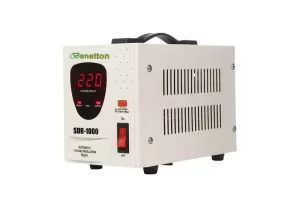
For applications that require a single-phase 220V AC voltage stabilizer with relay control, the SDR Series provides a corresponding solution.
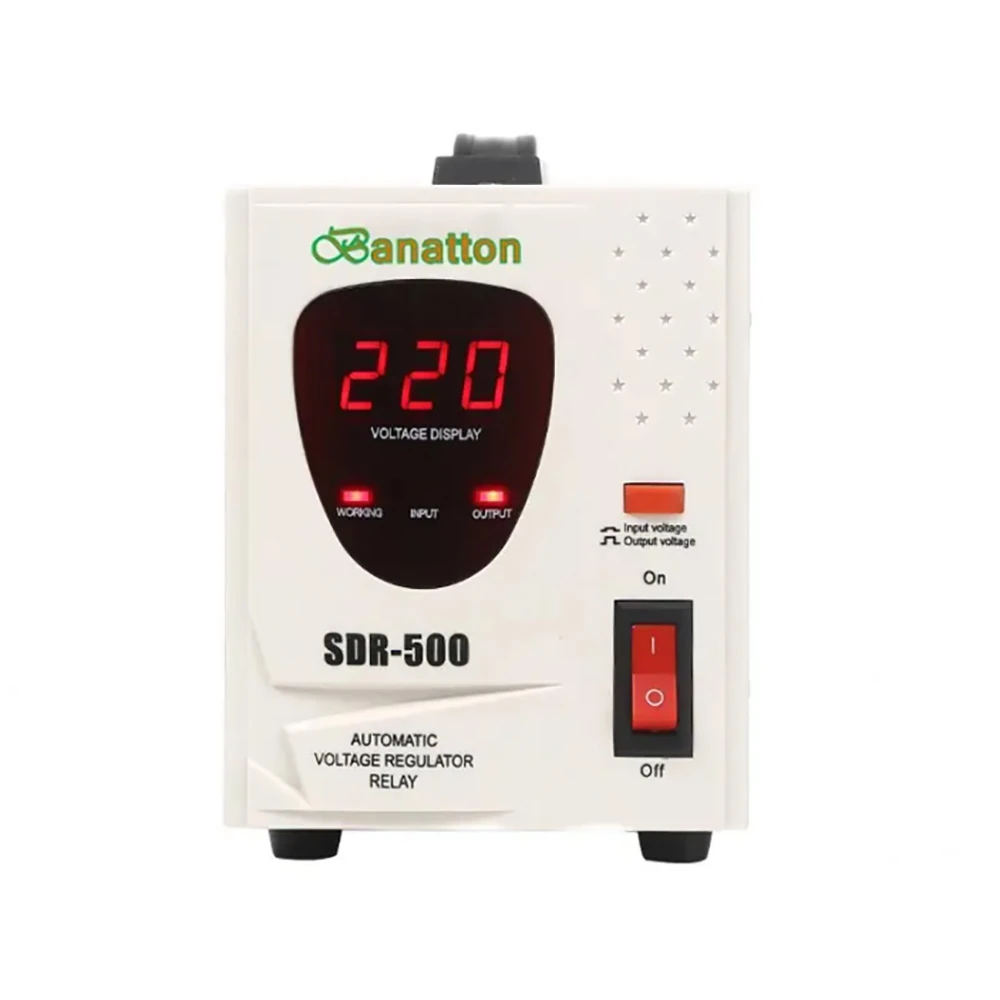
The SDR Series is a relay-controlled, fully automatic AC voltage regulator designed for users dealing with unstable voltage and electrical equipment requiring regulated power.
It uses programmed microcomputer control technology and a relay “cross zero” control algorithm.
The standard input voltage range is AC 140–260V.
According to the product information, customized input ranges include 100–260V, 100–270V, and 80–260VAC.
The output voltage is 220V±8% and is adjustable. The frequency is specified as 50Hz/60Hz, and the product is designed for single-phase applications.
The SDR Series includes overvoltage, low-voltage, overload, over-temperature, and short-circuit protection.
The technical parameters specify overload protection for loads above 120% and over-temperature protection at 120°C±10°C. The specified delay time is 3 seconds.
Its LED display can show input voltage, output voltage, load usage, time delay, normal working status, and protection information.
The technical parameter table provides several capacity options:
The corresponding power specifications listed in the product information range from 350W to 9600W depending on the model.
For B2B buyers, the SDR Series supports OEM and ODM services.
The supply capacity is 10,000 pieces per month. Standard packaging uses carton boxes, while packaging can also be arranged according to customer requirements.
| Specification | Details |
| Type | Relay-controlled automatic AC voltage regulator |
| Phase | Single Phase |
| Input Voltage | AC 140–260V |
| Output Voltage | 220V ± 8%, adjustable |
| Frequency | 50Hz/60Hz |
| Capacity | 500VA – 12000VA |
| Protection | Overvoltage, low-voltage, overload, over-temperature, short circuit |
| Display | Input/output voltage, load usage, delay and protection status |
| OEM/ODM | Available |
A 220V AC voltage stabilizer is a device that regulates changes in AC input voltage and provides a more stable output around the specified 220V level.
The input range depends on the specific model. For the SDR Series, the standard input range is AC 140–260V, while wider customized ranges are also available.
A relay type voltage stabilizer uses relays as part of its voltage regulation system. It can automatically adjust the output according to detected changes in the input voltage.
Start by identifying the equipment that will be connected and determining its actual load requirements. Then select a stabilizer capacity that matches the application and verify the manufacturer’s specifications.
Yes. Single-phase stabilizers can be used for certain industrial applications. The product information for the SDR Series specifically lists CNC machine tools and industrial automation equipment among its applications. The selected model must match the equipment’s voltage, phase, and capacity requirements.
A 220V AC voltage stabilizer uses voltage detection, control, regulation, and protection functions to provide a more stable AC power supply. Different stabilization technologies have their own characteristics, so the right choice depends on the actual electrical conditions and equipment requirements.
For B2B procurement, the most important factors include input voltage range, load capacity, output voltage, phase, protection functions, efficiency, operating environment, and regulation technology.
For applications requiring relay-controlled single-phase 220V regulation, the SDR Series offers multiple capacity options, adjustable 220V±8% output, protection functions, digital LED display, and OEM/ODM support. Buyers can select the appropriate configuration according to their voltage conditions, connected load, and project requirements. For more information about the SDR Series, please contact Banatton for a quote.
 26Sep
26Sep
 17Dec
17Dec
 24Dec
24Dec
 21Jan
21Jan