 26Sep
26Sep

1.What Is a Modular UPS System
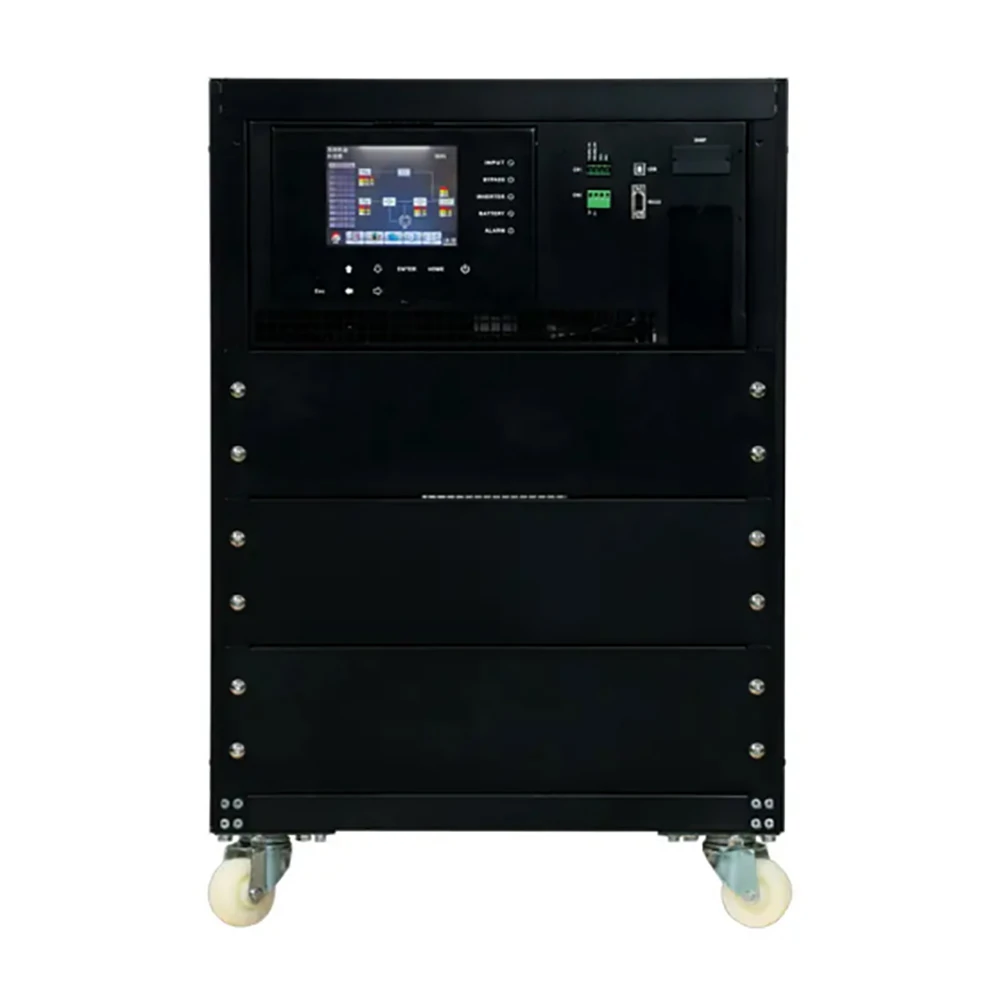
A traditional UPS is a single large device with fixed capacity. In contrast, modular UPS systems employ a rack-mount architecture with multiple independent power modules; each module is equipped with an independent rectifier, inverter, charger, and control circuitry. These modules operate in parallel to share the load, thus giving the system scalability.
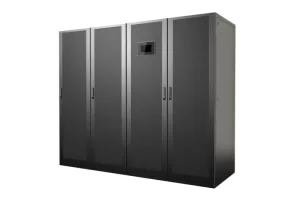
The BT9300-M series exemplifies this modular architecture. Cabinet capacity ranges from 20kVA to 300kVA. Individual power modules are available in 20kW, 25kW, and 30kW specifications. Depending on the cabinet model, the system accommodates 1 to 10 modules. The largest BT9300-M cabinet supports up to 10 modules, achieving a total capacity of 300kVA/300kW.
2.How Power Modules Work in Parallel
The BT9300-M uses advanced distributed active parallel technology, which lets up to 4 UPS units run in parallel without a centralized bypass cabinet.
Multiple modules automatically share the load.If a module fails or is removed for maintenance, the remaining modules will immediately take over—thereby ensuring that your critical equipment remains continuously online.
And when you need more power? Simply add another module while the system continues to run, without the need to shut down.That’s online capacity expansion, made simple.
3.Difference Between Modular and Traditional UPS Systems
Traditional UPS systems require capacity planning to be based on the anticipated maximum load right from the initial stage; this often results in significant expenditure wasted on idle capacity. Should power demand eventually exceed the original specifications, one is faced with two options: either replace the entire UPS unit or install an external bypass cabinet to connect an additional unit in parallel.
Modular systems—such as the BT9300-M—effectively resolve this issue through their “pay-as-you-grow” capability. You simply install the number of modules corresponding to your current capacity requirements, and future expansion can be achieved merely by adding more modules.
There are also distinct advantages regarding maintenance. With traditional UPS systems, should an internal fault occur, the entire unit must be taken offline for repairs. Modular systems, however, feature a hot-swappable design; even if a specific power module fails, there is no need to shut down the system—the faulty module can be removed and replaced with a new one while the UPS remains fully operational. Consequently, business operations remain completely uninterrupted.
4.Why Data Centers Are Shifting to Modular UPS
4.1 Rising Power Demands from AI, Cloud, and High-Density Servers
Modern data centers face unprecedented power density challenges. AI training clusters, high-performance computing, and cloud infrastructure all demand more power per rack than ever before. A UPS system sized for today’s server load may be completely inadequate within 24 to 36 months.
The modular approach — expanding from 20kVA to 300kVA by simply inserting additional power modules — aligns directly with this growth trajectory.
4.2 High Downtime Risks in Critical IT Infrastructure
Any interruption in power, even for milliseconds, can cause data corruption, transaction loss, and hardware damage. The BT9300-M achieves 0ms transfer time between power sources, meaning connected equipment never experiences a break in power during mode transitions. For data centers running financial transactions, real-time analytics, or customer-facing web services, this zero-transfer characteristic is essential.
5.Limitations of Traditional UPS Systems
Traditional UPS systems impose several operational constraints. They typically require input cabling cabinets and rear access for maintenance, consuming valuable raised floor space. Their fixed battery configurations often force complete battery replacement when migrating to a new UPS, increasing capital expenditure.
Most critically, a traditional UPS offers no module-level redundancy — a single internal component failure can take the entire system offline.
The BT9300-M eliminates these limitations through full front access design, flexible battery cell counts, and module-level redundancy.
6.Key Benefits of BT9300-M Modular UPS System
6.1 Hot-Swappable Power Modules for Zero Downtime Maintenance
Each BT9300-M power module is hot-swappable. When a module fails or requires firmware updates, technicians can remove the specific module while the UPS continues powering critical loads. The failed part can be replaced within minutes, not hours. This capability is listed explicitly in the product features: “UPS power module supporting hot swappable, capacity upgrade extremely simple.” For 24/7 data center operations, this means no scheduled downtime for UPS maintenance.
6.2 Scalable Power Capacity: From 20kVA to 300kVA
The BT9300-M series offers three cabinet configurations:
- BT990-M cabinet: 20-90kVA/20-90kW, supporting up to 3 power modules
- BT9150/180-M cabinet: 25-150kVA/25-150kW (BT9150) and 30-180kVA/30-180kW (BT180)
- BT9300-M cabinet: 30-300kVA/30-300kW, supporting up to 10 power modules
Single module capacities are available at 20kVA/20kW, 25kVA/25kW, and 30kVA/30kW.
This granularity allows data center operators to start small and expand incrementally, matching UPS capacity to actual IT load rather than speculative future maximums.
6.3 High Efficiency >96% at 50–75% Load (Lower Energy Cost)
Energy efficiency is a primary concern for data center operators. The BT9300-M achieves >96% efficiency when operating between 50% and 75% of rated load, and maintains >95% efficiency even at 25% rated load.
This high efficiency translates directly into reduced cooling requirements and lower electricity bills. For a 300kVA system running at typical data center load factors, the difference between 96% efficiency and the 92-93% common in older UPS designs can save thousands of dollars annually.
6.4 N+X Parallel Redundancy with Distributed Active Control
The modular UPS implements distributed active parallel technology, supporting parallel operation of up to 4 UPS units without a centralized bypass cabinet.
This enables N+X redundancy configurations — for example, using six 30kW modules to support a 150kW load (N=5, X=1). If any module fails, the remaining five modules continue to support the full load. The distributed control architecture means there is no single point of failure in the parallel control system itself.
6.5 Front-Access Design for Easy Maintenance & Lower Cost
All BT9300-M cabinets feature full front access. Technicians can install cabling from either the top or bottom of the cabinet, and no input cabling cabinet is required.
UPS cabinet dimensions:
- 600×850×1350mm for smaller configurations
- 600×850×1550mm for medium configurations
- 600×850×2000mm for the full 300kVA cabinet
Individual power modules measure 440×620×86mm and weigh 21kg.
This compact, front-access design allows the UPS to be placed against a wall or alongside other equipment, maximizing usable data center floor space.
7.Technical Highlights of BT9300-M Series
7.1 Ultra-Wide Input Voltage Range (138–485Vac) for Harsh Grid Conditions
The BT9300-M accepts nominal voltages of 380V, 400V, or 415Vac three-phase input. The usable voltage range is exceptionally wide: 305-485Vac at full load, and 138-305Vac with load adaptation (de-rated operation).
This wide range means the UPS can keep batteries in standby and continue powering loads even during severe brownouts or voltage sags. For data centers located in regions with unstable utility power, this characteristic significantly reduces battery wear and extends battery service life.
7.2 Input Power Factor >0.99 and THDi <3%
Input power factor exceeds 0.99, meaning the BT9300-M presents nearly a pure resistive load to the utility or generator. Total Harmonic Distortion of input current (THDi) is ≤3% at 100% load.
These specifications minimize upstream stress on transformers, generators, and switchgear. Low harmonic distortion also reduces neutral currents in three-phase systems, a common problem with older UPS designs that can cause overheating and fire risks.
7.3 Advanced DSP Full Digital Control
The BT9300-M uses advanced DSP (Digital Signal Processor) full digital control technologies. This digital architecture enables higher system stability, online capacity expansion, and simplified maintenance. DSP control also allows the UPS to achieve the precise output voltage regulation of 380/400/415Vac ±1%, regardless of input fluctuations.
7.4 Generator Compatibility and Bypass Protection
The product specifications explicitly list generator access as a supported feature. When utility power fails and a backup generator starts, the BT9300-M accepts the generator’s typically wider frequency and voltage variations without transferring to battery. Additionally, the system includes bypass back-irrigation protection, preventing reverse power flow into the utility or generator circuit.
8.Typical Applications of Modular UPS Systems
Based on the product documentation, the BT9300-M series is suited for the following applications:
- Centralized power supply for workstations and departmental facilities in medium and large data centers — This is the primary application, where the 20-300kVA range aligns perfectly with data hall power requirements.
- Industrial automation equipment and SMT placement machines — The 0ms transfer time and pure sine wave output protect sensitive manufacturing equipment from power disturbances.
- Transmitter stations, control rooms, and medical equipment — Critical facilities that cannot tolerate even millisecond power interruptions.
- Factory production equipment — The system’s overload capability (1 hour at 110%, 10 minutes at 125%, 1 minute at 150%) provides margin for motor starting currents and temporary overloads.
- Monitoring and security systems and information centers — Continuous operation ensures surveillance and access control systems remain functional during power outages.
- Mining, chemical, and petrochemical production equipment — The wide input voltage range of 138-485Vac accommodates the unstable utility power common in remote industrial sites.
- Other valuable equipment where power outages are not permitted — This catch-all category includes financial trading systems, emergency communication networks, and scientific instrumentation.
9.Conclusion: Why BT9300-M Is a Future-Ready Choice
9.1 Scalability, Reliability, and Efficiency for Modern Data Centers
The BT9300-M data center UPS addresses the three core requirements of modern data center power protection:
- Scalability: starting at 20kVA and growing to 300kVA by adding hot-swappable modules eliminates the “oversize now or replace later” dilemma
- Reliability: distributed active parallel technology, N+X redundancy, and 0ms transfer time ensure continuous power even during module failures or maintenance events
- Efficiency: >96% efficiency at typical operating loads reduces both electricity consumption and cooling requirements
9.2 Reduced Total Cost of Ownership Through Modular Design
Lower total cost of ownership results from multiple factors:
- Pay-as-you-grow model reduces initial capital expenditure
- High efficiency lowers operational expenses
- Front-access design and hot-swappable modules reduce maintenance labor costs
- Flexible battery configuration allows reuse of existing batteries during system upgrades
For data center operators planning for AI-driven power demand growth, cloud infrastructure expansion, or simply higher-density server deployments, the modular UPS architecture represented by the BT9300-M series offers a practical, cost-effective path forward.
26Sep
 20Nov
20Nov