 26Sep
26Sep
Both UPS and AVR are useful devices for ensuring electrical equipment and infrastructure receive adequate and high-quality power. However, you shouldn’t confuse UPS and AVR, as they are developed for different purposes. In some ways, they are as different as apples and oranges.
When your application only requires an AVR, installing a UPS is neither appropriate nor economical, and substituting an AVR for a UPS is technically unreasonable. Installing the wrong power solution can lead to inadequate protection, wasted money, or both.
In this article, we will thoroughly clarify the confusion between UPS and AVR. More importantly, you will understand the specific situations in which each device is needed.
I. What is a UPS?
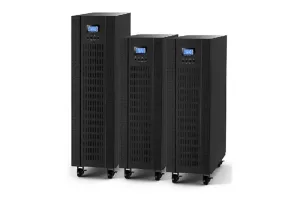
UPS stands for Uninterruptible Power Supply. It is a device that protects electrical equipment from a complete power outage or voltage drop by channeling power from an internal battery to the power line. This allows mission-critical equipment such as computers, telecommunications repeaters, industrial machinery, and data centers to continue operating normally during power problems.
1. How does a UPS work?
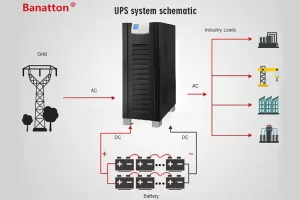
A UPS consists of charging circuitry, batteries, an inverter, and filters to ensure that the load is not reset during a power outage. During normal operation, a UPS converts incoming AC power to DC power and charges the battery. When the input voltage drops to a certain threshold, the UPS battery takes over. By reversing the battery’s DC voltage back to AC, the UPS ensures continuous load operation.
2. What are the types of UPS and their uses? Generally, there are three different categories of UPS
Standby: A standby UPS is a commercial UPS used by consumers to protect low-voltage electrical appliances, such as computers. The standby UPS is connected in parallel to the AC power supply. It provides basic outage protection through a static switch by connecting the load to the battery output. During the switching process, there is a small interval of approximately 25 milliseconds before the standby power starts. The switching window does not affect equipment such as computers, but it is unacceptable for sensitive industrial equipment and mainframe servers.
Line Interactive: A line interactive UPS uses a single charge-inverter module to provide outage protection for the load and compensate for fluctuations in the input voltage. During normal operation, a line interactive UPS stabilizes the load voltage to resist voltage drops, overvoltage, and other changes. In the event of a power outage, a static switch disconnects the input voltage from the battery and redirects the battery voltage back to the load.
Online UPS: Also known as a double-conversion UPS, this circuit is connected in series with an AC power source. The input voltage is converted to DC to charge the battery, and then converted back to AC to supply power. With seamless switching time and voltage stabilization capabilities, it provides ideal outage support for mission-critical or industrial applications such as data centers and medical equipment.
3. Common UPS Applications
Standby UPSs are common in applications up to 2kVA. For example, gamers use standby UPSs to protect their gaming computers from power problems. Similarly, line-interactive UPSs are primarily used for low-power loads because there is a slight delay when switching to battery output. Meanwhile, online UPSs are suitable for industrial applications such as data centers and medical equipment due to their seamless switching and voltage stabilization capabilities.
4. How Long Does a UPS Last?
A UPS consists of power electronic components and batteries. Due to the limitations of charging cycles, the average healthy lifespan of a battery is 3-5 years, while the lifespan of a UPS can be up to 13 years. Batteries will need to be replaced at least several times during their lifespan.
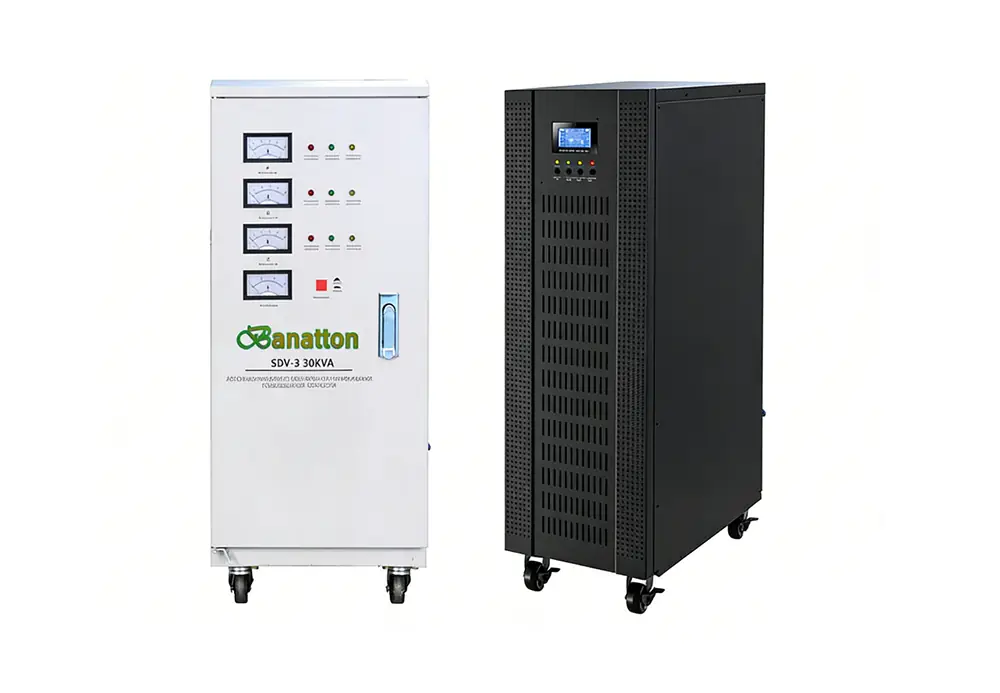
II. What is an AVR?
AVR, short for Automatic Voltage Regulator, is a voltage stabilizing device capable of fully automatic correction for inherent input voltage variations—optimizing the ideal nominal voltage level to suit the electrical system. It protects critical loads and sensitive electronic components from harmful anomalies from the AC power grid, such as voltage fluctuations, electrical noise and transients, voltage drops, and overvoltage.
1. How does an AVR work?
An AVR consists of a variable or self-regulating transformer and a feedback control mechanism. Its working principle is to rapidly change the winding ratio of the transformer to produce a clean and stable voltage level. Each AVR design has specific power limits or kVA capacity, and the charge must not be exceeded.
They are commonly used in facilities, infrastructure, and buildings subjected to severe voltage variations. AVRs ensure that electrical loads operate optimally at their respective rated voltages and protect sensitive electronic components from premature failure.
2. Types of AVRs: These are the types of AVRs commonly used in different industries
Servo AVRs: Servo AVRs utilize a servo motor to change the winding ratio of the transformer based on feedback signals from the control circuit. Although servo AVRs contain movable mechanisms in their design, they are adopted by leading industries due to their high reliability and efficiency. Typically, servo AVRs can stabilize mains grid voltage with an accuracy of ±0.5% to ±1%, and have an input voltage tolerance of up to ±40%.
Magnetic Induction: Magnetic induction AVRs use brushless (contactless) servo control to adjust the proximity of the primary and secondary windings. They operate by changing the amplitude and angle of the magnetic flux coupling between the windings. Therefore, magnetic induction AVRs require almost no maintenance and are ideal for harsh environments. These AVRs are highly accurate and have greater tolerance to electrical interference from the mains power grid. For example, Coca-Cola (Saudi Arabia) installed Ashley Edison magnetic induction AVRs to stabilize the three-phase input voltage of its production facilities.
Static: Static AVRs, also known as tap changer AVRs, use a series of silicon controlled rectifiers (SCRs) to change the winding ratio. Due to this structure, static AVRs are often an economical choice, but they cannot achieve the precise regulation of servo and magnetic induction AVRs. Furthermore, these SCRs are prone to electrical damage, making static AVRs unsuitable for extremely unstable operating environments.
3. How long does an AVR last?
The lifespan of an AVR varies depending on its type. Static AVRs require meticulous maintenance throughout their healthy lifespan, while servo AVRs are the safest choice in the industry (with a lifespan of 10 years or more). However, from an absolute reliability perspective, magnetic induction AVRs are widely considered the most reliable by electrical professionals due to their brushless, contactless design and robust construction.
III. Differences between UPS and AVR
Protection Level: UPS and AVR protect electrical loads in different ways. UPS is primarily designed to protect mission-critical equipment from power outages or voltage drops. In such situations, the UPS continuously provides backup power until battery capacity is reached or mains power is restored.
Meanwhile, AVR provides robust protection against overvoltage, undervoltage, and transient events. It allows the load to receive a clean and stable power supply, despite irregularities in the incoming power. Most AVRs also act as secondary protection buffers against lightning surges.
Function: UPS primarily serves as a backup power source, preventing sudden power outages to electrical loads and avoiding data loss, improper shutdown, or other abnormal equipment behavior. Meanwhile, AVR precisely compensates for input voltage differences by rapidly adjusting the transformer winding ratio. This allows electrical equipment to operate reliably even in noisy mains power grids.
Applications: UPS systems are widely used for power loads where unexpected power outages cannot be risked—such as medical facilities, data centers, and smaller work computers. AVRs, on the other hand, are installed to significantly protect high-value machines or infrastructure from damage caused by voltage fluctuations.
Price: UPS systems are more expensive than AVRs because batteries account for a large portion of their cost. Keep in mind that batteries need to be replaced at least 2-3 times during their lifespan. This means that even with this feature, simply using an online UPS to stabilize voltage is not economically viable. From a price perspective, AVRs are far more economical than AVRs. Furthermore, these products require less maintenance and have a longer lifespan.
IV. Which is better for power problems, a UPS or an AVR?
If your machines frequently fail due to unstable mains voltage, you will have to seek a solution promptly. Either a UPS or an AVR. While online UPSs offer voltage stabilization, there may be better solutions to address your problem.
UPSs are primarily designed to ensure continuous operation during power outages. This means they contain bulky batteries, taking up space and incurring high production costs. Not all installations can afford the extra space to accommodate the batteries inside a UPS. Furthermore, cost is a significant factor when seeking voltage stabilization solutions.
Unless your equipment requires outage protection, an AVR is the best choice for solving power quality issues. It is designed to respond quickly to various voltage irregularities and requires no redundant components, meaning you’ll have a more economical and compact solution. In addition, AVRs have a longer lifespan and require very little maintenance.