 26Sep

Choose an industrial voltage stabilizer by matching the site’s measured voltage range and load profile to the capacity available from the quoted unit. Compare continuous demand, peak current and its duration, and the equipment’s permitted input. Then ask for the guaranteed output limits and test conditions in writing.
A 100, 120, 200, or 300 kVA rating gives you a starting point for comparing offers. Each option still needs to meet the duty at the lowest expected input voltage. This guide shows what to measure, what to ask suppliers, and what to check before accepting the equipment.
When an industrial voltage stabilizer can help
Start with the event that caused the purchase request. A sustained voltage deviation and a short interruption can both stop a line, but they call for different investigations. Match the timestamps in the supply record to the equipment alarm and note what was running at the time.
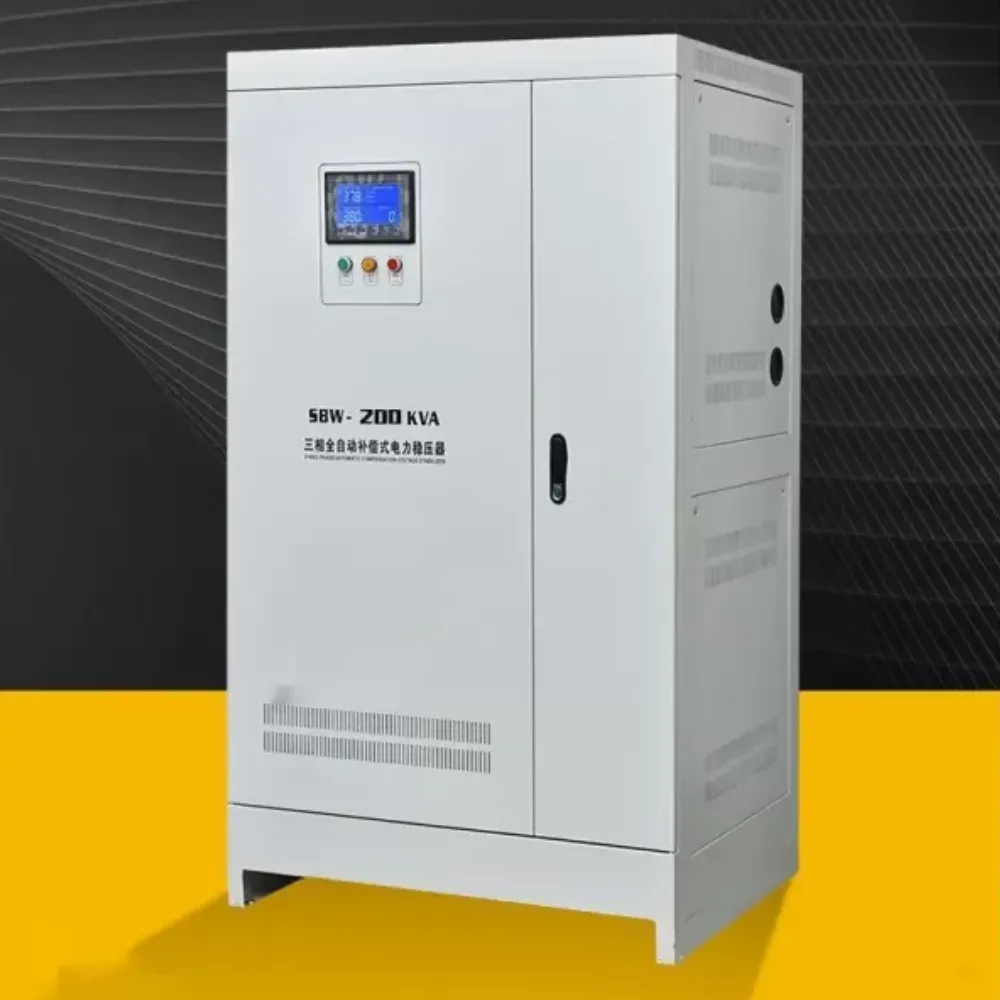
A servo automatic voltage regulator (AVR) monitors its output and drives a motorized adjustment mechanism. The mechanism changes the voltage correction as the supply varies. This is a practical option for sustained variations within the unit’s specified operating envelope. The size of the deviation, the load and the required correction time determine whether it fits a particular event.
| What the site sees | What to ask the electrical team to establish | What to request in the offer |
|---|---|---|
| Voltage stays low for part of a shift | Lowest loaded voltage and how long it lasts | Output and available capacity at that input |
| Equipment trips during a brief dip | Event depth, duration and equipment tolerance | Test evidence for the relevant event and load |
| Repeated phase alarms | Phase voltages, load balance and fault history | Permitted imbalance and the protection sequence |
| Brief spikes or full supply loss | Type of event and continuity needs | A separate assessment of surge protection or backup duty |
An industrial voltage stabilizer has a defined input window. A response figure alone gives limited information about what the load sees during a disturbance. Ask when the measurement starts, when the output returns to tolerance, and what the output does in between. A separate backup supply may be necessary if a load must keep operating through an outage.
Illustrative scenario. A packaging line trips during a nearby compressor start. The buyer asks for a larger AVR. The electrical team first compares the alarm time with a record of the dip at the line. The depth and duration of the event, along with the line’s supply tolerance, determine whether to investigate the feeder, the starting sequence, or a suitable correction device. This example assumes no field result.
Send Banatton the voltage record and alarm history if you want to discuss an industrial voltage stabilizer for a specific event. Include the equipment’s acceptable supply range and the point where the record was taken.
How to size an industrial voltage stabilizer
Define the load boundary before you add anything up. One machine, one feeder and an entire production area are different projects. Mark which equipment will sit downstream of the industrial voltage stabilizer and which loads have a separate supply. Include auxiliaries once and identify loads that can operate together.
Establish continuous demand
Collect equipment nameplates and the site’s measured demand. A nameplate may describe a maximum or a specific configuration. A reading on a quiet shift can miss the highest sustained production load. Keep the records side by side and ask your electrical team to explain any material difference.
For a balanced three-phase supply, calculate apparent power in kVA as √3 × line-to-line voltage × line current ÷ 1,000. At 400 V and 200 A, the result is about 138.6 kVA. Multiplying just 400 V by 200 A and dividing by 1,000 gives 80, which omits the three-phase factor. For unbalanced loads, use a suitable assessment of the phases and check the highest loaded phase.
If you know input real power and true power factor for the same operating condition, divide kW by power factor to find kVA. For example, 120 kW at a power factor of 0.80 is 150 kVA. The power factor in that example is an assumption. Use the measured or documented figure for your own load.
An industrial voltage stabilizer must also accommodate the actual electrical duty. Verify the proposed output current at the selected nominal voltage, the continuous load rating and any model limits. A calculated kVA value alone cannot establish the final unit rating or determine a cable or breaker size.
Verify the peak and low-input conditions together
A motor start or a change in production can create a brief peak above the normal operating current. Record how high the peak rises, how long it lasts, and whether other loads are on at that moment. Ask how often the offered unit can carry that duty and what it does when its limit is exceeded.
The lowest incoming voltage matters because input current can rise for the same delivered power. Ask the industrial voltage stabilizer supplier to state the capacity and current limits at your lowest expected input. If the range includes several options, identify the one in the quotation and ask for its capacity curve or written limits.
Illustrative scenario. A plant records 138.6 kVA on a balanced feeder during its normal cycle. An input voltage minimum occurs when two processes overlap. The buyer compares 200 and 300 kVA offers using the same voltage and peak records. One supplier gives a continuous rating at the measured low input and a timed overload curve. The other gives only a nominal kVA label. The first offer contains enough information for a more complete review. Neither rating is approved by the example.
Compare 100, 120, 200, and 300 kVA offers
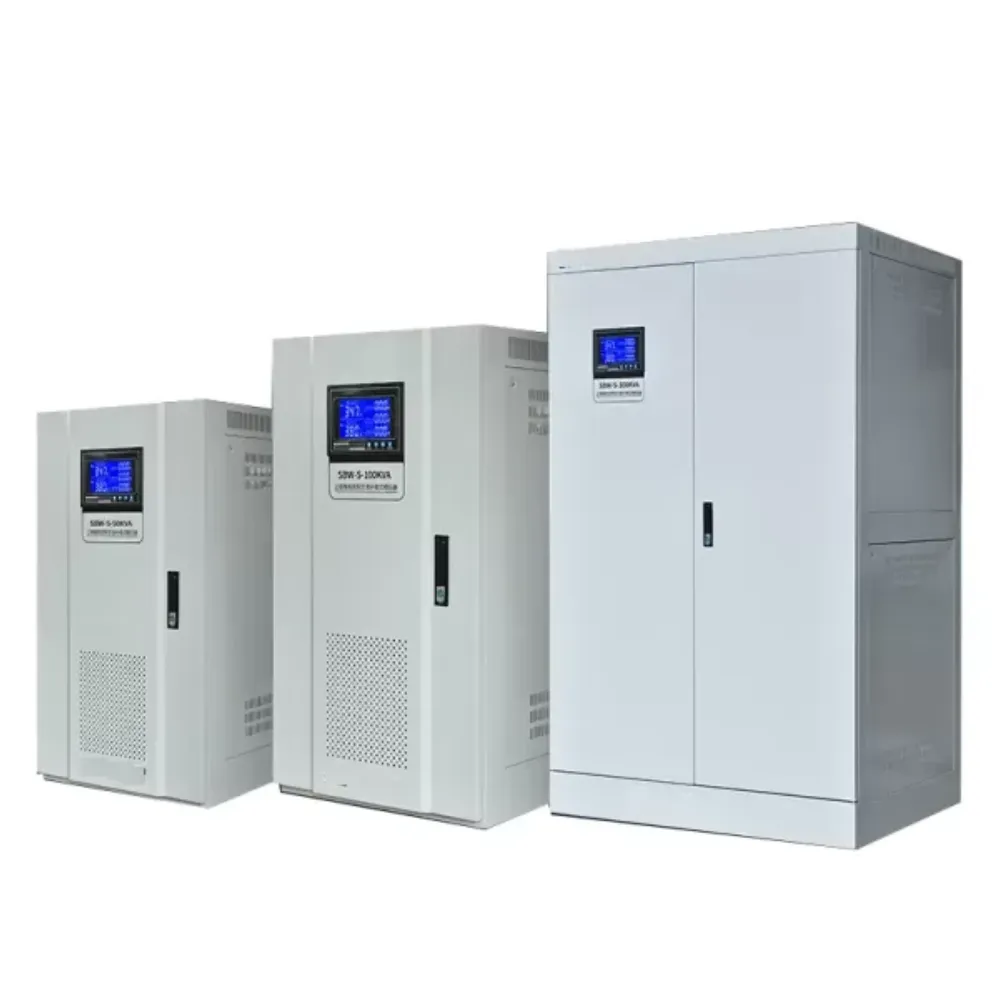
Treat each industrial voltage stabilizer rating as a candidate in the same comparison. Start with the smallest frame that appears to meet the continuous duty and ask for proof at the limiting site conditions. Check the next frame when the available output, phase current or peak duration rules out the first. Base any provision for growth on identified loads and when they will run.
| Candidate | Question that helps screen the offer |
|---|---|
| 100 kVA | Does the unit meet continuous demand and the highest phase current at the measured low input? |
| 120 kVA | What additional capacity is available at the same site input, and can it cover the recorded peaks? |
| 200 kVA | Can the unit carry simultaneous demand with the offered cooling, protection and duty limits? |
| 300 kVA | Can the supply, installation space and service plan support the proposed frame and its associated equipment? |
The same industrial voltage stabilizer rating can appear in offers with different input ranges, nominal output voltages and cooling arrangements. Compare the written configuration, including whether the stated voltage is line-to-line or line-to-neutral. Record the earthing and neutral requirements from the design. Check whether the offered regulation controls all phases together or adjusts them independently.
Banatton’s public SBW listing shows a 304–456 VAC input range and 380, 400, and 415 VAC output options. Use those values to start a model enquiry and request the confirmed input and output pairing for your order. Ask for the applicable limits at the ends of that range, including continuous output, phase imbalance and ambient conditions. A public family listing can contain options that differ from the unit in a specific quotation.
Explore the available product types and request the drawing and data sheet for the exact industrial voltage stabilizer you are comparing. Banatton voltage stabilizer range · Three-phase servo regulator range
What to specify in an industrial voltage stabilizer quote
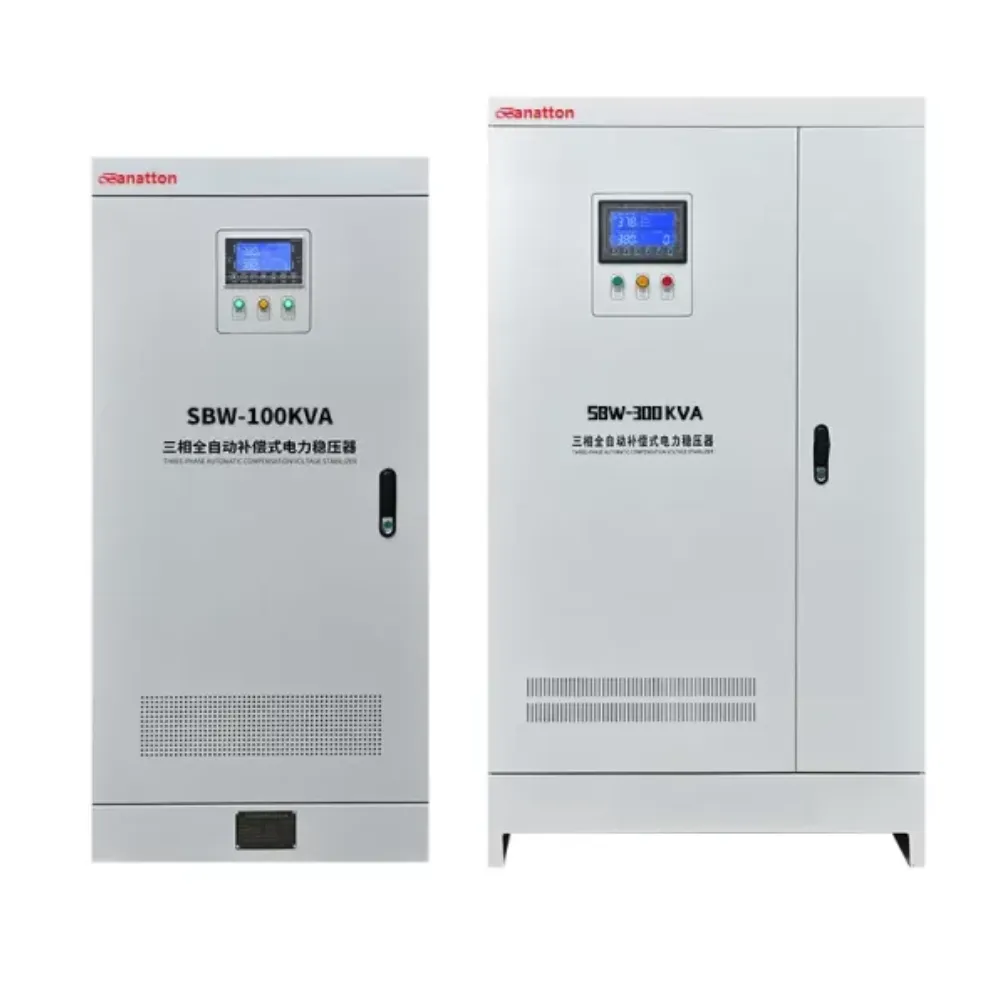
Ask industrial voltage stabilizer suppliers to respond to the same load schedule. Attach the supply records and describe the required output at the point the load receives it. Ask each supplier to list its assumptions and exceptions on the first page of the technical offer. An unqualified promise of a wide range or fast correction is difficult to compare with measured requirements.
Require the conditions behind each specification
Specify the voltage step, load level and measurement basis for dynamic comparisons. A correction speed in volts per second and a response time in seconds describe different things. Supplier selection guides can help organize the comparison. For example, Voltnex separates load sizing from grid voltage and phase checks. Record these as distinct fields for your industrial voltage stabilizer enquiry, and ask the supplier to verify the operating assumptions for the quoted unit.
Ask for the output tolerance across the agreed input and load window. Record the conditions for efficiency figures if your project uses them to estimate heat or running costs. Define site temperature, dust, access, ventilation, and the required enclosure for the industrial voltage stabilizer. Obtain the actual unit dimensions and weight before planning delivery or placement.
Confirm protection and bypass by configuration
Request the protection schedule for the offered model. Ask which events trigger an alarm, which disconnect the load, and what conditions allow output to return. Clarify the difference between a protective trip and a command to switch to bypass. Ask who approves the return to service and what happens if the supply remains outside the load’s tolerance.
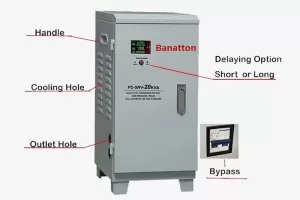
A bypass can feed the load from the incoming supply without regulation. Ask whether the industrial voltage stabilizer has a manual or automatic arrangement, what interlocks apply, and which protections remain active in each state. Have the electrical designer confirm how the transfer and isolation will be managed. The existence of a bypass gives no assurance that the incoming supply is acceptable when you need to use it.
Illustrative scenario. A workshop wants to service an AVR without shutting down a process. The buyer assumes bypass solves the problem. During the review, the team notices that the site voltage is sometimes outside the process equipment’s permitted range. The site therefore defines when bypass is acceptable and agrees on a shutdown plan for other conditions. The example illustrates why the bypass sequence belongs in the purchasing specification.
Share your load schedule and bypass requirements with Banatton to request a model-specific offer. Include any required documents, installation constraints and the planned test conditions.
Agree on acceptance and service before delivery
Ask the supplier and site team to agree on what will be checked at the factory, what will be checked after installation, and who will accept the results. The industrial voltage stabilizer test plan should state the input conditions, the load state, the expected result and the recording method. If a limiting condition cannot be reproduced safely on site, agree beforehand what factory record or other evidence is acceptable.
| Item | Before shipment | After installation |
|---|---|---|
| Configuration | Check the model, ratings, drawing revision and ordered options | Compare the delivered nameplate and documents with the approved offer |
| Regulation and load | Obtain results at the agreed conditions or identify test gaps | Record input, output and phase current during agreed operation |
| Protection and bypass | Review the settings schedule and approved test method | Verify agreed functions under the site procedure |
| Service | Request the manual, access needs and service responsibilities | Retain records and agree on inspection based on the actual unit |
Have qualified personnel perform installation and acceptance work under approved procedures. Keep the original electrical design and as-installed record with the industrial voltage stabilizer documentation. Include the model, serial number, settings record and deviations accepted by the project team. A later change in loads or supply conditions can then be checked against a known baseline.
Follow the industrial voltage stabilizer manual for inspection and service. Servo components and cooling provisions can differ by design, so the schedule should reflect the actual equipment and environment. Have the service team assess brush wear, alarms and other findings according to the manual. The general voltage stabilizer selection guide covers broader technology choices.
Frequently asked questions
Can a 300 kVA unit serve a whole factory?
It depends on the load boundary, the actual simultaneous demand, and the available capacity at the site voltage. Check each phase and any timed peaks. Compare the power and protection requirements of the full feeder before selecting an industrial voltage stabilizer for it.
Does a wider input range always make an offer better?
A wider range helps only if the offered unit still meets the required output and capacity under your conditions. Compare the range, available output and current limits together. Ask how the industrial voltage stabilizer behaves outside its specified correction range.
Can a servo AVR handle every brief voltage dip?
Check the event against the proposed unit’s test evidence and the load’s permitted input. Servo regulation has a finite correction rate. The required solution depends on the dip depth, duration, and equipment behavior. A factory can also face events such as interruptions or transients that require a separate design review.
What should I send before requesting a quote?
Send the voltage and current records, the equipment’s supply limits, the list of connected loads, and the expected duty. Include peak duration, simultaneous operating states, and any known changes in the next phase of the project. Add the environmental requirements and the bypass and acceptance expectations.
Contact Banatton with your site records to compare industrial voltage stabilizer configurations against the same operating conditions. Ask for a written model, verified limits, and an agreed way to check the installation.