 26Sep
26Sep

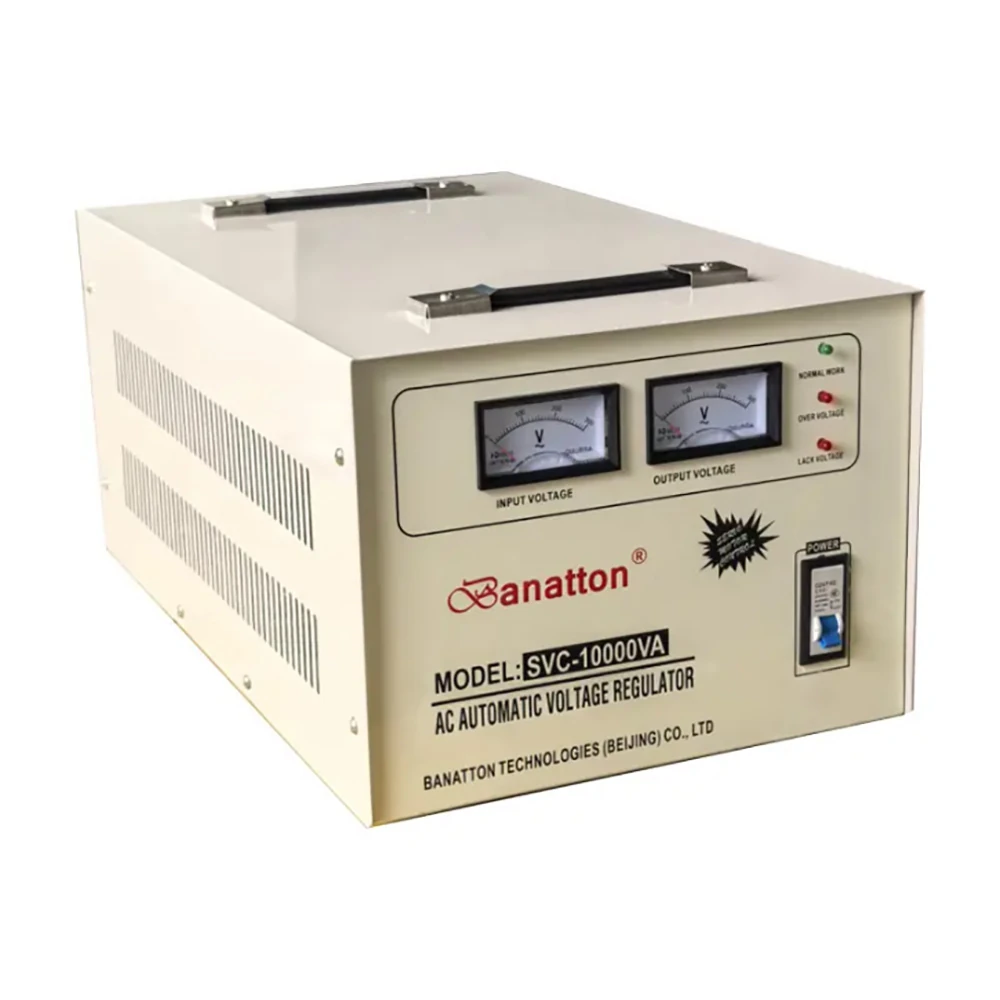
Voltage problems like brownouts, overvoltage, and constant fluctuations can damage expensive equipment. A single-phase servo-motor-type voltage stabilizer is one of the best solutions—provided that you select the right specifications and features.
In this guide, you will learn how a servo stabilizer works, how to correctly size a 10KVA, 15KVA, 20KVA, or 30KVA model for your equipment, and what features to prioritize.
Why Picking the Right Stabilizer Size Matters
Whether set too small or too large, a misjudgment of capacity will trigger numerous problems.
Risks of Undersized Stabilizers
Selecting an undersized voltage regulator often results in frequent shutdowns due to overload or overheating. Furthermore, being unable to withstand high starting currents, it may fail to start motors or compressors. Over time, this will lead to the premature failure of the equipment.
Problems with Oversized Stabilizers
An oversized unit costs more upfront and takes up unnecessary space. While it won’t damage your equipment, it is simply an inefficient use of money.
What Is a Single Phase Servo Voltage Stabilizer
A servo voltage stabilizer is an electromechanical device that automatically corrects unstable input voltage to a steady output voltage. It is more accurate and reliable than low-cost relay stabilizers.
How Servo Motor Control Works
This voltage regulator continuously monitors the input voltage. When the voltage drifts, a servo motor drives a carbon brush across a toroidal autotransformer—a smooth, ring-shaped structure. This process continuously adjusts the output voltage back to the correct level, rather than employing a stepped, discrete-level adjustment method.
According to the product specifications, this design does not utilize discrete taps; consequently, the voltage regulation process is both smooth and precise.
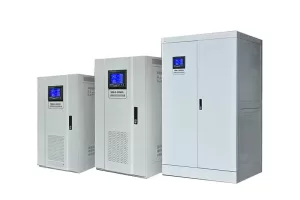
10KVA vs 15KVA vs 20KVA vs 30KVA – Which One Do You Need
All four models are single phase, 220V output, and use servo motor control. The only difference is how much load they can handle.
10KVA – Small Workshops, Medical Devices, Home Offices
Good for a few CNC machines, one X-ray or ray device, a room full of computers and printers, or test instruments.
15KVA – Small Industrial Equipment, Copiers, Hi-Fi Systems
Matches well with small automation equipment, copy machines, drying equipment, professional audio systems, or telecom base stations.
20KVA – Medium Manufacturing, Commercial Buildings
Handles several CNC machines at once, commercial HVAC controls, or moderate-power medical imaging equipment.
30KVA – Heavy Industrial, Large Workshops
Designed for heavy industrial automation, multiple numerical control machine tools, large drying equipment, or full workshops with mixed loads (motors + electronics).
How to Calculate the Right Capacity for Your Equipment
You don’t need to be an engineer. Just follow three simple steps.
Step 1: Add Up Your Load Power
Please check the nameplate of each device. If a value of VA (volt-ampere) is marked above, please use that value directly. If only the wattage is displayed, divide it by 0.8 to account for the power factor—a standard and safe estimate for most devices.
Example: A 2000W motor → 2000 ÷ 0.8 = 2500VA.
Step 2: Account for Starting Current
When starting up, motors, compressors, water pumps, and many other types of industrial equipment often draw a current that is 3 to 7 times their normal operating current. However, since most servo voltage regulators are capable of handling short-duration overloads, you do not need to size the equipment based on the full peak surge current. A practical rule of thumb is to multiply the equipment’s normal operating apparent power (VA) by a factor of 2 or 3. For instance, a motor with a normal operating power of 2500 VA typically requires a voltage regulator with a rated capacity ranging from 5000 to 7500 VA.
Step 3: Add a Safety Margin
Add 20–30% for future equipment.
- Total load 12KVA → choose 15KVA.
- Total load 22KVA → choose 30KVA.
Key Features to Look For
Not all voltage regulators are created equal. According to technical specifications, a high-quality single-phase voltage regulator should possess the following characteristics.
Wide Input Voltage Range
- Operating range: 120–275V
- Regulation range: 140–260V (custom available)
If your area has very low or high voltage, this stabilizer keeps working.
Tight Output Voltage Accuracy
- Output: 220V ±1.5% / 3%
- Protection triggers when output exceeds 255V or drops below 180V
- Safety cycle: 3 seconds or 180 seconds (optional)
Clear Display (LCD or Meter)
You can see:
- Input voltage
- Output voltage
- Load current
- Temperature
- Delay time
- Fault indication
This makes troubleshooting much easier.
Complete Protection – All Auto Shutdown
The stabilizer automatically shuts down to protect your equipment in these situations:
- Over temperature (at 120°C)
- Short circuit
- Overload
- Over / under voltage
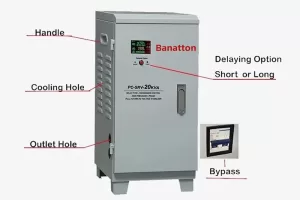
Useful Extra: Mains Bypass Mode
An optional feature allows you to switch between voltage regulation mode and utility bypass mode. When the utility voltage is stable, you can completely bypass the voltage regulation stage, enabling zero-power operation—a mode described in the product datasheet as “economical and convenient.”
High Efficiency Saves Money
An efficiency exceeding 95% means that virtually all electrical power is delivered to your equipment, rather than being wasted in the form of heat. For factories or commercial buildings operating around the clock, this undoubtedly translates into tangible and significant results.
Where Are These Stabilizers Used
- Computers and home/office equipment
- Test equipment and laboratory instruments
- Lighting systems and safe alarms
- Ray equipment and general medical equipment
- Copy machines
- Numerical control machine tools
- Industrial automation equipment
- Color and drying equipment
- Hi-Fi equipment
If your single-phase 220V power supply is connected to precision electronic equipment or motors, a servo voltage stabilizer would be an ideal choice.
What Voltage Problems Do Servo Stabilizers Solve
| Problem | What Happens Without a Stabilizer | How Servo Stabilizer Fixes It |
| Low voltage (brownout) | Motors overheat, electronics crash | Boosts 140V back to 220V |
| Overvoltage | Components burn out | Shuts down output at 255V |
| Constant fluctuations | Device misbehavior, data loss | Real-time servo correction to ±1.5% |
| Short circuit / overload | Fire risk, damaged wiring | Auto shutdown immediately |
Quick Buying Checklist
Before buying a 10–30KVA single phase voltage stabilizer, check these five things:
Input voltage range –Does it cover the worst-case voltage conditions at your site?
Load calculation – Have the starting current and a 20–30% margin been taken into account?
Protection features – Includes over temp, short circuit, overload, and over/under voltage shutdown?
Bypass mode – Mains bypass option included? (Saves power when grid is stable)
Certifications – ISO, CE, and RoHS Certified? (Required for commercial/medical facility installations)
Why Choose a Servo Motor Type Instead of a Relay Stabilizer
- Accuracy: Relay stabilizers do nothing until voltage drifts by ±7–10%. Servo corrects at ±1.5%.
- Power quality: No switching noise. No harmonic distortion.
- Durability: Toroidal transformer and servo motor built to last. Key parts (transformer, PCB) made in-house for better quality control.
- Overload tolerance: Electromechanical design handles short overloads better than static electronic types.
Frequently Asked Questions
Q1: How do I know whether I need 10KVA, 15KVA, 20KVA, or 30KVA?
Calculate your total load in VA, multiply motor loads by 2–3 for starting current, then add 20–30% margin. Pick the next size up.
Example: 12KVA → 15KVA; 22KVA → 30KVA.
Q2: Can a servo voltage stabilizer protect sensitive electronic equipment?
Yes. Accuracy is 220V ±1.5%, and protection includes over/under voltage, short circuit, overload, and over temperature. It is explicitly recommended for medical equipment, CNC machines, computers, and Hi-Fi systems.
Q3: What input voltage range works for industrial applications?
Standard is 140–260V (operates down to 120V, up to 275V). The manufacturer also offers custom input ranges if your site is more extreme.
Q4: What is the difference between a servo stabilizer and a static stabilizer?
A servo stabilizer uses a motor-driven transformer. It has no waveform distortion, handles overloads better, and is more durable. A static stabilizer uses electronics (IGBTs), reacts faster, but adds harmonic distortion and is less robust under overload.
Conclusion
Choosing the right 10KVA, 15KVA, 20KVA or 30KVA single phase servo voltage stabilizer comes down to accurately calculating your load, accounting for starting current, and leaving a reasonable margin for future expansion. Compared to relay-type products, servo voltage stabilizers deliver higher accuracy, more stable output, and more comprehensive protection.
Whether you need stable power for CNC machines, medical equipment, industrial automation systems, or commercial office devices, selecting a stabilizer that matches your actual load and includes full protection features will give you the best equipment protection and long-term return on investment. We offer a wide range of single phase servo voltage stabilizers. Contact us for more information and a quote.