 26Sep
26Sep

Why Industrial Voltage Stabilizers Are Essential for Modern Facilities
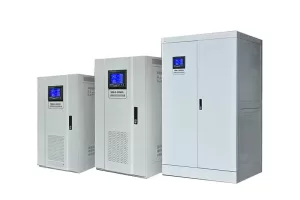
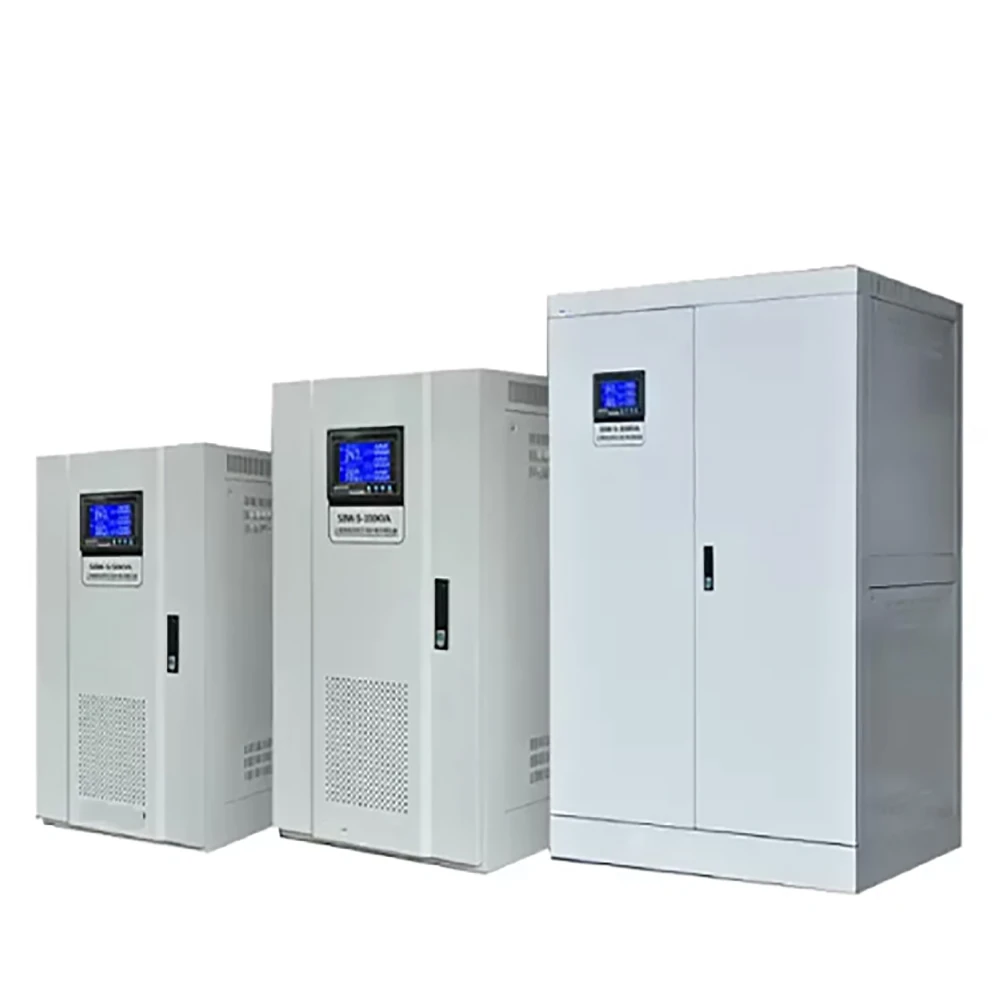
Precision instruments found in industrial facilities—such as CNC machine tools, laser cutters, and medical equipment—place extremely high demands on power supply stability. However, the utility grid is not always reliable. Power quality issues—including voltage sags, surges, and three-phase imbalances—can lead to equipment malfunctions, data loss, and even production interruptions; in severe cases, they may result in permanent damage. The Banatton SBW Series Three-Phase Automatic Voltage Regulator (AVR) ensures that the output voltage remains consistently within a safe range, regardless of fluctuations in the input voltage. This not only effectively safeguards your equipment assets but also ensures that your production operations run smoothly and without interruption.
Common Voltage Problems in Industrial Power Systems
Voltage Sags and Brownouts
Starting large motors or grid overload can cause a significant drop in voltage. This may lead to motor overheating and even trigger the controller to automatically restart without warning.
Overvoltage Conditions
A broken neutral line or the sudden disconnection of a heavy load can both trigger a voltage surge. Such overvoltage events not only damage power equipment and burn out motor windings but also shorten the service life of electronic circuit boards.
Phase Imbalance and Phase Failure
An unbalanced three-phase load or a phase loss condition can result in excessive motor current, subsequently leading to overheating and, ultimately, equipment failure. Banatton SBW series products are equipped with phase-loss and phase-sequence protection functions; should a phase loss or wiring error be detected, the system will automatically cut off the power supply.
Power Surges and Transient Spikes
When lightning strikes or switching operations occur, your power lines can carry sudden, destructive voltage spikes. The SBW stabilizer includes an optional input surge arrester — a small feature that can prevent major damage.
How a Three Phase AVR Voltage Stabilizer Works
Servo Motor Voltage Regulation Principle
The SBW 3 Phase Stabilizer uses a contact adjustable automatic voltage compensation design. Inside the stabilizer, a servo motor moves a carbon brush across the surface of a transformer. This smoothly adjusts the voltage up or down to compensate for input variations — without the clicking of relays or step switches.
Automatic Voltage Compensation Process
The regulator continuously monitors its output voltage. When load changes or grid faults cause the input voltage to rise or fall, the control circuit will detect this deviation. Subsequently, it instructs a servo motor to move the carbon brush. The carbon brushes adjust the voltage as needed to ensure a stable output voltage.
Input and Output Voltage Stabilization
The Banatton SBW series works with a wide range of input voltages, from 304V to 456VAC (three phase, five wires). The output can be set to 380V, 400V, or 415VAC, with an adjustable accuracy of ±1–5%. The unit also supports both 50Hz and 60Hz power systems.
Choosing the Right Capacity: 100KVA, 120KVA, 200KVA or 300KVA
The SBW series is available from 30KVA up to 2000KVA. For most medium-to-large industrial loads, 100KVA to 300KVA models are common.
When to Choose a 100KVA Voltage Stabilizer
A 100KVA stabilizer is suitable for small workshops, test labs, or groups of equipment with a total operating load under 80KW. Examples include multiple CNC lathes, printing presses, or medical imaging systems.
Applications for 120KVA AVR Systems
A 120KVA model gives you extra power for systems that occasionally spike in demand. Examples include industrial ovens, drying equipment, or several copy machines running at once.
When a 200KVA Stabilizer Is Required
A 200KVA unit is typically used for medium manufacturing lines, industrial automation equipment, or facilities where motor starting currents cause brief high demand. It also supports equipment with low power factor (the SBW series has a power factor rating of 0.8).
Benefits of a 300KVA Industrial Voltage Regulator
A 300KVA stabilizer can power an entire section of a factory or a large laser cutting system. It has enough capacity for several high-power machines running at the same time. And it delivers the same output precision of ±1–5% and efficiency of ≥98% as the smaller models.
Key Features to Look for in an Industrial AVR Stabilizer
Wide Input Voltage Range
The SBW series can handle a wide range of input voltages, from as low as 304V to as high as 456VAC. Even at these extremes, the stabilizer continues to deliver steady output.
Fast Response Time
The SBW voltage regulator can respond to voltage fluctuations within 1.5 seconds or less. This response speed is sufficient to prevent most industrial equipment from shutting down due to voltage dips.
High Efficiency Operation
The SBW series can achieve an efficiency of 98% or higher. Because so little energy turns into heat, you spend less on cooling and get more useful power from your facility.
Manual and Automatic Regulation Modes
The SBW supports both automatic stepless voltage adjustment and manual regulation. Operators can switch between modes as needed.
Automatic Power Recovery Function
If municipal power fails and then returns, the stabilizer automatically delays then restores regulated power. This prevents equipment from being hit by the full brunt of high or low voltage surges during grid restoration, and allows unattended operation.
Essential Protection Functions for Industrial Equipment
The Banatton SBW series includes a comprehensive set of protections:
- Overvoltage Protection: When output voltage exceeds a preset value (adjustable by the user), the regulator automatically cuts off output power.
- Undervoltage Protection: Similarly, if output voltage drops below the safe threshold, the unit disconnects the load to prevent equipment damage.
- Overcurrent Protection: When load current exceeds the rated value, the stabilizer trips and cuts power.
- Overload Protection: If the connected equipment draws more than the stabilizer’s capacity for an extended period, the unit disconnects power within a specified time.
- Short Circuit Protection: In case of a short circuit on the load side, the regulator immediately cuts off output to prevent fire or component damage.
- Phase Failure and Phase Sequence Protection: If any input phase is missing or the phase sequence is incorrect, the stabilizer automatically shuts down, protecting three-phase motors from reverse rotation or single-phasing damage.
- Lightning and Surge Protection: An optional surge arrester can be installed at the input end of the voltage regulator to suppress lightning-induced surges and switching transients.
Industrial Applications for 100KVA–300KVA Voltage Stabilizers
Manufacturing Plants
Entire production lines benefit from stable voltage, reducing reject rates and unplanned stops.
CNC Machines
Precision machining requires consistent power to maintain tolerance. Voltage variation causes servo drive errors and tool breakage.
Laser Cutting Equipment
Laser power supplies are sensitive to voltage changes. A stabilizer ensures consistent beam quality.
Industrial Motors and Pumps
Motors draw more current under low voltage, leading to overheating. The SBW prevents this by maintaining proper voltage.
Printing Equipment
Registration and color consistency depend on stable motor speeds, which in turn require stable voltage.
Data Centers and Communication Systems
Servers and network switches use switching power supplies that are stressed by undervoltage and overvoltage. The SBW series protects them.
Medical Equipment
X-ray machines, MRI systems, and other medical diagnostic devices require clean, stable power to operate safely and accurately.
Installation and Maintenance Tips for Industrial Voltage Stabilizers
Proper Site Selection
Install the stabilizer in a clean, dry area away from flammable materials. The ambient temperature range is -10°C to +40°C.
Ventilation Requirements
Although efficiency is ≥98%, some heat is generated. Ensure adequate clearance around the unit for natural convection.
Routine Inspection
Check the carbon brush and servo mechanism periodically. The SBW uses stepless adjustment, so brush wear is gradual but should be monitored.
Preventive Maintenance Schedule
Every six months: tighten electrical connections, clean dust from the enclosure and LCD display, and verify protection settings (overvoltage/undervoltage trip points).
Frequently Asked Questions
What Is the Difference Between an AVR and a Voltage Stabilizer?
For practical purposes, they are the same. An automatic voltage regulator (AVR) is a type of voltage stabilizer. The SBW is specifically a servo-motor controlled, contact adjustable automatic voltage compensation stabilizer.
How Do I Calculate the Correct Voltage Stabilizer Size?
Add the nameplate amperage of all equipment that will run simultaneously, multiply by operating voltage (380/400/415), then divide by 1000 to get KVA. Add a 20–30% safety margin for future expansion or motor starting.
Can a 300KVA Stabilizer Support an Entire Factory?
It depends on the factory’s total running load. A 300KVA unit can supply approximately 240KW of continuous power at 0.8 power factor. For a small to medium facility, yes. For larger plants, the SBW series extends to 2000KVA.
What Input Voltage Range Can Industrial AVR Stabilizers Handle?
The SBW series accepts 304–456VAC input. If your facility experiences voltage outside this range, you may need a different regulator design or upstream transformer.
How Fast Does a Servo Voltage Stabilizer Respond to Voltage Fluctuations?
The SBW three phase voltage regulator responds in ≤1.5 seconds. This is sufficient for most industrial voltage sags and swells, though it is not intended for sub-cycle transient suppression (that requires a UPS).
What Protection Functions Should an Industrial Voltage Stabilizer Include?
At minimum: overvoltage, undervoltage, overcurrent, short circuit, overload, overheat, phase failure, and phase sequence protection. The SBW includes all of these plus an optional lightning arrester and an automatic bypass function for maintenance.
What Happens If the Stabilizer Fails During Production?
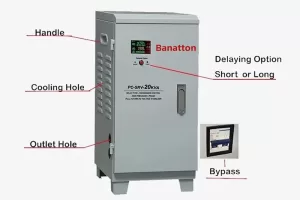
The SBW includes a bypass function. In case of failure or during maintenance, the regulator can be manually switched to direct mains power, keeping your equipment running while the stabilizer is serviced.
Conclusion
The Banatton SBW three-phase automatic voltage stabilizer (100KVA–300KVA) delivers reliable power regulation for industrial environments. With a wide input range of 304–456VAC, output options of 380/400/415VAC, ≥98% efficiency, and ≤1.5s response time, it effectively solves voltage sags, overvoltage, phase failure, and surges. Comprehensive protections including overcurrent, short circuit, and optional lightning arresters safeguard sensitive equipment. The stepless adjustment, bypass function, and automatic power recovery ensure uninterrupted operation. When selecting a stabilizer, match the KVA rating to your actual load with a 20–30% safety margin. For facilities facing unstable grid power, the SBW series is a practical, industrial-grade solution.