 26Sep
26Sep
Voltage fluctuation is one of the most common yet underestimated threats to industrial equipment. In manufacturing facilities, CNC machines, motors, compressors, and automated production lines rely on stable power. Even a brief voltage dip or surge can cause production downtime, equipment damage, or safety hazards.
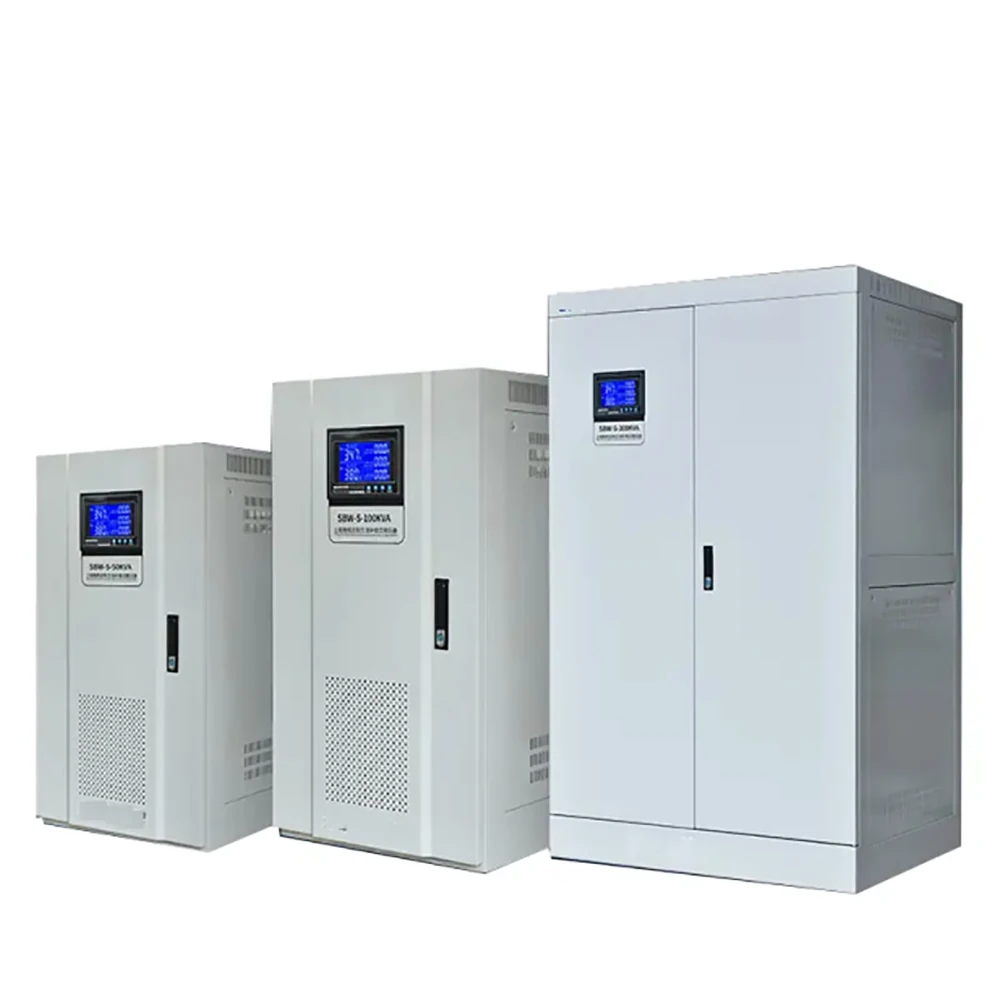
Using our SBW series industrial voltage regulators as an example, this article will explain how three-phase automatic voltage regulators provide reliable protection against voltage instability.
1. What Causes Voltage Fluctuation in Industrial Facilities
Understanding the root causes of voltage fluctuation is the first step toward effective protection. In industrial environments, voltage instability typically comes from:
Large motor startup and shutdown – High inrush current draws voltage down momentarily.
Unbalanced loads across three phases – Common in facilities with mixed equipment types.
Grid supply variations – Especially in regions with weak or overloaded power infrastructure.
Lightning strikes or switching operations – Induce voltage spikes.
Internal short circuits or ground faults – Create sudden voltage drops.
In many manufacturing plants, voltage fluctuation becomes more severe during peak production hours when multiple high-power machines start simultaneously. Facilities using compressors, welding systems, or large motors often experience temporary voltage drops that are difficult to detect without continuous monitoring. These events are often unavoidable, but their impact can be eliminated with the right automatic voltage stabilizer.
2. How Voltage Fluctuation Damages Industrial Equipment
Voltage fluctuations do not just cause immediate failures. They gradually degrade sensitive components, leading to unexpected breakdowns and high maintenance costs.
2.1 CNC Machines
CNC machines require precision. Voltage variations cause positioning errors, tool breakage, and controller malfunctions. A three phase voltage regulator ensures consistent power to servos and spindles.
2.2 Industrial Motors
Motors draw higher current under low voltage, leading to overheating and insulation breakdown. Prolonged exposure reduces motor lifespan significantly.
In real industrial environments, motors operating under repeated undervoltage conditions tend to draw excessive current during startup. Over time, this can accelerate insulation aging, increase winding temperature, and lead to unexpected maintenance shutdowns.
2.3 Compressors and Pumps
Voltage imbalance increases vibration and torque ripple in compressors and pumps. This leads to bearing wear and seal failures.
Factories with frequent compressor cycling often experience short-duration voltage dips, especially in facilities with unstable grid supply or insufficient transformer capacity. Stable voltage regulation helps reduce mechanical stress during motor startup.
2.4 Automated Production Lines
PLCs, sensors, and drives are voltage-sensitive. Even a 10% voltage dip can trigger false signals or emergency stops, halting production.
In automated manufacturing systems, even small voltage instability can interrupt communication between PLC controllers, sensors, and variable frequency drives, causing unnecessary production interruptions and reset procedures.
2.5 Laser Cutting Machines
Laser power supplies require stable DC bus voltage. Fluctuations cause inconsistent cutting quality and damage to expensive laser tubes.
3. What Is a 3 Phase Automatic Voltage Regulator
A 3 phase automatic voltage regulator (AVR) is an electrical device that automatically maintains a constant voltage level to connected equipment, regardless of input voltage variations.
Unlike simple surge protectors or UPS systems, an industrial automatic voltage stabilizer continuously corrects voltage in real time, without battery backup or waveform interruption.
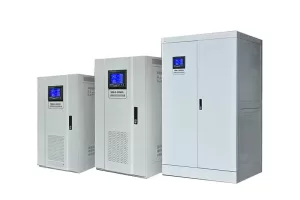
Our SBW series is a contact-adjustable, automatic voltage compensation power device. It is designed for high-power industrial applications from 30KVA up to 2000KVA.
4. How 3 Phase AVR Stabilizers Work
4.1 Step 1 — Voltage Detection
A nine-sampling monochrome LCD display monitors input and output voltage in real time. The control circuit detects any deviation from the set output value (380V, 400V, or 415VAC).
4.2 Step 2 — Automatic Compensation
When the input voltage fluctuates (304–456VAC), the internal servo motor drives a carbon brush to adjust the auto-transformer tap ratio. This increases or decreases the compensation voltage as needed.
The regulation is stepless — no relay clicks or sudden switching — ensuring smooth voltage correction.
4.3 Step 3 — Stable Output Voltage
The output voltage stabilizes within ±1–5% (adjustable) of the target value. The entire process takes ≤1.5 seconds, fast enough to protect most industrial loads.
A built-in gyrus function automatically centers the voltage regulation range, optimizing performance over time.
5. Key Features of SBW Industrial Voltage Stabilizers
5.1 Wide Input Voltage Range
Input range: 304–456VAC
Output options: 380 / 400 / 415VAC
This wide input window allows the stabilizer to work even when the grid is severely degraded, reducing unnecessary shutdowns.
5.2 High Efficiency (≥98%)
With efficiency ≥98%, the SBW stabilizer wastes very little energy as heat.
For factories operating continuously, high efficiency is important because even small energy losses can increase long-term operating costs and heat generation inside electrical rooms.
5.3 Intelligent LCD Display
The nine-sampling monochrome LCD provides real-time voltage and system status monitoring.
5.4 Automatic & Manual Regulation Modes
Automatic mode for continuous operation
Manual mode for maintenance or commissioning
5.5 Complete Protection Functions
| Protection Type | Function Description |
| Overvoltage | Cuts output automatically when voltage exceeds preset limit |
| Undervoltage | Disconnects load when voltage drops to dangerous low level |
| Overcurrent | Shuts down protection when current exceeds rated value |
| Short Circuit | Instant trip to disconnect power upon short circuit fault |
| Overload | Time-delayed trip after overload exceeds specified duration |
| Overheat | Thermal protection via built-in temperature sensor |
| Phase Failure | Detects missing input phase and triggers immediate protection |
| Phase Sequence Error | Prevents wrong motor rotation by detecting incorrect phase order |
5.6 Optional Lightning Protection
A surge arrester can be installed at the input end.
This is particularly important for factories located in industrial parks or rural areas where overhead power lines are more exposed to lightning activity and switching surges.
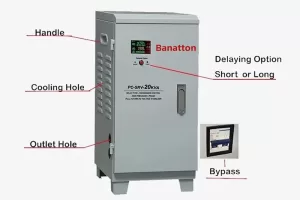
5.7 Automatic Power-On with Delay
After power restoration, the system delays restart to prevent voltage shock.
5.8 Bypass Function
Allows direct mains supply during maintenance.
6. Applications of Three Phase Automatic Voltage Regulators
Computers and office equipment
Test and measurement instruments
Lighting systems
Security alarm systems
X-ray and medical equipment
Copy machines
Numerical control machine tools
Industrial automation equipment
Color and drying equipment
Hi-Fi and AV systems
Main demand comes from CNC machining, injection molding, printing, and packaging industries.
7. How to Choose the Right Industrial Voltage Stabilizer
7.1 Based on Equipment Load
30 / 50 / 60 / 80 / 100 / 120 / 150 / 180 / 200 / 225 / 250 / 300 / 400 / 500 / 600 / 1000 / 2000 KVA
Add 20–30% safety margin.
7.2 Based on Startup Current
Motors may require 3–7x rated current during startup.
7.3 Based on Input Voltage Range
SBW supports 304–456VAC.
7.4 Based on Industry Application
Metalworking / Plastics / Textiles / Pharma / Manufacturing industries require stable three-phase voltage to ensure equipment accuracy, production continuity, and reduced downtime under varying load conditions.
8. Why Choose SBW 3 Phase Automatic Voltage Regulators
SBW industrial voltage stabilizers provide:
Wide input voltage tolerance
Fast stepless correction (≤1.5s)
High efficiency (≥98%)
Complete protection system
Bypass operation support
CE Certified – Certificate Number: M.2021.206.C68491, compliant with international industrial electrical safety requirements for global industrial applications.
Optional lightning protection
9. Frequently Asked Questions
Q1:What is a 3 phase automatic voltage regulator used for?
A:It stabilizes voltage and protects industrial equipment from fluctuations.
Q2:Can voltage fluctuation damage industrial equipment?
A:Yes, it can cause long-term degradation and sudden failure.
Q3:What size stabilizer do I need?
A:Load + 20–30% margin.
Q4:What is the difference between AVR and stabilizer?
A:In industry, they refer to the same function.
Q5:Which industries use it?
A:Manufacturing, CNC, plastics, textiles, pharma, etc.
Q6:How fast does it respond?
A:≤1.5 seconds.
Q7:What happens if it fails?
A:Bypass mode allows direct mains operation.
10. Conclusion
Voltage fluctuation is not an abstract power quality issue — it is a daily threat to industrial productivity and equipment lifespan. Common signs that a factory may need a voltage stabilizer include unexplained CNC machine restarts, motor overheating, inverter alarms, unstable PLC systems, lighting flicker, and unexpected equipment shutdowns during peak production periods. For factories running CNC machines, motors, compressors, or automated lines, investing in an industrial voltage stabilizer is one of the most cost-effective reliability upgrades available. If you need help selecting the right SBW AC Voltage Stabilizer for your application, please contact us for support.